2026.04.17 (금) 01:13




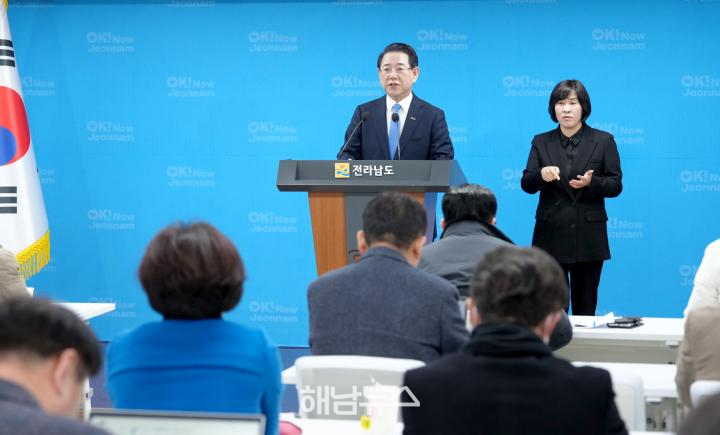 김영록 전남도지사 전남·광주 3+1축 산업 대부흥 비전 발표 / 사진제공=전라남도 |
전남·광주 행정통합이 단순한 제도 통합을 넘어 ‘산업 대전환’의 구체적 설계도로 제시됐다.
김영록 전라남도지사는 12일 ‘400만 전남광주통합특별시를 위한 Y4-노믹스 선언’과 함께 ‘전남·광주 3+1축 산업 대부흥 비전’을 공식 발표하며, 통합의 본질을 ‘경제’에 두겠다고 천명했다.
김 지사는 “지금은 행정구역을 합치는 차원이 아니라 대한민국 미래 산업지도를 다시 그리는 역사적 전환점”이라며 “이번 통합의 핵심은 경제”라고 강조했다.
그는 산업을 통해 기업 투자를 이끌고, 일자리를 확대하며, 청년이 돌아오고, 인구가 증가하는 구조를 만들겠다고 밝혔다.
이를 위해 80만 인구 유입과 450조 원 투자 유치를 목표로 도지사가 단장이 되는 ‘400만 특별시 기업유치 특별 전담반’을 즉시 가동하겠다고 덧붙였다.
김 지사가 제시한 ‘Y4-노믹스’는 수도권 일극 체제를 넘어 전남·광주를 4개 권역으로 재편하는 국가 경제 전략이다.
기존 광주권·서부권·동부권 3축에 남부권을 추가한 ‘3+1축’ 구조로 산업벨트를 구축하고, 총 4천만 평 규모의 특화산업단지와 첨단산업 신도시를 조성해 400만 경제권을 완성하겠다는 구상이다.
성장의 중심축에는 ‘Youth’, 즉 청년이 자리한다.
광주권에는 산업용지 500만 평과 배후도시 500만 평을 포함한 총 1천만 평 부지에 AI·반도체·미래모빌리티·바이오 중심의 글로벌 메가클러스터가 조성된다.
국가 NPU 전용 컴퓨팅센터와 AX 실증밸리, AI 모빌리티 신도시가 들어서고, 민간·군공항 이전 부지에는 첨단 융복합산업 콤플렉스가 설계된다.
광주·장성 첨단산단에는 첨단 패키징 클러스터를 구축해 반도체 설계부터 후공정까지 아우르는 공급망을 완성하고, 220만 평 규모의 미래차 산업벨트를 통해 차량용 반도체 생산 역량도 강화할 계획이다.
서부권은 에너지와 AI데이터 산업의 핵심 거점으로 조성된다.
산업용지 400만 평과 배후도시 700만 평 등 총 1천100만 평 부지에 해상풍력과 태양광을 기반으로 한 RE100 산업기지를 구축하고, 솔라시도에는 국가AI컴퓨팅센터와 글로벌 AI데이터센터를 유치한다는 방침이다.
화합물 반도체 생태계를 구축하고 무안국제공항을 반도체 항공물류 관문으로 육성해 동북아 에너지·해양 허브로 도약하겠다는 구상도 포함됐다.
동부권은 이차전지·반도체·로봇·우주항공 중심의 스마트 혁신제조 수도로 육성된다.
미래첨단산업 복합 콤플렉스를 확대 조성하고 로봇용 반도체 팹을 유치하며, 이차전지 핵심원료 산업을 전략적으로 육성할 계획이다.
석유화학 산업은 고부가가치 구조로 전환하고, 철강은 수소환원제철 도입을 통해 저탄소 산업으로 재편한다는 방침이다.
또한 고흥 제2우주센터 유치와 발사체 사이언스 콤플렉스 조성을 통해 우주·방산 산업의 전진기지로 키우겠다는 목표도 제시됐다.
남부권은 K-푸드와 그린바이오 산업의 전략 거점으로 구축된다.
산업용지 300만 평과 배후도시 500만 평 등 총 800만 평 부지에 농수산–가공–유통이 연결되는 산업벨트를 조성하고, 재생에너지를 기반으로 한 RE100 식품산업 모델을 정착시킬 계획이다.
국내 100대 식품기업을 유치하고 천연물 전주기 표준화 허브를 구축해 글로벌 수출 기반을 확립하겠다는 전략이다.
김영록 지사는 “이번 3+1축 산업 대부흥 비전은 전남·광주의 확정된 미래 청사진”이라며 “오는 7월 출범하는 전남광주통합특별시가 국가균형발전과 지방 주도 성장의 대표 모델이 되도록 모든 역량을 집중하겠다.”고 강조했다.
행정통합 논의는 이제 구조의 문제가 아니라 성장의 문제로 옮겨가고 있다. 400만 통합특별시 구상은 선언을 넘어 실행의 시간에 접어들고 있다.
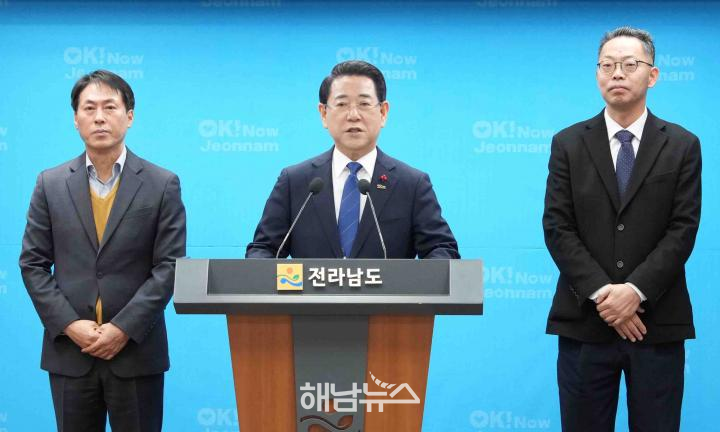 김영록 전남도지사 전남·광주 3+1축 산업 대부흥 비전 발표 / 사진제공=전라남도 |
[Jeonnam = Haenam News] haenamnews@kakao.com
“A 4-Million Unified Special City—Competing Through Economic Power”
Governor Kim Yeong-rok Declares ‘Y4-Nomics’ Vision, Unveils Blueprint for Industrial Transformation of Jeonnam and Gwangju
The administrative integration of Jeonnam and Gwangju has moved beyond a simple institutional merger and has now been presented as a concrete blueprint for industrial transformation.
On the 12th, Jeollanam-do Governor Kim Yeong-rok officially announced the “Y4-Nomics Declaration for a 4-Million Jeonnam–Gwangju Unified Special City” alongside the “3+1 Axis Industrial Renaissance Vision,” emphasizing that the essence of integration lies in economic growth.
Governor Kim stated, “This is not merely about combining administrative districts. We stand at a historic turning point to redraw the future industrial map of Korea,” stressing that “the core of this integration is the economy.” He explained that the strategy aims to stimulate corporate investment, expand jobs, bring young people back to the region, and ultimately increase population.
To achieve this, the province will target an influx of 800,000 people and attract KRW 450 trillion in investment. Kim added that he will personally lead a dedicated “4-Million Special City Corporate Investment Task Force” to aggressively pursue major anchor companies.
The Y4-Nomics strategy seeks to overcome the capital-region-centric structure by reorganizing Jeonnam and Gwangju into four major economic zones. By adding a Southern Zone to the existing Gwangju, Western, and Eastern axes—forming a “3+1 axis” framework—the plan envisions building industrial belts across a total of 40 million pyeong (approximately 132 square kilometers) of specialized industrial complexes and advanced industrial cities. At the heart of this growth strategy is “Youth.”
The Gwangju Zone will develop a global mega-cluster centered on AI, semiconductors, future mobility, and biotechnology across 10 million pyeong of industrial and supporting urban land. Plans include a national NPU-exclusive computing center, an AX demonstration valley, and an AI mobility new town. The former civil and military airport relocation site will be transformed into a cutting-edge convergence industrial complex surpassing Pangyo Techno Valley. An advanced semiconductor packaging cluster will be built in the Gwangju–Jangseong industrial complex to establish a full supply chain from design to back-end processing, while a 2.2-million-pyeong future mobility belt will strengthen automotive semiconductor production capacity.
The Western Zone will serve as a core hub for renewable energy and AI data industries. Spanning 11 million pyeong, it will establish an RE100 industrial base powered by offshore wind and solar energy. Solaseado will host a National AI Computing Center and global AI data centers, alongside the development of a compound semiconductor ecosystem. Muan International Airport will be upgraded as a semiconductor air logistics gateway, positioning the region as a Northeast Asian energy and marine hub.
The Eastern Zone will be fostered as a smart innovation manufacturing capital focused on secondary batteries, semiconductors, robotics, and aerospace. The province plans to expand advanced industrial complexes, attract semiconductor fabs for robotics, and strategically develop key secondary battery materials industries. The petrochemical sector will transition to higher value-added production, while steelmaking will shift toward hydrogen-based reduction to achieve low-carbon transformation. The plan also includes attracting a second space center to Goheung and developing a space launch science complex to establish the region as a forward base for Korea’s space and defense industries.
The Southern Zone will become a strategic base for K-Food and green bio industries. Across 8 million pyeong, an integrated industrial belt linking agriculture, fisheries, processing, and distribution will be created. An RE100-based food industry model powered by renewable energy will be established, while leading domestic food companies will be attracted as anchor firms. A full-cycle standardization hub for natural materials will also be built to strengthen global export competitiveness.
Governor Kim stated, “The 3+1 Axis Industrial Renaissance Vision for a 4-Million Jeonnam–Gwangju Unified Special City is the confirmed blueprint for our future,” adding that “when the unified special city launches this July, we will devote all our capabilities to making it a leading model of balanced national development and region-led growth.”
The debate over administrative integration has now shifted from structural adjustment to economic growth. The vision of a 4-million unified special city has moved beyond declaration and entered the stage of execution.
 해남뉴스 박충배 편집 및 논설위원 haenamnews@kakao.com