2026.09.05 (토) 19:09




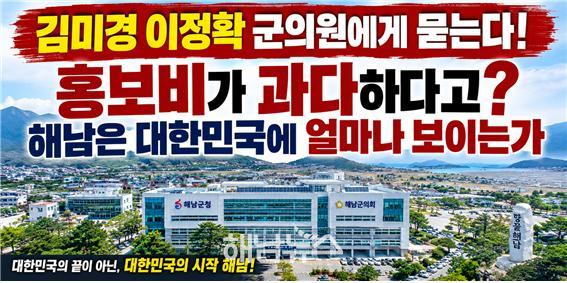 해남은 대한민국에 얼마나 보이는가 / 사진제공=ai호남뉴스 |
김미경·이정확 해남군의원에게 공개적으로 묻고 싶다.
해남군의 홍보비가 과다하다고 판단하기에 앞서 지역신문과 인터넷 언론, 포털과 각종 매체를 통해 실제 국민에게 노출되고 있는 해남의 공익광고가 얼마나 되는지 조사해 봤는가.
그리고 그 금액이 다른 지방자치단체와 비교해 정말 과다한 것인지 객관적인 자료를 가지고 있는가.
홍보예산은 단순히 숫자만 놓고 많고 적음을 판단할 일이 아니다.
어디에 사용했는지, 누구에게 노출됐는지, 얼마나 많은 사람에게 도달했는지, 관광객과 소비자를 얼마나 해남으로 움직이게 했는지를 함께 따져야 한다.
특정 언론사에 광고가 편중됐다면 당연히 지적해야 한다.
효과가 없는 광고라면 삭감해야 한다.
단체장 치적을 알리는 데 혈세가 과도하게 사용됐다면 군의회가 앞장서 바로잡아야 한다.
그러나 지역의 관광과 문화, 축제와 농수산물을 알리는 공익적 홍보까지 단순히 ‘홍보비’라는 하나의 항목으로 묶어 과다하다고 바라본다면 이야기는 달라진다.
해남군 예산이 1조2천억원 규모라고 한다면 단순 산술상 1%만 해도 120억원이다.
물론 해남군이 120억원을 홍보비로 써야 한다는 뜻은 결코 아니다.
■ 우리가 묻는 것은 다른 것이다.
1조2천억원 규모의 행정을 운영하면서 대한민국 시장에서 ‘해남’이라는 브랜드를 제대로 알리기 위해 과연 얼마나 투자하고 있는가.
해남은 알릴 것이 없는 지역이 아니다.
오히려 너무 많아서 무엇부터 알려야 할지 고민해야 할 지역이다.
세계유산 대흥사가 있다.
대한민국 육지 최남단이라는 상징성을 가진 땅끝이 있다.
두륜산의 사계가 있고 울돌목과 명량대첩의 역사가 있다.
공룡화석지와 공룡박물관이 있고 우수영 관광지가 있다.
오시아노 관광단지가 있고 솔라시도를 비롯한 미래 관광·산업 자원도 있다.
고구마와 배추, 쌀, 김을 비롯해 전국적인 경쟁력을 가진 농수산물도 넘쳐난다.
해남의 역사와 문화유산, 자연경관과 관광자원은 대한민국 어느 지역에 내놓아도 뒤지지 않는다고 자부할 만하다.
■ 그런데 여기서 뼈아픈 질문을 던져야 한다.
그렇게 좋은 것을 가지고 있는데 왜 해남 관광산업의 체감 성과는 기대만큼 크지 않은가.
좋은 관광지를 가지고 있다는 것과 관광객이 찾아오는 것은 전혀 다른 문제다.
관광객은 존재조차 모르는 관광지를 찾아갈 수 없다.
서울에 사는 사람이 대흥사의 아름다움을 모른다면 대흥사로 여행을 올 이유가 없다.
수도권의 젊은 세대가 땅끝과 두륜산, 울돌목을 모른다면 여행지 검색창에 ‘해남’을 입력할 이유도 없다.
외국인 관광객이 해남이라는 지명조차 접하지 못한다면 아무리 훌륭한 문화유산을 가지고 있어도 국제관광으로 연결되기 어렵다.
■ 그래서 우리는 두 의원에게 다시 묻는다.
서울역에서 해남을 몇 번이나 볼 수 있는가.
용산역과 수서역 KTX 대합실에서 해남 관광광고를 얼마나 만날 수 있는가.
서울고속버스터미널과 센트럴시티에서 땅끝 해남을 얼마나 홍보하고 있는가.
인천국제공항과 김포공항에서 대한민국을 찾은 외국인들에게 해남의 대흥사와 땅끝을 얼마나 보여주고 있는가.
제주공항을 오가는 수많은 관광객에게 “다음 여행지는 해남”이라는 메시지를 얼마나 던지고 있는가.
중앙방송과 전국 단위 미디어에서는 어떠한가.
유튜브와 SNS, OTT와 대형 포털에서 대한민국 국민이 해남을 얼마나 자주 만나고 있는가.
■ 그리고 더 가까운 곳을 보자.
해남지역 신문과 인터넷 언론에 해남군의 관광·문화·농수산물·축제·귀농귀촌·고향사랑기부제 등을 알리는 공익광고가 도대체 얼마나 노출되고 있는가.
이러한 실태조사와 다른 지방자치단체와의 객관적 비교 없이 홍보비 총액만 보고 ‘과다하다’고 판단한다면 우리는 그 판단의 근거를 묻지 않을 수 없다.
지금 지방자치단체는 관광객 한 사람을 더 데려오기 위해 전쟁을 벌이고 있다.
제주와 강릉, 경주와 전주, 여수와 순천, 통영과 부산이 모두 경쟁자다.
강진·완도·진도·신안 등 인접 지역 역시 관광과 축제, 농수산물 판매를 위해 적극적으로 자신들의 이름을 알리고 있다.
■ 해남도 그 경쟁 한복판에 서 있다.
해남군민만을 상대로 해남 고구마를 팔 수 없다.
해남군민끼리 대흥사를 방문한다고 관광산업이 살아나는 것도 아니다.
해남군민끼리 고향사랑기부금을 주고받을 수도 없다.
결국 해남의 돈은 해남 밖에서 벌어와야 한다.
서울에서 관광객을 데려와야 한다.
경기·인천에서 소비자를 데려와야 한다.
부산과 대구, 대전에서도 해남 농수산물을 주문하게 만들어야 한다.
제주를 찾는 관광객에게도 해남을 다음 여행지로 선택하게 해야 한다.
외국인에게도 대한민국의 남쪽 끝에 대흥사와 땅끝, 두륜산과 울돌목이 있다는 사실을 알려야 한다.
그 일을 하는 것이 바로 홍보다.
■ 따라서 제대로 된 지역 홍보는 단순한 행정비용이 아니다.
관광객을 불러오는 투자이고 농수산물을 판매하는 영업이며 지역경제를 살리는 마케팅이다.
지역소멸을 걱정하면서 지역을 알리는 돈부터 줄이자는 것은 신중해야 한다.
사람이 오지 않는다고 걱정하면서 사람을 불러오기 위한 광고까지 낭비로 바라봐서는 안 된다.
농수산물이 제값을 받지 못한다고 걱정하면서 전국 소비자에게 해남 농수산물을 알리는 비용을 무조건 아끼는 것도 앞뒤가 맞지 않는다.
그렇다고 홍보예산에 백지수표를 주자는 것은 아니다.
오히려 더 철저하게 따져야 한다.
누구에게 얼마를 줬느냐가 아니라 그 광고가 몇 명에게 도달했고, 관광객을 몇 명 더 불러왔으며, 지역에서 얼마를 소비하게 했고, 농수산물 매출을 얼마나 증가시켰는지를 공개해야 한다.
■ 효과 없는 홍보에는 1억원도 많다.
그러나 10억원을 투자해 100억원의 지역경제 효과를 만들어 낸다면 그것을 단순히 ‘홍보비가 많다’고 비판할 수 있겠는가.
그래서 해남군의회의 역할은 홍보비를 무조건 자르는 것이 아니다.
낭비성 홍보는 잘라내고 효과가 있는 홍보에는 오히려 더 투자하도록 만드는 것이 제대로 된 예산감시다.
■ 김미경·이정확 군의원에게 다시 묻는다.
해남군 홍보예산의 액수를 지적하기 전에 해남이 대한민국에서 얼마나 보이고 있는지 살펴봤는가.
지역신문과 인터넷에서 해남의 공익광고가 실제 얼마나 노출되고 있는지 조사했는가.
서울역·용산역·수서역과 수도권 고속버스터미널, 인천공항·김포공항·제주공항에서 경쟁 지방자치단체와 비교해 해남의 광고가 얼마나 보이는지 확인해 봤는가.
그리고 무엇보다 묻고 싶다.
전국 어디에 내놓아도 뒤지지 않을 문화유산과 관광자원을 가지고도 왜 해남 관광이 그 가치만큼 국민에게 각인되지 못하고 있는지 고민해 봤는가.
군의회가 정말 군민의 혈세를 걱정한다면 홍보예산 몇억원을 줄이는 데서 멈춰서는 안 된다.
■ 해남군에 더 어려운 숙제를 내야 한다.
“돈을 쓰지 마라”가 아니라 “제대로 써서 관광객을 데려오고 해남 농수산물을 더 팔아라.”
“광고하지 마라”가 아니라 “대한민국 국민이 해남을 모를 수 없을 정도로 제대로 알려라.”
그리고 성과가 없다면 그때 책임을 물으면 된다.
해남의 문화유산과 관광자원이 부족해서 관광객을 끌어오지 못하는 것이 아니라면 결국 남는 문제는 접근성과 콘텐츠, 그리고 얼마나 제대로 알렸느냐다.
■ 지역소멸 시대에는 지역 자체가 하나의 상품이고 브랜드다.
알리지 않는 상품은 팔리지 않는다.
보이지 않는 관광지는 선택받기 어렵다.
해남이 아무리 아름다워도 국민이 모르면 오지 않는다.
이 단순한 시장의 원리를 외면해서는 안 된다.
이제 논쟁의 방향을 바꾸자.
“해남군이 홍보비를 얼마나 썼는가”에서 “그 돈으로 대한민국에 해남을 얼마나 알렸는가”로 바꿔야 한다.
그리고 해남군과 군의회가 함께 답해야 한다.
■ 1조2천억원 시대의 해남.
대한민국 어디에 내놓아도 뒤지지 않는 문화유산과 관광자원을 가지고 있으면서 우리는 과연 ‘해남’을 제대로 팔고 있는가.
지금 해남에 필요한 것은 침묵하는 절약이 아니다.
낭비는 단호하게 자르고, 해남을 대한민국에 알리는 데는 더 치열하고 더 전략적으로 투자하는 행정이다.
그것이 관광객을 불러오고 농어민의 소득을 높이며 지역경제를 살리는 길이다.
[Editorial] A Question for Council Members Kim Mi-kyung and Lee Jeong-hwak — Is Haenam Really Spending Too Much on Promotion?
Before criticizing the budget, have we even examined how much public-interest advertising for Haenam actually appears in local newspapers and online media?
Judging promotional spending as “excessive” based solely on the total amount ignores the realities of regional marketing.
Daeheungsa Temple, Ttangkkeut, Duryunsan Mountain, Usuyeong, and the dinosaur fossil sites are tourism assets that can stand proudly alongside those of any region in Korea.
Yet why does Haenam’s tourism economy still struggle to generate the level of activity its resources deserve? We must also examine whether Haenam has simply failed to promote itself effectively.
How visible is “Haenam” at Seoul Station, Yongsan Station, Suseo Station, express bus terminals, Incheon International Airport, and Jeju International Airport?
If advertising in local media is reduced while nationwide promotion remains inadequate, who will tell the rest of Korea about Haenam?
Favoritism toward particular media outlets must be prevented, but public-interest campaigns promoting tourism, agriculture, fisheries, and local products should not be dismissed as wasteful spending.
The question the County Council should be asking is not simply, “How much was spent?” but rather, “Why is Haenam still not sufficiently visible nationwide?”
[Haenam=AI Honam News] aihnnews@kakao.com
We would like to publicly ask Haenam County Council members Kim Mi-kyung and Lee Jeong-hwak a question.
Before concluding that Haenam County is spending excessively on publicity and promotion, have you examined how much public-interest advertising about Haenam is actually reaching the public through local newspapers, online news outlets, internet portals, and other media?
And do you have objective data demonstrating that Haenam’s promotional spending is genuinely excessive compared with that of other local governments?
A promotional budget should not be judged simply by looking at the total amount.
We must examine where the money was spent, who saw the advertising, how many people it reached, and most importantly, whether it persuaded tourists and consumers to come to Haenam or purchase Haenam products.
If advertising funds are disproportionately concentrated in a particular media outlet, that should certainly be questioned.
Advertising that produces no measurable results should be cut.
If taxpayers’ money is being excessively used to promote the achievements of an incumbent county administration or its leadership, the County Council should take the lead in correcting it.
However, it is an entirely different matter to lump together public-interest campaigns promoting local tourism, culture, festivals, agricultural products, and seafood and simply label all of that spending “excessive.”
If Haenam County’s annual budget is approximately KRW 1.2 trillion, then just 1 percent of that amount would equal KRW 12 billion.
That does not mean Haenam should spend KRW 12 billion on publicity.
■ Our question is different.
For a local government managing a KRW 1.2 trillion budget, how much is Haenam actually investing in promoting the “Haenam” brand in the national marketplace?
Haenam does not suffer from a lack of things to promote.
If anything, it has so many assets that the challenge should be deciding what to promote first.
There is Daeheungsa Temple, a UNESCO World Heritage site.
There is Ttangkkeut, the symbolic southernmost point of the Korean mainland.
There are the four seasons of Duryunsan Mountain, as well as the history of Uldolmok Strait and the Battle of Myeongnyang.
There are dinosaur fossil sites, the Haenam Dinosaur Museum, and Usuyeong.
There is the Hwawon–Oceano Tourism Complex, along with SolaSeaDo and other tourism and development assets with enormous future potential.
Haenam also produces nationally competitive agricultural and marine products, including sweet potatoes, napa cabbage, rice, and seaweed.
Haenam’s history, cultural heritage, natural scenery, and tourism resources can proudly compete with those of virtually any region in Korea.
■ But that raises a painful question.
If Haenam possesses so many outstanding assets, why does the local tourism economy still fail to generate results commensurate with their value?
Having excellent tourism resources and actually attracting tourists are two very different things.
People cannot visit a destination they do not even know exists.
If someone living in Seoul has never seen the beauty of Daeheungsa Temple, why would that person plan a trip there?
If younger generations in the Seoul metropolitan area know little about Ttangkkeut, Duryunsan, or Uldolmok, why would they type “Haenam” into a travel search engine?
If international visitors have never even encountered the name “Haenam,” world-class cultural and natural assets alone will not automatically turn the county into an international tourism destination.
■ So we ask the two council members again.
How often can travelers see Haenam at Seoul Station?
How much Haenam tourism advertising can passengers encounter in the KTX waiting areas at Yongsan Station and Suseo Station?
How actively is Ttangkkeut Haenam promoted at Seoul Express Bus Terminal and Central City Terminal?
At Incheon International Airport and Gimpo International Airport, how effectively are Daeheungsa Temple and Ttangkkeut being introduced to international visitors arriving in Korea?
At Jeju International Airport, how often are the countless travelers passing through the airport presented with a message saying:
“Make Haenam Your Next Destination”?
What about national television networks and nationwide media?
How frequently do Koreans encounter Haenam through YouTube, social media, OTT platforms, and major internet portals?
■ And let us look closer to home.
How much public-interest advertising promoting Haenam County’s tourism, culture, agricultural and marine products, festivals, rural relocation programs, and Hometown Love Donation Program actually appears in Haenam’s local newspapers and online media?
If promotional spending is labeled “excessive” solely on the basis of its total amount without first conducting such an assessment and objectively comparing Haenam with other local governments, then we have every reason to question the basis for that judgment.
Local governments across Korea are now engaged in fierce competition to attract even one more visitor.
Jeju competes with Gangneung. Gyeongju competes with Jeonju. Yeosu and Suncheon compete for travelers alongside Tongyeong and Busan.
Neighboring counties such as Gangjin, Wando, Jindo, and Sinan are also aggressively promoting their tourism, festivals, and local products.
■ Haenam stands in the middle of that competition.
Haenam cannot sell its sweet potatoes only to Haenam residents.
Haenam’s tourism industry cannot thrive simply by having local residents visit Daeheungsa Temple.
Nor can Haenam residents simply make Hometown Love donations to their own county.
Ultimately, Haenam must earn money from outside Haenam.
It must bring tourists from Seoul.
It must attract consumers from Gyeonggi Province and Incheon.
It must persuade consumers in Busan, Daegu, and Daejeon to order agricultural and marine products from Haenam.
It must persuade visitors to Jeju to consider Haenam as their next travel destination.
It must tell international visitors that at the southern end of the Korean Peninsula lies a place called Haenam, home to Daeheungsa Temple, Ttangkkeut, Duryunsan Mountain, and Uldolmok.
That is precisely what promotion is supposed to do.
■ Effective regional promotion is therefore not merely an administrative expense.
It is an investment that attracts tourists, a sales operation that markets agricultural and marine products, and a regional economic strategy that generates local income.
At a time when rural communities are worried about population decline and regional extinction, cutting the very resources used to tell the outside world about the region should be approached with great caution.
It makes little sense to worry that people are not coming while simultaneously dismissing the advertising designed to bring them in as wasteful.
Likewise, it makes little sense to complain that local agricultural and marine products do not receive fair market value while insisting that money spent introducing those products to consumers nationwide should simply be reduced.
This does not mean the promotional budget should be given a blank check.
Quite the opposite.
Every won should be scrutinized more rigorously.
The question should not merely be which outlet received how much money.
The public deserves to know how many people an advertisement reached, how many additional visitors it generated, how much those visitors spent locally, and how much agricultural and marine product sales increased as a result.
■ Even KRW 100 million is too much for ineffective promotion.
But if an investment of KRW 1 billion generates KRW 10 billion in additional economic activity, can it simply be condemned because the “promotional budget is too large”?
The role of the Haenam County Council is therefore not to cut promotional spending indiscriminately.
Its responsibility is to eliminate wasteful promotion while ensuring that effective campaigns receive the investment they need.
That is what responsible budget oversight should mean.
■ So we ask Council Members Kim Mi-kyung and Lee Jeong-hwak once again.
Before criticizing the size of Haenam County’s promotional budget, have you examined how visible Haenam actually is across Korea?
Have you investigated how much public-interest advertising for Haenam appears in local newspapers and online media?
Have you compared Haenam’s advertising presence with that of competing local governments at Seoul Station, Yongsan Station, Suseo Station, major metropolitan bus terminals, Incheon International Airport, Gimpo International Airport, and Jeju International Airport?
And above all, have you asked why a county blessed with cultural heritage and tourism resources that can compete with anywhere in Korea has still not established a national tourism brand commensurate with the value of those assets?
If the County Council truly wants to protect taxpayers’ money, its work should not end with cutting a few hundred million won from a promotional budget.
■ The Council should give Haenam County a much more difficult assignment.
Do not simply say:
“Stop spending.”
Say instead:
“Spend effectively. Bring tourists to Haenam and sell more of Haenam’s agricultural and marine products.”
Do not say:
“Stop advertising.”
Say:
“Promote Haenam so effectively that people across Korea cannot help but know its name.”
Then measure the results.
If the results are poor, demand accountability.
If Haenam’s cultural heritage and tourism resources themselves are not the problem, then the remaining issues are accessibility, content, and above all, how effectively those assets have been communicated to the public.
■ In an era of regional decline, a region itself is both a product and a brand.
A product that is never promoted does not sell.
A destination that people never see is unlikely to be chosen.
No matter how beautiful Haenam is, people will not come if they do not know about it.
That basic principle of the marketplace cannot be ignored.
It is time to change the direction of this debate.
Instead of asking:
“How much did Haenam County spend on promotion?”
we should be asking:
“How effectively did that money introduce Haenam to the rest of Korea?”
That is the question both Haenam County and the County Council must answer.
■ Haenam in the era of a KRW 1.2 trillion budget.
With cultural heritage and tourism resources that can compete with anywhere in Korea, are we truly doing enough to market Haenam?
What Haenam needs today is not silent austerity.
Waste must be cut without hesitation.
But when it comes to telling Korea and the world about Haenam, the county needs a far more ambitious, strategic, and results-oriented approach.
That is how Haenam can attract more visitors, increase the incomes of farmers and fishermen, and ultimately strengthen the local economy.
 해남뉴스 박충배 편집/논설 news@hbcnews.kr