2026.08.06 (목) 02:29




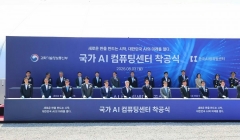
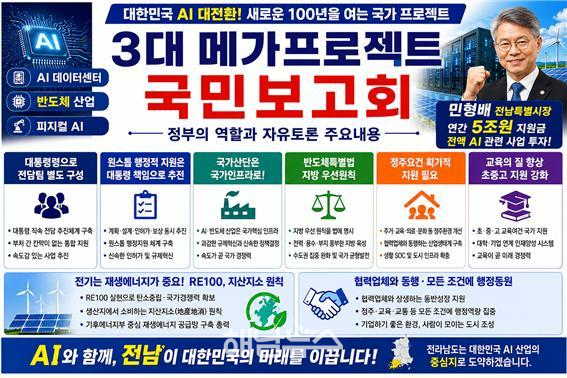 3대 메가프로잭트 국민보고회(정부) / 사진제공=AI호남뉴스 |
대한민국이 반도체와 초거대 AI 데이터센터, 피지컬 AI를 국가 미래산업의 핵심 축으로 삼는 '대한민국 대도약 3대 메가프로젝트'를 본격 추진하면서 정부가 대통령 직속 전담 추진체계를 구축하고 국가 차원의 원스톱 행정지원에 나선다. 이번 프로젝트는 단순한 산업정책을 넘어 국가 운영체계 자체를 AI 시대에 맞게 전환하는 초대형 국가 프로젝트라는 평가를 받고 있다.
청와대에서 열린 '대한민국 대도약 3대 메가프로젝트 국민보고회'와 자유토론에서는 정부와 기업, 지방정부가 함께 추진해야 할 핵심 과제들이 집중적으로 논의됐다.
가장 눈길을 끈 부분은 대통령이 직접 "원스톱 행정지원은 대통령의 책임"이라고 밝히며 기존의 부처별 분산 행정에서 벗어나 대통령령에 따른 별도 전담 추진조직을 구성해 사업 전 과정을 신속하게 지원하겠다는 방침을 제시한 점이다.
정부는 앞으로 계획과 설계, 인허가, 보상 절차를 동시에 진행하는 새로운 국가사업 추진방식을 도입해 수년씩 소요되던 행정절차를 획기적으로 단축한다는 계획이다.
국가산단도 국가 인프라…규제보다 속도가 경쟁력
자유토론에서는 AI와 반도체 산업은 기존 산업단지 개념으로 접근해서는 안 된다는 의견이 이어졌다.
참석자들은 국가산업단지를 단순한 공장 부지가 아니라 국가 핵심 인프라로 인식해야 한다며 과감한 규제혁신과 신속한 정책결정이 필요하다고 강조했다.
특히 AI 데이터센터와 반도체 공장은 전력과 용수, 초고속 통신망이 동시에 구축되어야 하는 국가 기반시설인 만큼 일반 산업단지와 동일한 절차를 적용해서는 세계 경쟁에서 뒤처질 수 있다는 지적도 나왔다.
"반도체특별법 지방 우선원칙 반드시 반영"
이번 토론에서는 수도권 집중을 완화하기 위해 반도체특별법에 지방 우선원칙을 명확히 반영해야 한다는 의견도 제시됐다.
수도권 전력난과 용수 부족이 심화되는 상황에서 재생에너지와 풍부한 용수, 넓은 산업용지를 갖춘 지방이 국가 반도체 생산기지로 성장해야 한다는 데 공감대가 형성됐다.
이는 정부가 발표한 서남권 반도체 클러스터 조성 계획과도 맥을 같이하는 것으로 평가된다.
"정주여건이 기업 경쟁력"
국민보고회에서는 첨단기업 유치의 핵심 조건으로 정주환경 개선이 거듭 강조됐다.
단순히 공장만 건설해서는 글로벌 기업과 우수 인재를 확보할 수 없으며, 주거와 교육, 의료, 문화시설까지 포함한 종합적인 도시 조성이 필요하다는 것이다.
특히 협력업체와 동반성장을 위한 산업생태계 구축, 초·중·고 교육여건 개선, 대학과 기업 간 인재양성 시스템 구축, 생활 SOC 확충 등이 국가 차원의 지원사업으로 함께 추진되어야 한다는 의견이 이어졌다.
정부 역시 첨단산업은 사람을 중심으로 움직이는 산업인 만큼 교육과 정주환경을 국가 경쟁력으로 인식하고 관련 행정역량을 집중하겠다는 입장을 밝혔다.
민형배 전남광주특별시장 "연간 5조 원 모두 AI에 투자"
민형배 전남광주특별시장은 자유토론에서 "정부 지원금 연간 5조 원을 AI 산업 육성에 집중 투자하겠다."고 밝혔다.
그는 AI 반도체와 데이터센터, AI 인재양성, AI 기반 미래산업 생태계를 동시에 구축해 전남을 대한민국 AI 산업의 중심으로 육성하겠다는 구상을 제시했다.
또한 RE100 기반 산업생태계 구축과 AI 데이터센터 집적화를 통해 세계적인 AI 산업거점을 만들겠다는 비전도 함께 밝혔다.
"AI 시대 전기는 재생에너지"
토론에서는 AI 시대 국가경쟁력은 결국 전력 확보 능력에서 결정된다는 점도 강조됐다.
특히 AI 데이터센터는 막대한 전력을 소비하는 만큼 태양광과 풍력 중심의 재생에너지 공급체계를 구축하는 것이 국가 경쟁력이라는 데 의견이 모였다.
정부는 RE100 실현과 함께 생산지역에서 소비하는 '지산지소(地産地消)' 원칙을 적극 확대하고, 기후에너지환경부를 중심으로 재생에너지 공급망 구축에 총력을 기울일 방침이다.
전력 생산지와 AI 산업단지를 연계하는 새로운 국가 에너지 전략이 본격 추진될 것으로 전망된다.
서남권 전략 가치 더욱 커져
이번 국민보고회는 단순한 투자계획 발표를 넘어 국가 행정체계와 산업정책을 AI 중심으로 전환하겠다는 선언이라는 평가를 받고 있다.
대통령 직속 전담 추진체계와 원스톱 행정지원, 지방 우선 반도체 전략, RE100 기반 에너지 정책, 교육과 정주환경 개선까지 포함된 종합 지원체계가 가동될 경우 전력과 용수, 재생에너지, 넓은 산업용지를 모두 갖춘 전남 서남권의 전략적 가치는 더욱 높아질 것으로 전망된다.
특히 해남 솔라시도를 비롯한 전남 서남권은 RE100 재생에너지와 풍부한 용수, 대규모 산업부지를 동시에 확보한 지역으로, 국가 AI 데이터센터와 반도체 클러스터 조성의 최적지로서 경쟁력이 한층 강화될 것이라는 분석이 나오고 있다.
【Jeonnam = AI Honam News】
aihnnews@kakao.com
South Korea Launches AI Fast-Track Strategy with Three Mega Projects Under Presidential Task Force
President: "One-Stop Administrative Support Is the Government's Responsibility"
Jeonnam-Gwangju Special Metropolitan Mayor Min Hyeong-bae: "Annual KRW 5 Trillion Government Support Will Be Invested Entirely in AI"
South Korea has officially launched its "Three National Mega Projects for a Great Leap Forward", placing semiconductors, hyperscale AI data centers, and Physical AI at the center of its future industrial strategy. The government announced that a presidential task force will oversee the initiative while providing comprehensive one-stop administrative support at the national level.
The initiative is widely regarded not merely as an industrial policy but as a nationwide transformation designed to reshape South Korea's governance and economic system for the AI era.
During the National Report Conference on the Three Mega Projects and the subsequent open policy discussion held at the Presidential Office, government officials, industry leaders, and local government representatives discussed the key strategies required to successfully implement the national initiative.
One of the most significant announcements came from the President, who declared that "one-stop administrative support is the responsibility of the President." He emphasized that the government will move away from fragmented, ministry-based administrative procedures and instead establish a dedicated task force through a Presidential Decree to accelerate every stage of the projects.
The government also plans to fundamentally reform the implementation process by allowing planning, design, permitting, and compensation procedures to proceed simultaneously, significantly reducing project timelines that traditionally required many years.
National Industrial Complexes Must Be Recognized as National Infrastructure
During the open discussion, participants stressed that AI and semiconductor industries should no longer be treated under the conventional concept of industrial complexes.
They argued that national industrial complexes should be regarded as critical national infrastructure requiring bold regulatory reforms and rapid policy decisions.
Since AI data centers and semiconductor fabrication plants demand enormous amounts of electricity, water resources, and ultra-high-speed communications infrastructure, applying conventional industrial development procedures could undermine South Korea's global competitiveness.
Semiconductor Special Act Should Prioritize Regional Development
Participants also called for the Semiconductor Special Act to explicitly include a regional priority principle in order to ease excessive concentration in the Seoul metropolitan area.
A consensus emerged that regions possessing abundant renewable energy, sufficient water resources, and vast industrial land should become the nation's next-generation semiconductor production hubs.
This approach aligns closely with the government's strategy to develop a large-scale semiconductor cluster in the southwestern region of the country.
Quality Living Conditions Are Essential to Industrial Competitiveness
Another major topic during the conference was the importance of creating attractive living environments to attract advanced industries and highly skilled professionals.
Participants emphasized that constructing factories alone would not be sufficient to attract global companies or world-class talent.
Instead, comprehensive urban development—including housing, education, healthcare, cultural facilities, and public infrastructure—must accompany industrial investment.
They further stressed that central government support should extend to strengthening industrial ecosystems, supporting partner companies, improving elementary, middle, and high school education, establishing university-industry cooperation for talent development, and expanding essential public infrastructure.
The government agreed that people—not factories—are the foundation of advanced industries and pledged to concentrate administrative resources on improving education and quality of life.
Mayor Min Hyeong-bae: "KRW 5 Trillion Annually Will Be Fully Invested in AI"
Jeonnam-Gwangju Special Metropolitan Mayor Min Hyeong-bae announced during the discussion that the annual government support fund of approximately KRW 5 trillion would be invested entirely in AI-related industries.
He presented a vision to establish Jeonnam as South Korea's leading AI hub by simultaneously developing AI semiconductors, AI data centers, AI talent cultivation programs, and a comprehensive AI industrial ecosystem.
Mayor Min also emphasized building a globally competitive AI industrial base founded on RE100 renewable energy and large-scale AI data center clusters.
Renewable Energy Is the Power Source of the AI Era
Participants agreed that national competitiveness in the AI era will ultimately depend on the ability to secure stable electricity supplies.
Because AI data centers consume enormous amounts of electricity, renewable energy—particularly solar and offshore wind power—was identified as the most sustainable long-term solution.
The government plans to expand the RE100 initiative while promoting the "local production for local consumption" principle, ensuring that renewable electricity generated in each region is utilized locally.
The Ministry of Climate, Energy and Environment is expected to play a central role in establishing a nationwide renewable energy supply network linked directly to AI industrial clusters.
Strategic Importance of Southwestern Jeonnam Continues to Grow
The National Report Conference is widely viewed as a declaration of South Korea's determination to transform not only its industrial policy but also its national governance system around artificial intelligence.
With presidential leadership, one-stop administrative support, regional priorities for semiconductor development, RE100-based energy policies, and comprehensive investments in education and living environments, the strategic value of southwestern Jeonnam is expected to increase significantly.
In particular, Haenam Solar City (Solaseado) and the broader southwestern Jeonnam region possess a unique combination of abundant renewable energy, stable water resources, and extensive industrial land.
These advantages position the region as one of South Korea's most competitive candidates for future AI data center clusters and semiconductor manufacturing complexes, further strengthening its role in the nation's AI-driven industrial transformation.
 해남뉴스 박충배 편집 및 논설위원 news@hbcnews.kr