2026.04.16 (목) 23:16




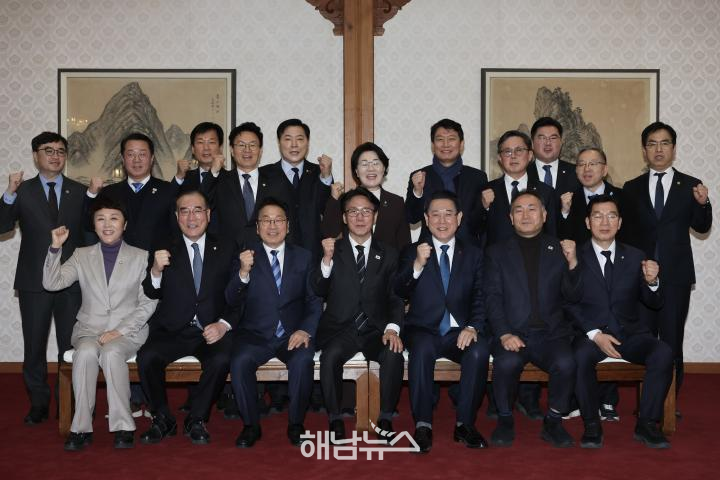 전남광주통합특별법 핵심특례 반영 총력 건의 / 사진제공=국무총리실 |
전남·광주 행정통합이 입법의 문턱에서 다시 한 번 시험대에 올랐다.
김영록 전라남도지사가 정부의 소극적 태도를 정면으로 지적하며, 전남광주통합특별시 설치를 위한 특별법에 실질적 권한 이양과 장기 재정지원, 에너지 산업 핵심특례를 반드시 반영해야 한다고 강력히 촉구했다.
김영록는 9일 저녁 국무총리 공관에서 김민석를 만나, 전남·광주 통합특별시 출범의 성패를 가를 핵심 특례들이 정부 부처 검토 과정에서 대거 누락·축소된 현실을 지적하며 공식 건의에 나섰다.
이날 면담에는 강기정 광주광역시장과 더불어민주당 광주·전남 지역 국회의원들이 함께 참석해, “과감한 권한 이양을 약속했던 정부의 초기 구상이 실제 입법 과정에서 후퇴하고 있다는 데 인식을 같이했다.
실제로 정부 부처 검토 결과, 특별법 전체 386개 조문 가운데 119건의 핵심 특례가 불수용 됐고, 수용된 조항마저도 상당 부분 수정·축소된 것으로 알려졌다.
이에 앞서 김 지사와 강 시장, 지역 국회의원들은 지난 8일 열린 제5차 전남·광주 행정통합 특별법 간담회에서 ‘재정과 권한이 살아 있는 진짜 통합특별법 제정’을 촉구하는 공동결의문을 발표한 바 있다.
김영록 지사는 면담에서 “이재명 대통령이 행정통합을 지방주도 성장의 출발점이자 국가 생존 전략이라고 강조했지만, 일부 부처는 여전히 권한 이양에 소극적”이라고 직격했다.
이어 AI·에너지 산업을 통합특별시의 전략 산업으로 육성하기 위해서는 특별법 차원의 과감한 특례가 필수라고 강조했다.
특히 재정 분야와 관련해 김 지사는 “통합 이후 4년간의 한시적 지원만으로는 통합특별시의 안정적 안착이 불가능하다”며, 통합특별교부금 신설과 국세 이양 등 장기 재정지원 체계를 법률에 명확히 규정해야 한다고 못 박았다.
에너지 분야에서는 권한 이양의 필요성을 구체적으로 제시했다.
김 지사는 태양광·풍력 발전사업 인허가 권한을 특별시장에게 이양할 경우, 주민 수용성을 높이고 사업 추진 속도를 획기적으로 개선할 수 있으며, 발전 수익의 지역 환원과 이익공유 모델도 제도화할 수 있다고 설명했다.
서남권 RE100 산업단지 조성과 관련해선 “단기간 내 대규모 재생에너지 공급이 가능한 현실적 대안은 영농형 태양광”이라며, 영농형 태양광 지구 지정 권한의 특별시장 이양과 농지 타용도 일시사용 허가기간을 현행 8년에서 30년으로 확대해야 한다고 강조했다.
이는 첨단산업 유치와 재생에너지 확대를 동시에 달성하기 위한 최소 조건이라는 설명이다.
아울러 재생에너지의 공공성을 강화하기 위해 지방공기업의 개발사업 참여 확대를 위한 출자·사채 발행 한도 특례와 면세 특례, 재생에너지 수익을 공동체 자산으로 환원하는 이익 공유 제도의 법제화 필요성도 함께 제기했다.
김영록 지사는 “전남광주통합특별시 출범을 실질적으로 견인할 핵심 특례 31건은 선택이 아니라 필수”라며, 정부 차원의 결단과 책임 있는 지원을 거듭 요청했다.
이에 대해 김민석 국무총리는 행정통합의 취지와 특례 필요성에 공감을 표하며, “시·도 부지사와 부시장이 참여하는 TF를 구성해 부처별로 불수용된 특례를 다시 면밀히 검토하겠다.”고 밝혔다.
또한 “국무총리 소속 지원위원회를 통해 통합특별시 지원 방안을 보다 구체화하고, 과감한 권한 이양이 이뤄지도록 관심을 갖고 추진하겠다.”고 답했다.
전남·광주 통합특별법을 둘러싼 논의는 이제 ‘통합의 명분’에서 ‘권한과 재정의 실체’로 옮겨가고 있다.
이번 면담이 선언에 그칠지, 아니면 지방분권의 분기점이 될지는 정부의 최종 선택에 달려 있다.
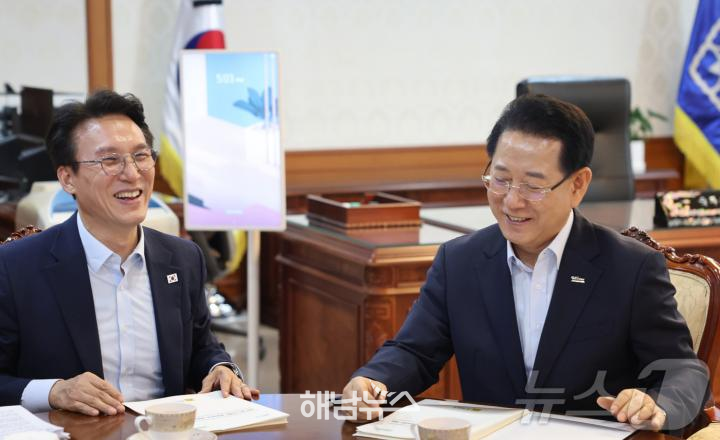 전남광주통합특별법 핵심특례 반영 총력 건의 / 사진제공=국무총리실 |
[Jeonnam = Haenam News] haenamnews@kakao.com
“Integration Is Not a Declaration, but Authority”
Governor Kim Young-rok Pushes to Secure Fiscal and Energy-Related Key Special Provisions in the Jeonnam–Gwangju Integration Special Act
The administrative integration of Jeonnam Province and Gwangju Metropolitan City has once again reached a critical test at the threshold of legislation.
Governor Kim Young-rok of Jeollanam-do strongly urged that the Special Act for the Establishment of the Jeonnam–Gwangju Integrated Special City must include substantive transfers of authority, long-term fiscal support, and key special provisions related to the energy industry, directly criticizing the central government’s passive stance.
On the evening of the 9th, Governor Kim met with Prime Minister Kim Min-seok at the Prime Minister’s official residence, formally submitting a request after pointing out that many of the core special provisions crucial to the success or failure of the integrated special city had been omitted or significantly reduced during inter-ministerial reviews.
The meeting was attended by Gwangju Mayor Kang Ki-jung and National Assembly members from the Democratic Party representing the Gwangju and Jeonnam regions. The participants shared the view that the government’s initial commitment to bold decentralization of authority had retreated during the actual legislative process.
According to the government’s review, 119 key special provisions out of the total 386 articles of the proposed Special Act were not accepted, and even many of the accepted provisions were substantially revised or scaled back. In response, Governor Kim, Mayor Kang, and regional lawmakers had issued a joint resolution at the 5th Jeonnam–Gwangju Administrative Integration Special Act meeting held on the 8th, calling for the enactment of a “genuine integration special act with real fiscal power and authority.”
During the meeting, Governor Kim stated, “Although President Lee Jae-myung has emphasized administrative integration as the starting point of locally led growth and a national survival strategy, some ministries remain reluctant to transfer authority.” He stressed that bold, legally guaranteed special provisions are essential to foster AI and energy industries as strategic pillars of the integrated special city.
In the fiscal sector, Governor Kim made clear that “a four-year, time-limited support framework is insufficient to ensure the stable settlement of the integrated special city,” insisting that long-term fiscal support mechanisms—such as the creation of a special integration grant and the transfer of national tax revenue—must be explicitly stipulated in law.
Regarding energy policy, he explained that transferring permitting authority for solar and wind power projects to the special city mayor would significantly enhance public acceptance, accelerate project implementation, and enable institutionalized models for regional revenue return and profit-sharing.
With respect to the planned RE100 industrial complex in the southwestern region, Governor Kim noted that “agrivoltaic solar power is virtually the only realistic option for supplying large-scale renewable energy in the short term.” He emphasized that authority to designate agrivoltaic zones should be transferred to the special city mayor, and that the current temporary farmland conversion permit period—limited to eight years—must be extended to 30 years. This, he said, is the minimum condition for simultaneously advancing high-tech industry development and renewable energy expansion.
Governor Kim also called for special exemptions to expand the participation of local public enterprises in renewable energy development, including relaxed limits on equity investment and bond issuance, as well as tax exemptions. He further stressed the need to legislate profit-sharing systems that return renewable energy revenues to communities as shared assets.
“Thirty-one key special provisions essential to driving the launch of the Jeonnam–Gwangju Integrated Special City are not optional—they are indispensable,” Governor Kim said, urging decisive and responsible support from the central government.
In response, Prime Minister Kim Min-seok expressed agreement with the purpose of administrative integration and the need for special provisions, stating, “We will form a task force including vice governors and vice mayors to re-examine the special provisions that were not accepted by individual ministries.” He added that the government would pursue more proactive and substantial transfers of authority.
The Prime Minister also noted that a support committee under the Prime Minister’s Office would be used to further concretize support measures for the integrated special city.
Debate surrounding the Jeonnam–Gwangju Integration Special Act is now shifting from the justification for integration to the substance of authority and fiscal power. Whether this meeting becomes another symbolic declaration or a true turning point for decentralization now depends on the final decision of the central government.
 해남뉴스 박충배 편집 및 논설위원 haenamnews@kakao.com