2026.09.14 (월) 12:52




 해남 지진 / 사진제공=ai이미지 |
해남 땅이 다시 흔들리고 있다.
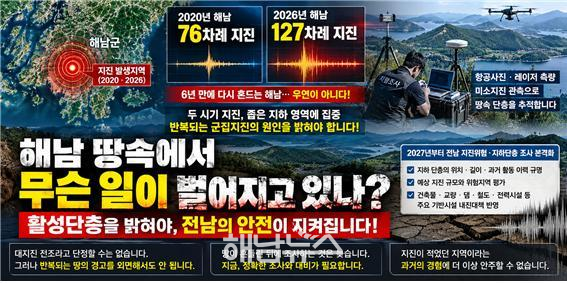
2020년 해남지역에서 76차례의 군집지진이 발생한 데 이어 2026년 들어 같은 지역에서 다시 100차례가 넘는 지진이 집중적으로 관측되면서 서남권 지하 단층에 대한 정밀조사가 시급한 과제로 떠올랐다.
기상청과 지진 전문가들이 주목하는 것은 단순한 지진 발생 횟수가 아니다. 6년의 간격을 두고 비슷한 지역에서 군집지진이 반복되고 있다는 점이다. 특히 2020년과 2026년 지진이 비교적 좁은 지하 영역에 집중된 것으로 분석되면서 지하 단층의 위치와 구조, 운동 특성을 규명해야 할 필요성이 커지고 있다.
이에 따라 2027년부터 전남을 포함한 전라·충청권의 지하단층과 지진위험에 대한 조사·연구가 본격화될 예정이다. 항공사진과 고해상도 레이저 측량, 미소지진 관측 등을 통해 땅속에 숨어 있는 단층 흔적을 추적하고 과거 단층이 언제, 얼마나 움직였는지를 분석하는 작업이 핵심이다.
전문가들은 활성단층 조사의 목적이 공포를 키우는 데 있는 것이 아니라 “어디가 위험한지 미리 찾아 피해를 줄이는 것”이라고 강조한다. 단층이 확인되면 예상 가능한 지진 규모와 위험지역을 평가해 건축물과 교량, 댐, 철도, 전력시설 등 주요 기반시설의 내진대책에 반영할 수 있기 때문이다.
현재까지의 자료만으로 해남의 반복 지진을 대규모 지진의 전조라고 단정할 과학적 근거는 없다. 그러나 반복되는 군집지진 역시 가볍게 넘겨서는 안 된다.
땅이 흔들린 뒤 조사하는 것은 늦다.
정부와 관계기관은 이번 조사를 통해 해남 지하에 어떤 단층이 존재하는지, 얼마나 길고 깊은지, 과거 큰 지진을 일으킨 흔적은 없는지, 최대 어느 정도 지진을 발생시킬 가능성이 있는지를 명확하게 밝혀야 한다.
2020년 76차례, 2026년 다시 127차례.
숫자가 던지는 메시지는 분명하다.
“대지진이 온다.”는 공포가 아니라, “모르기 때문에 지금 조사해야 한다.”는 경고다.
전남의 지진 안전은 더 이상 ‘지진이 적었던 지역’이라는 과거의 경험에만 맡겨둘 문제가 아니다.
“What Is Happening Beneath Haenam?”…127 Earthquakes Again After Six Years, Active Faults Must Be Identified
76 clustered earthquakes struck Haenam in 2020…127 more recorded in the same area in 2026
Earthquakes from both periods concentrated within a narrow underground zone…Determining the cause of repeated seismic swarms is crucial
Full-scale investigation of earthquake hazards and underground faults in Jeonnam to begin in 2027…Aerial imagery, LiDAR and microearthquake monitoring to be used
Too early to call it a “precursor to a major earthquake”…but repeated warnings from beneath the ground cannot be ignored
Location, length and past activity of active faults must be identified and reflected in seismic safety measures for critical infrastructure
[Haenam=AI Honam News] aihnnews@kakao.com
The ground beneath Haenam is shaking again.
After 76 clustered earthquakes were recorded in the Haenam area in 2020, more than 100 earthquakes have again been concentrated in the same general area in 2026, raising the urgent need for a detailed investigation into underground fault structures across southwestern Korea.
What the Korea Meteorological Administration (KMA) and earthquake experts are focusing on is not simply the number of earthquakes.
Of greater significance is the fact that clusters of earthquakes have occurred in similar areas six years apart. In particular, the earthquakes recorded in 2020 and 2026 appear to have been concentrated within relatively narrow underground zones, increasing the need to determine the location, structure and movement characteristics of the faults beneath the region.
Beginning in 2027, full-scale research and investigations into underground faults and earthquake hazards are expected to be conducted across Jeonnam and the broader Jeolla and Chungcheong regions.
The research will use aerial imagery, high-resolution LiDAR surveying and microearthquake monitoring to trace hidden fault structures beneath the surface and determine when and how much those faults moved in the past.
Experts emphasize that the purpose of active-fault investigations is not to create fear, but to “identify areas at risk in advance and reduce potential damage.”
If active faults are identified, researchers can assess potential earthquake magnitudes and hazardous areas, allowing the findings to be incorporated into seismic safety measures for buildings, bridges, dams, railways, power facilities and other critical infrastructure.
Based on the evidence currently available, there is no scientific basis for concluding that the repeated earthquakes in Haenam are a precursor to a major earthquake.
However, repeated earthquake swarms should not be dismissed.
It will be too late to investigate only after a damaging earthquake strikes.
The government and relevant authorities must use the upcoming investigations to clearly determine what faults exist beneath Haenam, how long and deep they are, whether they show evidence of having generated larger earthquakes in the past, and what maximum earthquake magnitude they may potentially produce.
76 earthquakes in 2020.
Another 127 in 2026.
The numbers send a clear message.
It is not the fear that “a major earthquake is coming.”
It is a warning that “because we do not yet know enough, we must investigate now.”
Earthquake safety in Jeonnam can no longer depend solely on the past assumption that the region is “an area where earthquakes rarely occur.”
 해남뉴스 박충배 편집/논설 news@hbcnews.kr