2026.09.23 (수) 19:46



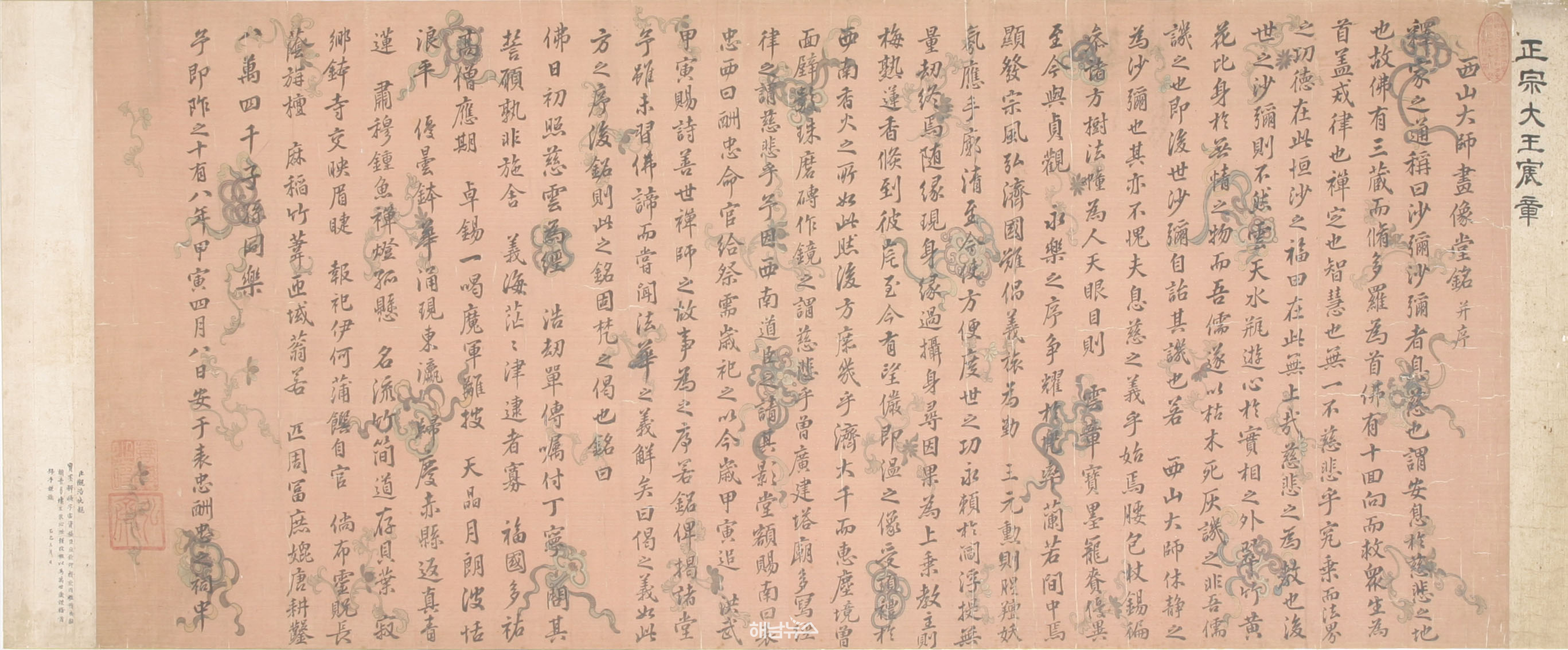 대흥사 성보박물관 소장 화상당명병서 / 사진제공=해남뉴스 |
박충배 편집‧칼럼‧논설
조선의 시대는 흔히 ‘억불숭유(抑佛崇儒)’로 요약된다.
그러나 역사는 언제나 단순하지 않다.
2006년 8월 14일 국가가 보물 제1357호로 지정한 ‘교지(敎旨)·화상당명병서(和尙堂名幷書)’는, 조선 왕실과 불교계의 관계가 단절이 아니라 복잡한 조율과 인정의 역사였음을 보여주는 귀중한 사료다.
이 문서는 승려에게 내린 교지(왕명)와 승려의 위계를 공적으로 인증하는 화상당명병서, 즉 ‘화상에게 당호(堂名)를 허락하고 내리는 문서’를 말한다.
조선 시대에 불교가 억압받았다면, 왜 국왕의 이름으로 이런 문서가 발급되었을까?
바로 이 지점에서 이 문화재의 역사적 의미가 빛난다.
Ⅰ. 교지·화상당명병서의 핵심 내용 — ‘승려의 공식 지위 인정’이라는 국가적 행위
보물 제1357호 문서의 요지는 다음과 같은 세 축으로 요약된다.
1. 왕명의 직접 하달
교지는 단순한 행정 공문이 아니다.
“왕이 직접 하달하는 명령서”라는 점에서, 해당 승려는 국가가 인정한 제도권 종교인으로 확고히 자리 잡는다.
2. 승려의 법계·위상 공인
화상당명병서는 승려에게 주어진 일종의 ‘직급 증서’이자 ‘공적 호칭(堂名) 부여 문서’다.
이는 단순히 사찰 내부의 인정이 아니라 조선 왕조가 공식적으로 불교 승려의 사회적 위치를 보증한 기록이다.
3. 사찰 운영·의례·교단 체계의 법적 안정성 확보
국가가 아무리 불교를 억제하려 해도, 사찰은 지방에서 교육·구휼·문화·지역공동체의 거점 역할을 수행했다.
따라서 일정한 통제와 보호는 필수적이었다.
이 교지와 병서는 그러한 ‘국가의 관리·인정·통제’가 결합된 복합적 성격의 문서다.
Ⅱ. 왜 국가유형문화재(보물)로 지정됐는가? — ‘문서 이상의 문서’로 평가된 네 가지 이유
문화재청이 이 문서를 보물로 지정한 배경에는 다음과 같은 역사·학술적 가치가 자리한다.
① 희소성 — 조선 불교계 공식 문서의 현존 비율이 극히 낮다
조선 불교는 억불 정책 속에서도 명맥을 이어왔지만, 승려 관련 국가 문서는 대부분 소실되거나 전란 속에 사라졌다.
이 문서가 가진 희소성은 곧 한 시대 종교사 연구의 원형 자료라는 의미다.
② 원형 보존 상태가 우수하다
교지의 서체, 인장, 문신, 종이 재질이 당대의 공문 제작 체계를 잘 보여주며 당명병서 역시 조선 관문서의 전형적 형식을 갖추고 있어
문서사 연구의 기준점이 된다.
③ 조선 왕조와 불교계의 실제 관계를 밝히는 핵심 사료
억불정책만으로는 설명되지 않는 왕실의 의례적·정치적·사회적 필요성이 문서에 고스란히 드러난다.
[Haenam = Haenam News] haenamnews@kakao.com
Park Chung-bae, Editor · Columnist · Editorial Writer
“A Single Document That Testifies to the Status of Buddhism in Joseon”
― Reexamining the Significance of Treasure No. 1357, Royal Edict and Certificate of Buddhist Title, Designated as a National Tangible Cultural Heritage ―
The Joseon Dynasty is often summarized by the phrase “Eokbul Sungu”—oppressing Buddhism and honoring Confucianism.
But history is never that simple.
The Royal Edict (Gyoji) and Certificate of Buddhist Title (Hwasang Dangmyeong Byeongseo), designated as Treasure No. 1357 on August 14, 2006, reveal that the relationship between the Joseon royal court and the Buddhist community was not one of complete severance, but rather a complex interplay of control, negotiation, and formal recognition.
These documents refer to:
A royal edict issued to a Buddhist monk, and
A formal certificate granting a monk an official hall title (Dangho)—a document that publicly acknowledges his rank and position.
If Buddhism was truly oppressed in Joseon,
why would the king himself issue such documents?
It is at precisely this point that the historical significance of this cultural asset becomes clear.
Ⅰ. Core Content of the Royal Edict and Certificate — A State-Level Recognition of a Monk’s Official Status
The essence of Treasure No. 1357 can be summarized in three main points:
1. A royal command issued directly by the king
A Gyoji is not an ordinary administrative paper.
It is a direct royal decree, meaning that the recipient monk was formally recognized by the state as a legitimate religious figure within the institutional order.
2. Official approval of a monk’s rank and status
The Hwasang Dangmyeong Byeongseo serves as both
a certificate of clerical rank, and
a document conferring an officially sanctioned hall title.
This was not merely internal recognition within the Buddhist community.
It is a state-issued certification of a monk’s social and institutional prestige under the Joseon royal authority.
3. Securing legal stability for temple operations and clerical hierarchy
Despite its Confucian ideology, the Joseon state relied on temples for education, charity, social support, and local governance.
Some degree of state oversight, protection, and structural regulation was unavoidable.
Thus, the edict and certificate embody a hybrid nature combining
state control, official approval, and institutional management of Buddhism.
Ⅱ. **Why Was It Designated a National Treasure?
— Four Reasons This “Document Is More Than a Document”**
The Cultural Heritage Administration designated these documents as a Treasure for the following reasons:
① Rarity — Very few official Buddhist documents from Joseon survive
Although Buddhism persisted under suppression, most state-issued Buddhist documents were lost to war, fire, or neglect.
As such, this piece is an indispensable primary source for understanding the religious history of the era.
② Excellent preservation
The handwriting, signatures, seals, and paper quality all exhibit the formal characteristics of Joseon administrative documents.
The certificate also follows a highly standardized structure, making it
a benchmark artifact for the study of document culture in Joseon.
③ A key record illuminating the true relationship between monarchy and Buddhism
Beyond the official rhetoric of suppression, the document exposes the monarchy’s
ritual, political, and social dependence on Buddhist institutions.
It demonstrates that state–religion relations were far more nuanced and interconnected than the ideology suggests.
 해남뉴스 박충배 편집 및 논설위원 haenamnews@kakao.com