2026.08.29 (토) 13:12




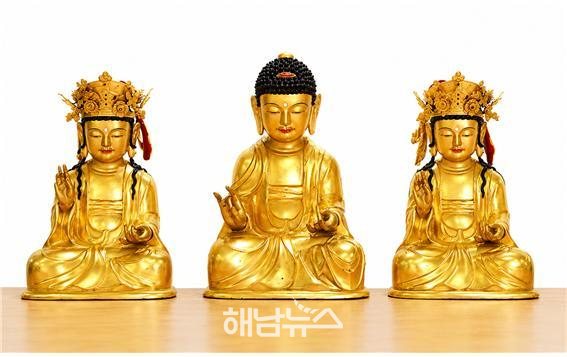 대흥사 아미타 삼존불 / 사진제공=ai호남뉴스 |
전남 해남 대흥사에서 1991년 도난당해 25년 동안 행방이 묘연했던 ‘목조아미타삼존불좌상’의 350여 년 역사가 불상 내부에서 발견된 조성발원문과 개금중수기 등을 통해 구체적으로 드러나고 있다.
특히 이 삼존불은 당초 대흥사 천불전을 위해 제작된 불상이 아니라 1670년 대흥사 산내암자인 ‘천개산 상원암’에 봉안하기 위해 조성됐다가 이후 천불전으로 옮겨져 주존불로 모셔졌던 불상으로 확인된다.
1991년 천불전에서 사라진 뒤에는 수십 년 동안 소재조차 파악되지 않았으나 2016년 서울의 한 사립박물관장 수장고에서 발견됐다. 이후 형사재판과 대법원 몰수 확정 판결 등을 거쳐 원소장 사찰로 돌아갈 수 있는 길이 열렸다.
■ 1670년 봄 조성…복장발원문이 350년 전 역사를 증언
삼존불의 정확한 제작연대와 조성자는 불상 내부에서 발견된 조성발원문이 밝혀냈다.
관련 전시자료 등에 따르면 이 삼존불은 1670년 봄 수조각승 천신(天信)을 중심으로 색난(賾蘭)과 충옥(忠玉) 등이 참여해 조성했다.
더욱 중요한 것은 발원문에 최초 봉안 장소까지 기록돼 있다는 점이다.
자료에는 삼존불을 조성해 ‘천개산 상원암’에 봉안했다는 내용이 확인된다. 현재 대흥사 천불전의 주존불로 알려져 온 이 삼존불의 역사를 17세기까지 거슬러 올라갈 수 있게 하는 결정적인 기록이다.
따라서 이 삼존불의 역사를 단순히 ‘대흥사 천불전 불상’으로 설명하는 것은 충분하지 않다.
1670년 상원암 봉안 → 이후 대흥사 천불전 이안 → 1991년 도난 → 2016년 발견·회수 → 대법원 몰수 판결 → 원소장처 환수라는 굴곡진 이동사를 함께 살펴봐야 한다.
■ 상원암에서 천불전으로…언제 옮겨졌나
그러나 풀리지 않은 부분도 있다.
1670년 조성발원문을 통해 상원암이 최초 봉안처였다는 사실은 명확하지만 상원암에서 대흥사 천불전으로 언제, 어떤 이유로 옮겨졌는지는 현재 공개된 자료만으로 정확하게 특정하기 어렵다.
따라서 ‘상원암에서 곧바로 천불전으로 옮겨졌다’거나 특정 연도에 이안됐다고 단정하는 것은 경계해야 한다.
분명한 것은 1991년 도난 당시에는 이 삼존불이 대흥사 천불전의 주존불로 봉안돼 있었다는 사실이다. 2016년 회수 당시 보도에서도 ‘대흥사 천불전 목조아미타삼존불좌상’으로 확인됐다.
이는 향후 『대둔사지』를 비롯한 대흥사 사적기와 중수기·불사기록 등을 추가 대조해 상원암→천불전 이안 시점을 규명할 필요가 있는 대목이다.
■ 천불전 자체도 보물…1811년 화재 이후 중건
삼존불이 오랫동안 주존불로 모셔졌던 대흥사 천불전 역시 국가유산이다.
국가유산청 국가유산포털에 따르면 ‘해남 대흥사 천불전’은 보물로 지정돼 있으며, 현재 소재지는 전남 해남군 삼산면 대흥사길 400이다. 국가유산청은 천불전을 과거·현재·미래 어느 곳에나 항상 부처가 존재한다는 의미에서 천불을 봉안한 전각으로 설명한다.
천불전의 천불상은 19세기 대흥사의 대규모 불사와도 연결된다.
학술연구에 따르면 현재 알려진 천불상은 1817년 풍계현정의 주도로 경주 기림사에서 조성돼 대흥사로 옮겨진 것으로 파악된다. 이 가운데 일부 불상은 운송 과정에서 일본으로 표류했다가 다시 돌아온 사연까지 전한다.
따라서 1670년 상원암을 위해 만들어진 아미타삼존불과 19세기에 조성된 천불은 제작시기와 원래 조성 목적이 서로 다른 불상군이라는 점도 주목된다.
■ 1991년 8월 22일 사라진 삼존불
350여 년을 이어온 삼존불의 역사는 1991년 큰 단절을 맞는다.
관련 전시자료에는 대흥사 목조아미타삼존불좌상의 도난일이 1991년 8월 22일로 기록돼 있다.
천불전 주존불이었던 삼존불이 사라진 것이다.
이후 무려 25년 동안 불상의 행방은 확인되지 않았다.
전환점은 2016년이었다.
경찰 수사 과정에서 서울 종로의 한 사립박물관장과 관련된 수장고에서 대흥사 삼존불을 비롯해 여러 사찰에서 사라졌던 불교 성보들이 무더기로 발견됐다.
당시 경찰은 대흥사 삼존불을 포함해 위봉사·운암사·팔성사·법주사·용문사 등에서 도난당한 불상 11점을 회수했다.
불상 뱃속에서 나온 ‘대흥사’…결정적 증거 됐다
원소장처를 밝히는 데 결정적인 역할을 한 것은 불상 내부의 복장유물이었다.
대흥사 삼존불에서는 1670년 조성발원문뿐 아니라 1982년 개금중수기도 발견됐다.
특히 개금중수기에는 ‘대흥사’라는 사찰명이 명확하게 기록돼 있었다.
이는 삼존불의 출처를 확인하는 중요한 물증이 됐다. 당시 경찰도 이 기록을 근거로 문화재에 대한 전문지식이 있는 소장자가 불상의 출처를 몰랐다는 주장에 의문을 제기했다.
복장유물은 결국 불상의 ‘신분증’ 역할을 한 셈이다.
350여 년 전 누가 불상을 만들었는지, 처음 어느 사찰에 모셨는지뿐 아니라 근현대에 어느 사찰이 관리했는지를 동시에 입증하는 기록이 불상 내부에 그대로 남아 있었기 때문이다.
■ 사립박물관 측 ‘선의취득’ 주장…법정으로 간 불상
발견됐다고 해서 곧바로 대흥사로 돌아갈 수 있었던 것은 아니다.
당시 사립박물관 측은 불상을 정상적인 거래를 통해 취득했다는 취지의 ‘선의취득’을 주장했다.
반면 경찰은 문화재 은닉·유통 혐의에 무게를 뒀다.
수사 관계자는 당시 불상들이 구입 직후 포장된 상태로 장기간 별도 공간에 보관됐으며 박물관 직원들조차 해당 장소를 알지 못했고, 유물카드나 대장도 작성되지 않았다는 취지로 설명했다.
결국 문제는 법정으로 넘어갔다.
2020년 대법원 판결…‘환지본처’ 길 열려
장기간 이어진 법적 절차는 2020년 대법원 판결을 통해 중요한 전환점을 맞았다.
불교중앙박물관의 2022년 ‘환지본처(還至本處)-돌아온 성보문화재 특별공개전’ 관련 자료에 따르면 사립박물관에 은닉돼 있던 성보들은 대법원에서 유죄 및 몰수 명령이 확정됐고, 대흥사 목조아미타삼존불좌상을 포함한 7건의 성보문화재가 원소장처로 돌아가는 대상에 포함됐다.
2022년 4월 29일부터 6월 12일까지 열린 특별전에서는 대흥사 삼존불을 비롯해 환수된 성보들이 일반에 공개됐다.
전시 제목인 ‘환지본처’는 ‘본래 있던 곳으로 돌아간다’는 의미였다.
불교중앙박물관 측은 전시 종료 뒤 해당 성보들을 원래 봉안처인 사찰로 돌려보내고 환수와 이운을 부처 앞에 고하는 환수고불식을 진행할 예정이라고 밝혔다.
■ ‘국보되나’…현재 지정현황과는 구분해야
최근 이 삼존불의 가치가 재조명되면서 국가유산 지정 여부에도 관심이 쏠리고 있다.
그러나 ‘국보가 된다’거나 이미 국보로 지정됐다고 단정해서는 안 된다.
현재 국가유산청 디지털 서비스에서 대흥사 관련 지정유산으로 확인되는 것은 대흥사 자체를 비롯해 북미륵암 마애여래좌상, 대웅보전, 천불전, 석가여래삼불좌상, 서산대사 관련 유물 등이다. 검색 결과상 이 1670년 목조아미타삼존불좌상이 독립된 국가지정유산으로 등재된 사실은 확인되지 않는다.
따라서 국가유산청의 조사 또는 지정가치 검토가 진행되고 있다면 ‘국보 지정 검토’, ‘국가지정유산 가치 조사’ 등의 단계와 실제 지정 여부를 명확히 구분해 보도할 필요가 있다.
■ 조각승 ‘색난’ 연구에도 중요한 기준작
미술사적으로도 이 삼존불의 의미는 작지 않다.
조성발원문에 수조각승 천신을 비롯해 색난과 충옥이 참여한 사실이 기록돼 있기 때문이다.
색난은 17세기 후반에서 18세기 초 호남지역을 중심으로 활발하게 활동한 대표적인 조각승 계열을 연구하는 데 중요한 인물이다.
대흥사에는 색난 또는 색난계 조각승과 관련된 불교조각이 다수 전한다. 학술연구에서도 대흥사 응진전의 삼세불과 십육나한상이 1701년 색난과 색난파에 의해 제작됐으며 대웅전 일부 불상 역시 17세기 말 색난파 조각승과 관련된 것으로 분석되고 있다.
그런 점에서 제작연대가 1670년으로 명확한 대흥사 아미타삼존불은 색난과 그 계보의 초기 조각활동을 연구하는 중요한 편년자료가 될 가능성이 크다.
■ 350년 불상의 이동사가 남긴 과제
대흥사 목조아미타삼존불좌상의 역사는 한 점의 불교조각이 어떻게 만들어지고 이동하고 도난당한 뒤 다시 돌아오는지를 보여주는 사례다.
1670년 천개산 상원암에서 시작된 역사는 어느 시점 대흥사 천불전으로 이어졌고, 1991년 8월 22일 도난으로 단절됐다.
그리고 25년이 지난 2016년 서울의 은닉 수장고에서 다시 모습을 드러냈고, 수사와 재판을 거쳐 2020년 대법원 판결, 2022년 ‘환지본처’ 특별전으로 이어졌다.
무엇보다 불상 내부에 남아 있던 1670년 조성발원문과 1982년 개금중수기가 불상의 제작자와 최초 봉안처, 근현대 소장처를 밝혀냈다는 점에서 복장유물의 중요성을 다시 보여준다.
■ 다만 아직 풀어야 할 과제도 있다.
상원암의 정확한 위치와 성격, 상원암에서 천불전으로 삼존불이 옮겨진 시점과 이유, 이안 이후 천불전에서의 봉안 변화, 환수 이후 현재 정확한 보관·봉안 상태, 그리고 국가유산 지정가치에 대한 최신 조사 결과 등은 추가적인 공식 기록 확인이 필요하다.
특히 향후 국가유산 지정조사가 본격화된다면 1670년이라는 명확한 제작연대와 조성발원문, 조각승 천신·색난·충옥의 계보, 원봉안처가 확인된 완전성, 도난과 환수 과정까지 포함해 이 삼존불의 역사·학술·예술적 가치가 어떻게 평가되는지가 핵심이 될 전망이다.
350여 년 전 두륜산 자락 상원암에서 시작된 삼존불의 역사가 도난과 25년의 유랑을 넘어 다시 대흥사의 역사로 돌아왔다. 이제 남은 과제는 그 불상이 지나온 350년의 빈칸을 채우고, 그에 걸맞은 국가유산적 가치를 제대로 평가하는 일이다.
Amitabha Triad Born at Daeheungsa in 1670 Returns Home After 25 Years Following Theft
Consecration inscription records enshrinement at “Sangwonam Hermitage on Mt. Cheongae”… Sculptor-monks Cheonsin, Saengnan and Chungok participated
Moved from Sangwonam Hermitage to become the principal triad of Daeheungsa’s Cheonbuljeon Hall… Exact date of relocation remains unknown
Stolen from Cheonbuljeon Hall on August 22, 1991… Whereabouts unknown for 25 years
Discovered in 2016 in a concealed storage facility belonging to a private museum director in Seoul… Inscription identifying “Daeheungsa” found inside
Supreme Court finalized confiscation in 2020 → Featured in the 2022 “Return to the Original Place” exhibition → Path cleared for return to original temple
Precise date of creation, sculptor-monks and original place of enshrinement all documented… Heritage value draws renewed attention
[Haenam = AI Honam News] aihnnews@kakao.com
The 350-year history of the Wooden Seated Amitabha Buddha Triad of Daeheungsa Temple in Haenam, South Jeolla Province, which was stolen in 1991 and remained missing for 25 years, has been reconstructed in considerable detail through a consecration inscription and records of later regilding discovered inside the statues.
Significantly, the triad was not originally created for Daeheungsa’s Cheonbuljeon Hall, or Hall of a Thousand Buddhas. Instead, it was made in 1670 for enshrinement at Sangwonam Hermitage on Mt. Cheongae, a hermitage affiliated with Daeheungsa. It was subsequently transferred to Cheonbuljeon Hall, where it came to be worshipped as the principal triad.
After disappearing from Cheonbuljeon Hall in 1991, its whereabouts remained unknown for decades. In 2016, the statues were discovered in a storage facility associated with the director of a private museum in Seoul. Criminal proceedings and a final Supreme Court confiscation ruling subsequently opened the way for the Buddhist heritage objects to be returned to their original temple.
■ Created in the Spring of 1670… Consecration Inscription Reveals a 350-Year History
The precise date of creation and the sculptors responsible for the triad were identified through a consecration inscription discovered inside the statues.
According to exhibition and related research materials, the triad was created in the spring of 1670, under the direction of the chief sculptor-monk Cheonsin (天信), with the participation of Saengnan (賾蘭) and Chungok (忠玉).
Even more significant is that the inscription records the original place of enshrinement.
The document states that the triad was created for enshrinement at “Sangwonam Hermitage on Mt. Cheongae.” This is crucial evidence tracing the history of the statues—later known as the principal triad of Daeheungsa’s Cheonbuljeon Hall—back to the 17th century.
The history of the triad therefore cannot be adequately explained simply by describing it as “the Buddhist statues of Daeheungsa’s Cheonbuljeon Hall.”
Its remarkable journey should instead be understood as follows:
1670: Enshrined at Sangwonam Hermitage → Later transferred to Daeheungsa’s Cheonbuljeon Hall → Stolen in 1991 → Discovered and recovered in 2016 → Supreme Court confiscation ruling → Return to the original temple.
■ From Sangwonam Hermitage to Cheonbuljeon Hall… When Were the Statues Moved?
One important question remains unanswered.
While the 1670 consecration inscription clearly establishes Sangwonam Hermitage as the original place of enshrinement, currently available records do not establish precisely when or why the triad was transferred from Sangwonam to Daeheungsa’s Cheonbuljeon Hall.
It would therefore be inappropriate to state that the statues were moved directly from Sangwonam to Cheonbuljeon immediately after their creation, or to assign a specific date to the transfer without additional documentary evidence.
What is certain is that, by the time of the 1991 theft, the triad had been enshrined as the principal Buddhist triad of Daeheungsa’s Cheonbuljeon Hall. Reports issued when the statues were recovered in 2016 also identified them as the “Wooden Seated Amitabha Buddha Triad of Cheonbuljeon Hall at Daeheungsa Temple.”
Further comparison of historical sources, including the Daedunsaji, Daeheungsa temple chronicles, restoration records and documentation of Buddhist projects, will be necessary to determine when the triad was moved from Sangwonam Hermitage to Cheonbuljeon Hall.
■ Cheonbuljeon Hall Is Itself a National Treasure… Rebuilt After the 1811 Fire
Cheonbuljeon Hall, where the triad was worshipped for many years as the principal icon, is itself a nationally designated cultural heritage property.
According to the Korea Heritage Service’s National Heritage Portal, Cheonbuljeon Hall of Daeheungsa Temple in Haenam is designated as a Treasure of Korea. It is located at 400 Daeheungsa-gil, Samsan-myeon, Haenam-gun, South Jeolla Province.
The Korea Heritage Service explains that Cheonbuljeon is a Buddhist hall containing one thousand Buddha images, symbolizing the belief that Buddhas exist throughout the past, present and future.
The Thousand Buddha statues currently associated with the hall are also linked to major Buddhist projects undertaken at Daeheungsa in the 19th century.
Academic research indicates that the Thousand Buddha statues were created in 1817 under the leadership of the monk Punggye Hyeonjeong at Girimsa Temple in Gyeongju and subsequently transported to Daeheungsa. Some of the statues are said to have drifted to Japan during transportation before eventually returning to Korea.
The Amitabha Triad created in 1670 for Sangwonam Hermitage and the Thousand Buddha statues created in the 19th century are therefore distinct groups of Buddhist sculptures, differing both in date and original purpose.
■ August 22, 1991: The Triad Disappears
The triad’s centuries-long history was abruptly interrupted in 1991.
Exhibition records identify August 22, 1991, as the date on which the Wooden Seated Amitabha Buddha Triad of Daeheungsa was stolen.
The principal triad of Cheonbuljeon Hall had disappeared.
For the next 25 years, its whereabouts remained unknown.
The breakthrough came in 2016.
During a police investigation, Buddhist heritage objects that had disappeared from several temples were discovered in a storage facility associated with the director of a private museum in Jongno, Seoul.
Police recovered 11 stolen Buddhist statues, including the Daeheungsa triad and objects taken from temples including Wibongsa, Unamsa, Palseongsa, Beopjusa and Yongmunsa.
■ “Daeheungsa” Found Inside the Statues… Decisive Evidence of Provenance
The objects placed inside the Buddhist statues proved crucial in establishing their provenance.
Along with the 1670 consecration inscription, investigators found a 1982 record documenting the regilding and restoration of the Daeheungsa triad.
Of particular importance was the explicit appearance of the name “Daeheungsa” in the restoration record.
This became important physical evidence establishing the triad’s provenance. Police at the time reportedly questioned claims that a collector knowledgeable about cultural heritage could have been unaware of the statues’ origins given the documentary evidence contained inside them.
The contents of the statues effectively served as their historical “identity cards.”
They preserved evidence not only of who created the statues and where they were originally enshrined more than 350 years ago, but also of the temple responsible for their care in the modern period.
■ Private Museum Claims “Good-Faith Acquisition”… Statues Become Subject of Court Battle
The discovery of the statues did not mean that they could immediately be returned to Daeheungsa.
The private museum side reportedly argued that the objects had been obtained through legitimate transactions and asserted a claim of good-faith acquisition.
Police, however, focused their investigation on allegations involving the concealment and circulation of stolen cultural heritage.
Investigators stated that the Buddhist statues had reportedly remained wrapped and stored for extended periods in a separate space after their acquisition, that even museum employees were unaware of the location, and that no proper artifact cards or inventory records had been maintained.
The dispute eventually proceeded to court.
■ 2020 Supreme Court Ruling Opens the Way for “Return to the Original Place”
The lengthy legal process reached a crucial turning point with a Supreme Court ruling in 2020.
According to materials related to the Buddhist Central Museum’s 2022 special exhibition, “Hwanjiboncheo (還至本處): Returned Sacred Buddhist Heritage,” convictions and confiscation orders concerning the concealed Buddhist heritage objects were finalized by the Supreme Court.
Seven groups of Buddhist heritage objects, including the Wooden Seated Amitabha Buddha Triad of Daeheungsa, were included among the items designated to return to their original temples.
The recovered objects were presented to the public during the special exhibition held from April 29 to June 12, 2022.
The exhibition title, “Hwanjiboncheo,” literally conveys the idea of “returning to the place where one originally belonged.”
The Buddhist Central Museum stated that after the exhibition, the recovered heritage objects would be returned to their original temples, with Buddhist ceremonies to be conducted to formally report and commemorate their recovery and transfer.
■ Could It Become a National Treasure? Current Status Must Be Distinguished From Future Designation
Renewed attention to the triad’s historical and artistic significance has also raised questions about its possible designation as nationally protected heritage.
However, it would be premature to state that the triad will become a National Treasure or has already been designated as one.
Current Korea Heritage Service digital records identify numerous nationally designated heritage properties associated with Daeheungsa, including the temple complex itself, the Rock-carved Seated Buddha at Bungmireugam Hermitage, Daeungbojeon Hall, Cheonbuljeon Hall, the Seated Sakyamuni Buddha Triad, and heritage associated with the renowned monk Seosan Daesa.
However, available search results do not currently confirm the 1670 Wooden Seated Amitabha Buddha Triad as an independently designated national heritage property.
If the Korea Heritage Service is conducting an assessment of its designation value, reporting should therefore clearly distinguish between stages such as “assessment for National Treasure designation” or “evaluation for national heritage designation” and an actual formal designation.
■ An Important Benchmark for Research on Sculptor-Monk Saengnan
The triad is also of considerable importance to Korean Buddhist art history.
The consecration inscription identifies Cheonsin as the chief sculptor-monk and records the participation of Saengnan and Chungok.
Saengnan is an important figure in the study of Buddhist sculptor-monks who were active primarily in the Honam region from the late 17th to the early 18th century.
Daeheungsa preserves a number of Buddhist sculptures associated with Saengnan or sculptors belonging to his artistic lineage.
Academic research has identified the Three Buddhas and Sixteen Arhats of Daeheungsa’s Eungjinjeon Hall as works produced in 1701 by Saengnan and sculptors of his school. Some Buddhist statues associated with Daeungjeon Hall have likewise been analyzed in connection with the Saengnan school of the late 17th century.
The Daeheungsa Amitabha Triad, whose date of creation is firmly established as 1670, may therefore constitute an important chronological benchmark for studying the early sculptural activities of Saengnan and his artistic lineage.
■ Questions Remaining in the Triad’s 350-Year Journey
The history of the Wooden Seated Amitabha Buddha Triad of Daeheungsa illustrates how a Buddhist sculpture can be created, relocated, stolen, lost for decades and eventually recovered.
Its story began at Sangwonam Hermitage on Mt. Cheongae in 1670, continued at some later point at Daeheungsa’s Cheonbuljeon Hall, and was abruptly interrupted by the theft on August 22, 1991.
Twenty-five years later, in 2016, the triad re-emerged from a concealed storage facility in Seoul. Its recovery was followed by a police investigation, court proceedings, the 2020 Supreme Court ruling and the 2022 “Hwanjiboncheo” exhibition.
Above all, the 1670 consecration inscription and 1982 regilding and restoration record preserved inside the statues revealed their makers, original place of enshrinement and modern provenance, demonstrating the extraordinary historical importance of materials placed inside Buddhist statues.
■ Important Questions, However, Remain Unresolved
Further research is needed to establish the precise location and historical character of Sangwonam Hermitage, when and why the triad was moved from Sangwonam to Cheonbuljeon Hall, how its placement within Cheonbuljeon changed over time, its exact location and enshrinement status following its recovery, and the latest official assessment of its value for national heritage designation.
If a formal national heritage designation review proceeds, the key issues are likely to include the triad’s firmly documented 1670 date of creation, the survival of its consecration inscription, its association with sculptor-monks Cheonsin, Saengnan and Chungok, the clearly identified original place of enshrinement, its historical integrity, and its remarkable history of theft and recovery.
The story that began more than 350 years ago at Sangwonam Hermitage in the foothills of Mt. Duryunsan has endured theft and a 25-year disappearance before returning to the history of Daeheungsa.
The task that remains is to fill in the missing chapters of the triad’s 350-year journey and to ensure that its historical, academic and artistic significance is properly evaluated and preserved as part of Korea’s cultural heritage.
 해남뉴스 박충배 편집/논설 news@hbcnews.kr