2026.03.17 (화) 15:21




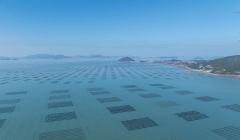
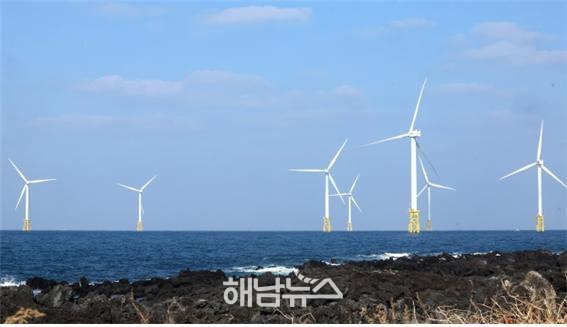 제주 해상 풍력 발전 / 사진제공=해남뉴그 |
전남 진도군이 대한민국 해상풍력 산업의 핵심 거점으로 부상했다. 기후에너지환경부는 3월 16일 해상풍력 집적화단지 7곳을 지정하면서 진도 1단계(1,470MW)와 2단계(2,130MW)를 모두 포함시켰다.
이로써 진도는 총 3.6GW 규모의 초대형 해상풍력 단지를 확보하게 됐으며, 이는 원전 3~4기에 맞먹는 수준이다.
단일 단지 기준으로는 신안 해상풍력단지(3.7GW)에 버금가는 규모로, 전남이 명실상부한 해상풍력 중심지로 자리매김하는 계기가 됐다.
이번 사업은 단순한 발전단지 조성을 넘어 지역 경제 구조를 바꾸는 대형 프로젝트로 평가된다.
총 민간 투자 규모만 약 20조 원에 달할 것으로 예상되며, 1단계는 2031년, 2단계는 2033년 준공을 목표로 추진된다.
특히 해상풍력 집적화단지는 지자체가 주도해 입지를 발굴하고 주민과 어업인의 수용성을 확보하며 공동 접속 설비를 구축하는 방식으로 추진된다.
이로 인해 기존 민간 주도 사업에서 반복되던 어업 갈등과 송전선 문제, 주민 반발 등을 최소화할 수 있어 사업 속도와 성공 가능성이 크게 높다는 평가다.
무엇보다 주목되는 것은 ‘바람연금’으로 불리는 군민 이익 공유 구조다. 진도군은 주민이 조합을 구성해 사업비의 일부를 투자할 경우 발전 수익을 배당받는 구조를 도입해 향후 20년간 약 1조 4천억 원 규모의 배당이 가능할 것으로 내다보고 있다.
진도군 1만6천여 세대가 참여할 경우 세대당 연평균 약 436만 원의 소득이 발생할 것으로 예상되며, 최대 1천만 원 수준까지 확대될 수 있다.
재생에너지 수익이 주민에게 직접 돌아가는 ‘에너지 기본소득 모델’이 현실화되는 셈이다.
직접적인 재정 효과도 상당하다.
진도군은 발전 수익으로 연간 154억 원씩 20년간 총 3,084억 원을 확보하고, 발전소 주변 지원금 890억 원을 더해 약 4천억 원 규모의 재원을 확보할 것으로 전망된다.
전라남도 역시 약 1,384억 원의 수익이 예상되며, 송전선 경과지인 해남군도 약 3,996억 원의 경제적 효과를 얻게 될 것으로 분석된다. 해남은 단순한 경유지가 아니라 사실상 핵심 수혜 지역으로 평가받고 있다.
이번 성과는 진도군과 전라남도, 그리고 정치권의 긴밀한 협력이 만들어낸 결과라는 점에서도 의미가 크다.
지난해 10월 사업 신청 이후 불과 반년 만에 집적화단지로 지정된 것은 다른 지역에서 수년 이상 소요되는 과정을 단기간에 돌파한 사례로 평가된다. 박지원 국회의원은 “진도군민은 물론 송전선 통과 지역인 해남군민까지 이익을 공유하는 성공 모델이 될 수 있도록 끝까지 챙기겠다.”고 밝혔다.
이번 지정은 진도에 국한된 성과를 넘어 해남·완도·진도를 아우르는 서남권 에너지 산업 지형을 근본적으로 바꾸는 신호탄으로 읽힌다.
진도가 해상풍력 생산 거점으로 자리 잡고, 해남은 송전망과 AI·데이터센터·RE100 산업과 연계되며, 완도는 해양·수산 산업과 결합하는 구조가 형성될 경우 서남해안은 대한민국을 대표하는 에너지 산업 벨트로 도약할 가능성이 크다.
결국 이번 해상풍력 집적화단지 지정은 단순한 발전 사업을 넘어 지역이 생산한 에너지가 지역 주민의 소득으로 환원되는 새로운 경제 모델의 출발점이다.
바다가 산업이 되고, 바람이 소득이 되는 시대가 진도에서 현실로 다가오고 있다.
 해남완도진도 박지원의원 / 사진제공=박지원의원실 |
【Jindo = Haenam News】 haenamnews@kakao.com
“Wind Becomes Wealth”… Jindo’s 20 Trillion Won Offshore Wind Project Opens the Era of ‘Wind Pension’
Jindo County in Jeollanam-do has emerged as a key hub for South Korea’s offshore wind industry. On March 16, the Ministry of Climate, Energy and Environment designated seven offshore wind cluster complexes, including both Phase 1 (1,470 MW) and Phase 2 (2,130 MW) of Jindo.
With this designation, Jindo has secured a massive 3.6 GW offshore wind complex—equivalent to the output of three to four nuclear power plants. The scale is comparable to the Shinan offshore wind complex (3.7 GW), positioning Jeollanam-do as a leading center of offshore wind power in Korea.
This project is being evaluated as more than just a power generation initiative—it represents a large-scale transformation of the regional economic structure. Total private investment is expected to reach approximately 20 trillion won, with completion targeted for 2031 (Phase 1) and 2033 (Phase 2).
Notably, the offshore wind cluster model is led by local governments, which identify suitable sites, secure acceptance from residents and fishermen, and build shared grid connection infrastructure. This approach significantly reduces conflicts over fisheries, transmission lines, and local opposition—issues that have often delayed privately led projects—thereby improving both speed and feasibility.
The most remarkable aspect of the project is the so-called “Wind Pension,” a profit-sharing model for residents. Jindo County plans to allow residents to form cooperatives and invest a portion of the project cost, enabling them to receive dividends from power generation revenues. Over 20 years, total dividends are projected to reach approximately 1.4 trillion won.
If around 16,000 households in Jindo participate, each household is expected to earn an average of 4.36 million won annually, with potential earnings ranging from 1 million to up to 10 million won. This effectively realizes a model of “energy basic income,” where renewable energy profits are directly returned to local residents.
The direct fiscal benefits are also substantial. Jindo County is expected to secure 3.084 billion won over 20 years from annual revenues of 154 million won, along with an additional 890 billion won in power plant support funds, totaling approximately 400 billion won.
Jeollanam-do is projected to gain about 138.4 billion won, while Haenam County—located along the transmission route—is expected to benefit by approximately 399.6 billion won. Haenam is thus considered not merely a transit area but a key beneficiary of the project.
This achievement is also significant as a result of close cooperation among Jindo County, Jeollanam-do, and political leadership. The designation was secured in just six months after the application was submitted in October last year—an unusually rapid timeline compared to other regions, where similar processes often take several years.
Rep. Park Ji-won stated, “We will do our utmost to ensure that this offshore wind cluster becomes a successful model that shares benefits not only with Jindo residents but also with the people of Haenam affected by transmission lines.”
Beyond Jindo itself, this designation is seen as a turning point that could fundamentally reshape the energy industry landscape of the southwestern region, including Haenam and Wando. With Jindo as a production hub, Haenam connected through transmission infrastructure and linked to AI, data centers, and RE100 industries, and Wando integrating marine and fisheries sectors, the southwestern coast is poised to become Korea’s leading energy industrial belt.
Ultimately, the designation of the offshore wind cluster marks not just a power generation project, but the beginning of a new economic model—one in which locally produced energy is returned as income to local residents.
The era in which the sea becomes industry and the wind becomes income is now becoming a reality in Jindo.
 해남뉴스 박갑석 기자 haenamnews@kakao.com