2025.12.17 (수) 18:40




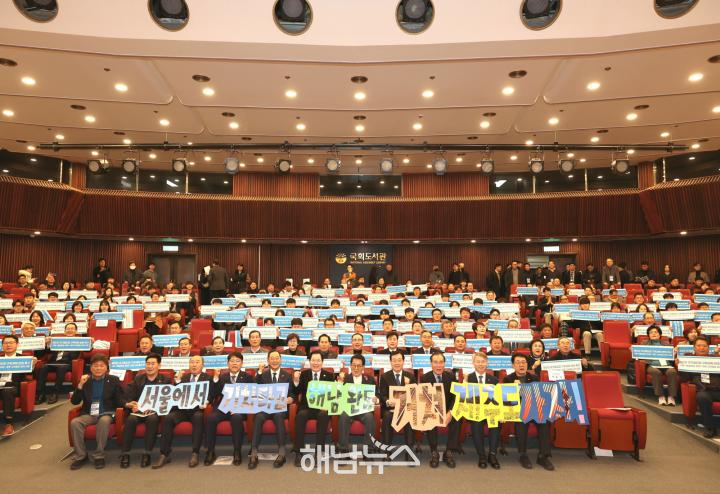 고속철도 유치 국회 토론회 / 사진제공=해남군 |
【박충배 편집/칼럼/논설】
“서울에서 기차를 타고 해남과 완도를 거쳐 제주로 간다.”
한때 공상처럼 들렸던 이 구상이 이제 국가정책의 문턱 앞까지 다가왔다.
17일 국회도서관에서 열린 ‘해남·완도 경유 서울~제주 고속철도 유치 국회 토론회’는 단순한 지역 현안 논의가 아닌, 대한민국 국토 구조를 다시 설계하는 문제를 본격적으로 공론화한 자리였다.
이번 토론회는 서울~제주 고속철도 사업을 제5차 국가철도망 구축계획에 반드시 반영해야 한다는 공감대를 형성하기 위해 마련됐으며, 해남·완도·진도 지역구 박지원 국회의원을 비롯해 민홍철·민병덕·민형배·허종식·손명수 의원이 공동 주최했다.
해남군과 완도군, 대중교통포럼이 공동 주관하며 중앙 정치권과 지역, 전문가 집단이 한목소리를 냈다.
■ “왜 해남을 지나야 하는가”에 대한 분명한 답
이날 토론회의 핵심은 단 하나였다.
서울~제주 고속철도는 왜 반드시 해남과 완도를 경유해야 하는가.
그 답은 명확했다.
첫째, 국가균형발전의 원칙이다.
지금까지 대한민국의 철도망은 수도권과 동남권 중심으로 확장돼 왔다.
전남 서남권은 고속철도·광역철도에서 구조적으로 배제돼 왔으며, 이는 인구 유출과 산업 공백으로 이어졌다. 해남·완도 경유 노선은 수도권–충청–호남–서남권–제주를 잇는 국가 최초의 ‘종단형 균형축’을 형성한다.
박지원 국회의원은 개회사에서 “서울~제주 고속철도는 단순한 교통망이 아니라 수도권과 지방의 격차를 줄이는 ‘균형의 길’”이라며 “해남과 완도를 경유하는 노선이야말로 지역 경제와 관광 산업을 동시에 살릴 수 있는 최적의 대안”이라고 강조했다.
둘째, 실질적 대체 교통망의 필요성이다.
제주국제공항은 기상이변으로 매년 1,500건 이상 항공기 결항이 반복되고 있다.
항공에 전적으로 의존하는 제주 교통체계는 이미 한계에 도달했다.
고속철도는 단순한 보조 수단이 아니라 국가적 재난·기후 리스크를 분산하는 필수 인프라다.
셋째, 서남권 산업 지형 변화다.
전남 서남권은 더 이상 ‘변방’이 아니다.
해남 솔라시도를 중심으로 AI 컴퓨팅센터, 데이터센터, RE100 재생에너지 산업이 집적되며 ‘국가 AI·에너지 수도’로 급부상하고 있다.
대규모 기업 투자와 인구 유입이 예고된 상황에서, 이를 감당할 철도 기반이 없다면 성장은 지속될 수 없다.
해남군이 고속철도 유치에 사활을 거는 이유도 여기에 있다.
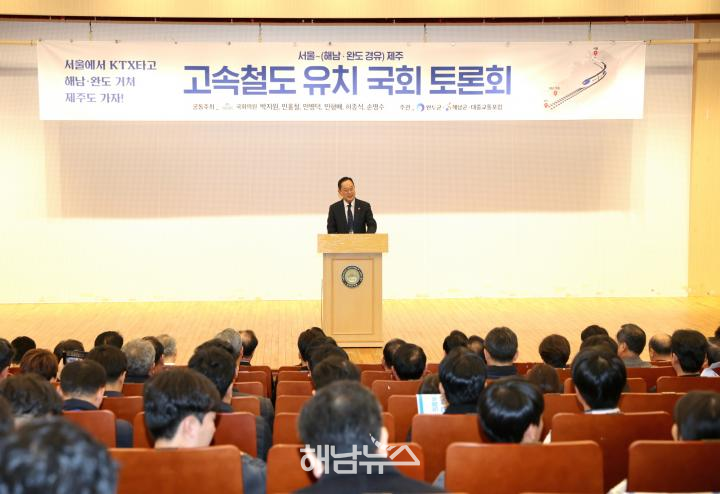 고속철도 유치 국회 토론회 / 사진제공=해남군 |
■ “해남을 빼고 제주를 잇는 철도는 완성될 수 없다”
토론회에서는 김시곤 서울과학기술대 교수의 기조 발제를 시작으로, 곽재호 한국철도기술연구원 단장, 윤태호 서울과학기술대 교수, 안종배 제주세계미래발전포럼 회장 등 교통·기술·미래전략 분야 전문가들이 참여해 해남·완도 경유 노선의 기술적·경제적 타당성을 다각도로 분석했다.
전문가들은 공통적으로 “서울~제주 고속철도는 단선적인 ‘제주 연결’이 아니라, 남해안과 서남권을 묶는 국가 복합 교통축으로 설계돼야 한다.”고 진단했다.
즉, 해남을 거치지 않는 노선은 국가적 효율성과 정책 명분을 모두 잃게 된다는 것이다.
■ 지방이 요구하는 특혜가 아니다, 국가 전략이다
해남군은 이미 지난해부터 전담 TF팀을 구성해 국토교통부, 국가철도공단, 한국교통연구원을 수차례 방문하며 사업 필요성을 설명해 왔다.
지난해 2월에는 완도군·영암군과 함께 해남읍 경유 노선을 제5차 국가철도망 구축계획에 반영해 달라는 공동 건의서도 제출했다.
명현관 해남군수는 토론회에서 “서울~제주 고속철도는 해남과 완도의 교통 인프라를 근본적으로 바꾸는 사업”이라며 “제5차 국가철도망 구축계획 반영은 전남 서남권 발전의 출발선이자, 국가균형발전의 실질적 시험대”라고 밝혔다.
■ 이제는 결단의 시간이다
총사업비 27조 원이 투입되는 서울~제주 고속철도는 분명 초대형 국가 프로젝트다.
그러나 비용만을 이유로 미뤄왔던 결과는 지역 소멸과 국토 불균형이라는 더 큰 사회적 비용으로 되돌아왔다.
이제 질문은 단순하다.
제주로 가는 길을 또다시 수도권 중심으로 설계할 것인가, 아니면 해남을 지나 대한민국의 균형을 복원할 것인가.
서울~제주 고속철도는 해남을 경유할 때 비로소 완성된다.
그것은 지역의 요구가 아니라, 국가의 논리다.
 고속철도 유치 국회 토론회 / 사진제공=해남군 |
[Haenam = Haenam News] haenamnews@kakao.com
[Edited / Column / Editorial by Park Chung-bae]
“The Road to Jeju Must Pass Through Haenam”
The Seoul–Jeju High-Speed Rail via Haenam and Wando Is Not an Option, but an Imperative for Balanced National Development
“Board a train in Seoul, pass through Haenam and Wando, and arrive in Jeju.”
What once sounded like a fantasy is now standing at the threshold of national policy.
The National Assembly Forum on Attracting the Seoul–Jeju High-Speed Rail via Haenam and Wando, held on the 17th at the National Assembly Library, was not merely a discussion of a regional project. It marked the beginning of a serious public debate on redesigning the structural geography of the Republic of Korea.
The forum was convened to build nationwide consensus on including the Seoul–Jeju High-Speed Rail project in the 5th National Rail Network Construction Plan. It was jointly hosted by National Assembly members Park Jie-won (representing Haenam, Wando, and Jindo), Min Hong-chul, Min Byeong-deok, Min Hyung-bae, Heo Jong-sik, and Son Myung-soo.
The event was co-organized by Haenam County, Wando County, and the Public Transportation Forum, bringing together central government figures, local governments, and experts with a unified voice.
■ A Clear Answer to the Question: “Why Must the Line Pass Through Haenam?”
The core issue of the forum was singular and unmistakable:
Why must the Seoul–Jeju High-Speed Rail pass through Haenam and Wando?
The answer was equally clear.
First, the principle of balanced national development.
Until now, Korea’s rail network has expanded primarily around the Seoul metropolitan area and the southeastern region. The southwestern Jeonnam region has been structurally excluded from high-speed and metropolitan rail networks, accelerating population decline and industrial stagnation.
A route via Haenam and Wando would create the nation’s first longitudinal balanced development axis, linking the Capital Region, Chungcheong, Honam, the southwestern coast, and Jeju into a single national corridor.
In his opening remarks, Assemblyman Park Jie-won emphasized:
“The Seoul–Jeju High-Speed Rail is not merely a transportation project; it is a ‘road of balance’ that narrows the gap between the capital and the regions. A route passing through Haenam and Wando is the optimal alternative that can simultaneously revive regional economies and tourism.”
Second, the necessity of a genuine alternative transportation system.
Jeju International Airport experiences more than 1,500 flight cancellations annually due to extreme weather conditions. A transportation system that relies almost exclusively on aviation has reached its structural limits.
High-speed rail is not a supplementary option—it is essential national infrastructure that disperses disaster and climate-related risks.
Third, the transformation of the southwestern industrial landscape.
The southwestern Jeonnam region is no longer a “periphery.”
Centered on Haenam’s Solaseado, AI computing centers, data centers, and RE100 renewable energy industries are rapidly clustering, positioning the region as a rising national hub for AI and energy. With large-scale corporate investment and population inflows anticipated, sustainable growth is impossible without a corresponding rail infrastructure.
This is why Haenam County is staking its future on attracting the high-speed rail project.
■ “A Rail Line That Skips Haenam Cannot Be Complete”
The forum featured a keynote presentation by Professor Kim Si-gon of Seoul National University of Science and Technology, followed by in-depth discussions involving Kwak Jae-ho, Director at the Korea Railroad Research Institute; Professor Yoon Tae-ho of SeoulTech; and Ahn Jong-bae, Chairman of the Jeju World Future Development Forum.
Experts from transportation, technology, and future strategy fields comprehensively analyzed the technical and economic feasibility of the Haenam–Wando route.
They shared a common conclusion:
“The Seoul–Jeju High-Speed Rail must not be designed as a simple ‘Jeju connection,’ but as a national multimodal transportation axis linking the southern coast and the southwestern region.”
In other words, a route that bypasses Haenam would lose both national efficiency and policy legitimacy.
■ Not a Demand for Privilege, but a National Strategy
Since last year, Haenam County has operated a dedicated task force, making repeated visits to the Ministry of Land, Infrastructure and Transport, the National Railroad Corporation, and the Korea Transport Institute to argue for the project’s necessity.
In February last year, Haenam, Wando, and Yeongam counties jointly submitted a formal proposal requesting that the Haenam-eup route be included in the 5th National Rail Network Construction Plan.
At the forum, Haenam County Mayor Myung Hyun-kwan stated:
“The Seoul–Jeju High-Speed Rail will fundamentally transform transportation infrastructure in Haenam and Wando. Its inclusion in the 5th National Rail Network Plan marks the starting line for southwestern Jeonnam’s future—and a real test of Korea’s commitment to balanced national development.”
■ The Time for Decision Has Come
With a projected total cost of 27 trillion won, the Seoul–Jeju High-Speed Rail is undeniably a mega-scale national project.
Yet postponement based solely on cost considerations has already resulted in far greater social costs: regional extinction and structural imbalance of the national territory.
Now, the question is simple.
Will the road to Jeju once again be designed around the capital region alone?
Or will it pass through Haenam—restoring balance to the Republic of Korea?
The Seoul–Jeju High-Speed Rail is complete only when it passes through Haenam.
This is not a regional demand—it is a national logic.
해남뉴스 박충배 편집 및 논설위원 haenamnews@kakao.com