2026.09.23 (수) 19:44




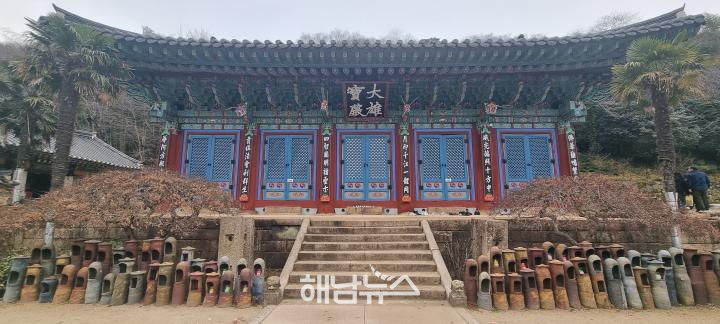
 대흥사 대웅보전 전경 / 사진제공=해남뉴스 |
박충배 편집/칼럼/논설
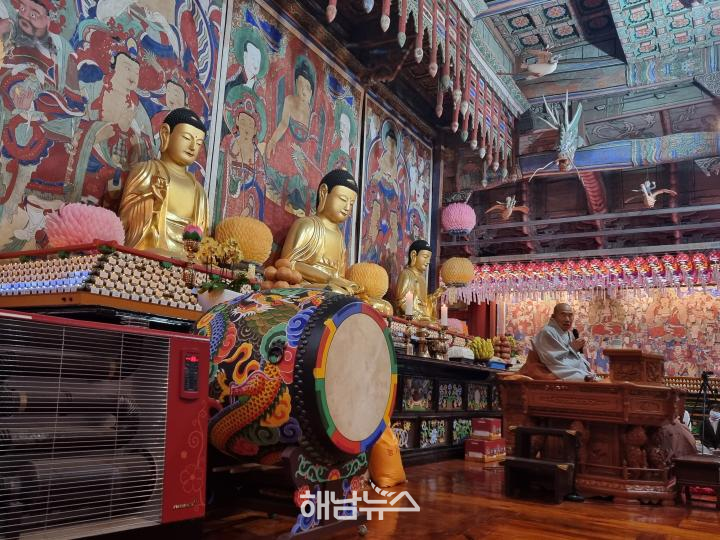
해남 대흥사 대웅보전에 봉안된 보물 제1863호 삼존불(2015.3.4. 지정)은 조선 후기 불상사(佛像史)에서 손꼽히는 ‘이질적 재료의 공존’이라는 독특한 제작 기법으로 학계의 큰 주목을 받아왔다.
이 삼존불의 가장 두드러진 특징은 본존 석가모니불은 적송(赤松)으로 조성, 좌우 협시보살은 은행나무로 조각, 그리고 세 존 모두 몸체 겉면 상당 부분을 흙으로 두텁게 입혀 소조(塑造)적 외형을 완성했다는 점이다.
이는 목조불상과 소조불상의 기법이 복합적으로 적용된 매우 희귀한 사례로, 최근 복장물 조사와 재질 분석을 통해 조성 시기와 제작 의도가 보다 명확하게 밝혀지기 시작했다.
Ⅰ. 조성 시기 — 복장물(腹藏物)이 밝혀낸 연대
대흥사 삼존불의 조성 시기는 오랫동안 정확히 알려지지 않았으나, 복장물에서 확인된 기록과 유물이 결정적 단서를 제공했다.
복장에는 조성 발원문 조각, 사경 조각, 공양물 목록, 조선 후기 특유의 한지 인출 방식 등이 확인되었으며, 이를 통해 18세기 후반~19세기 전반 사이에 제작된 것으로 판단된다.
■ 왜 이 시기에 이러한 혼합 기법이 등장했을까?
조선 후기에 이르면 재목의 부족, 경제적 여건의 제약, 사찰 중창의 반복적 필요.
이 복합적으로 작용해 목조 위에 흙을 얹어 형태를 보완하는 방식이 일부 도입된다.
그러나 대흥사 삼존불처럼 본존·협시가 서로 다른 목재를 사용하고, 다시 흙 입히기 기법이 전면적으로 적용된 경우는 극히 드물다.
이 점에서 대흥사 삼존불은 조선 후기 불상 제작의 과도기적 실험성과 지역 장인의 창의성이 드러난 사례로 평가된다.
Ⅱ. 조형 재료와 기법 — “적송·은행나무·흙”… 세 재료가 만든 하나의 신체
■ 1. 본존불(석가여래) — 적송의 선택
적송은 잘 건조되었을 때 변형이 적고 대형 불상 조형에 유리하며, 남방의 소나무에 비해 결이 고운 편.
이러한 특성 때문에 불신(佛身)의 중심축을 튼튼히 세워야 하는 석가모니본존불에 적합한 재료였다.
그러나 목조 표면만으로 섬세한 법의 문양을 표현하기에는 한계가 있었고, 이에 흙으로 표면을 재조형하는 소조적 마감 기법이 활용되었다.
■ 2. 좌우 협시보살 — 은행나무의 유연성
반면 협시보살상은 은행나무가 사용되었다. 은행목은 조직이 비교적 균질하고, 섬세한 세부 조각에 적합하며, 머리 장식·보관·보살의 부드러운 얼굴 표현에 용이한 목재로 알려져 있다.
이는 곧 삼존불 내부에서도 역할과 성격에 따라 재료를 달리 선택한 매우 치밀한 조형 전략으로 이해된다.
■ 3. 흙 입히기(토립, 塗立) — 목조와 소조의 경계를 허물다
이 삼존불의 가장 중요한 특징은 목심(木心) 위에 흙을 입혀 외형을 마무리한 점이다.
흙은 볼륨감 조절, 법의 주름 표현 강화, 보존과 보수의 용이성을 위해 사용되었다.
특히 흙층이 상당히 두껍게 남아 있는 점은, 장인이 목조 조형보다 소조의 조형미를 더 중시했음을 보여주는 중요한 단서다.
Ⅲ. ‘목조+소조’ 혼합 기법의 의의 — 조선 후기 불상 조형의 마지막 변주
학술적으로 대흥사 삼존불이 갖는 가치는 다음 두 가지로 요약된다.
1) 조선 후기 불상 제작 기법의 실험성과 지역적 다양성
대부분의 조선 후기 불상은 목조 또는 소조 둘 중 한 방식으로 정형화되어 있다.
그러나 이 삼존불은 두 방식을 과감히 결합했다는 점에서 한국 불상 공예의 다양성을 보여주는 흔치 않은 증거가 된다.
이는 당시 대흥사 불사가 지역 장인들의 창의적 기법을 적극 수용했음을 방증한다.
2) 복장물 연구를 통해 드러난 조성 시기와 불사 네트워크
복장물은 당시 대흥사와 인근 사찰의 불사 네트워크, 후원 계층, 장인의 이동과 기술 전승 양상 등을 추적하는 중요한 자료이다.
특히 대흥사 삼존불은 복장물의 구성 방식과 문서 형태가 대표적인 조선 후기 양식을 따르고 있어, 지역 불교사 연구의 핵심 사례로 평가된다.
Ⅳ. 결론 — “재료의 차이가 조화로 승화된 불상”
보물 제1863호 대흥사 대웅보전 삼존불은 단순한 전각 장엄물이 아니다.
그 안에는 목재의 물성, 흙의 조형성, 장인의 기술, 시대적 경제·종교적 조건이 중층적으로 포개져 있다.
적송과 은행나무, 그리고 흙이 만나 하나의 신체를 이룬 이 삼존불은,
한국 불상 조각사에서 보기 드문 “유기적 혼합미의 결정체”이며, 그 자체로 조선 후기의 종교·기술·미학을 고스란히 품은 산 교과서다.
■ 결구 한 줄 요약
“목조와 소조의 경계를 넘어선 조선 후기 장인의 실험정신이, 대흥사 삼존불에 천년의 생명력을 불어넣었다.”
 대흥사 대웅보전 삼존불 / 사진제공=해남뉴스 |
[Haenam = Haenam News] haenamnews@kakao.com
Park Chung-bae | Editorial Writer / Columnist
“A Curious Fusion of Wood and Clay” — The Creation Secret of Treasure No. 1863, the Three Buddhist Statues of Daheungsa’s Daeungbojeon
— A rare experiment in late-Joseon Buddhist sculpture, revisiting its history, technique, and cosmological meaning —
The Three Buddhist Statues enshrined at Daheungsa’s Daeungbojeon Hall—designated Treasure No. 1863 on March 4, 2015—are regarded as one of the most striking examples of “coexistence of disparate materials” in late-Joseon Buddhist sculpture. Their unusual fabrication has drawn significant academic attention.
What makes this triad so remarkable is the fact that
the central Śākyamuni Buddha was carved from red pine,
the attendant bodhisattvas on either side were carved from ginkgo wood, and
all three figures were then covered with a thick layer of clay, creating an exterior surface modeled in the style of sculpted clay (sojo, 塑造).
This combination represents an exceedingly rare hybrid methodology in Korean Buddhist sculpture. Recent analysis of the bokjang (reliquary deposits) and material examinations have clarified both the period of construction and the intent behind this unusual choice.
Ⅰ. Period of Construction — What the Bokjang (腹藏物) Reveals
For many years, the precise construction date of the Daheungsa triad remained unclear. However, the bokjang materials uncovered inside the statues have provided definitive evidence.
Among the items found were:
fragments of a construction vow,
pieces of Buddhist sutra manuscripts,
offerings and donor lists,
and late-Joseon-style handmade paper.
These indicate that the statues were created between the late 18th century and early 19th century.
■ Why did this hybrid technique emerge in this period?
By the late Joseon dynasty, several conditions converged:
shortage of quality timber,
economic constraints,
frequent temple renovations and reconstructions.
These led artisans to adopt a supplementary method in which a wooden core was reinforced or reshaped with clay.
Even so, a case like the Daheungsa triad—where different woods were intentionally selected for the central figure and attendants, and the clay layer was extensively applied to all three—is virtually unparalleled.
Thus, the triad stands as clear evidence of experimental craftsmanship and regional creativity in the transitional period of late-Joseon Buddhist sculpture.
Ⅱ. Materials and Techniques — “Red Pine, Ginkgo, and Clay” Forming a Single Body
1. The Central Buddha (Śākyamuni) — Why Red Pine?
Red pine, when well dried, is
highly stable,
resistant to warping,
suitable for large-scale carving,
and finer in grain than southern pines.
These qualities made it ideal for the central structural body of the principal Buddha.
However, wood alone could not express the subtle folds, drapery, and refined modeling desired by the sculptor. Thus, a clay finishing layer was added to provide the detailed contours.
2. The Attendant Bodhisattvas — The Flexibility of Ginkgo Wood
The two attendant bodhisattvas were carved from ginkgo wood, which is known for:
its uniform and soft texture,
suitability for detailed carving,
exceptional expressiveness in facial features, hands, and ornamental crowns.
This indicates that even within the triad, materials were deliberately selected according to function and iconographic role, reflecting a highly calculated sculptural strategy.
3. Clay Application (Torip, 塗立) — Erasing the Border Between Wood and Clay Sculpture
The most defining feature of the triad is the extensive use of clay over the wooden cores.
Clay allowed artisans to:
adjust volume and mass,
refine drapery folds,
reinforce form,
and facilitate future repairs.
The unusually thick clay layer remaining on the statues reveals that the sculptor placed greater aesthetic emphasis on clay modeling than on pure wood carving.
Ⅲ. The Significance of the Wood–Clay Hybrid Method — The Final Variation of Late-Joseon Sculpture
From an art-historical standpoint, the significance of the Daheungsa triad may be summarized in two key points:
1) Experimental and Regional Diversity in Late-Joseon Buddhist Sculpture
Most late-Joseon statues conform to either:
the wooden-core (mokjo) tradition, or
the clay-modeled (sojo) tradition.
The Daheungsa triad, by boldly uniting the two, serves as crucial evidence of diversity and stylistic variation within Korean Buddhist craftsmanship.
It also demonstrates that the reconstruction projects at Daheungsa were open to innovative, regionally rooted techniques.
2) Bokjang Materials as Evidence of the Temple’s Religious Network
The bokjang artifacts provide insights into:
Daheungsa’s connections with surrounding temples,
patronage patterns,
and the movement and lineage of craftsmen.
The structure and arrangement of the bokjang follow typical late-Joseon formats, making this triad a key source for understanding the religious and artistic landscape of the region at the time.
Ⅳ. Conclusion — “A Sculpture Where Contrasts Converge Into Harmony”
Treasure No. 1863, the Three Buddhist Statues of Daheungsa’s Daeungbojeon, is far more than a ritual ornament.
Embedded within the statues are layers of:
the physical properties of wood,
the expressive flexibility of clay,
the hands of skilled artisans,
and the economic and religious conditions of an era.
Through the union of red pine, ginkgo wood, and clay, the triad emerges as one harmonious body—
a rare masterpiece of blended aesthetics and a living archive of late-Joseon religious art, craftsmanship, and ideology.
■ One-Sentence Summary
“The Daheungsa triad embodies the experimental spirit of late-Joseon artisans, who transcended the boundary between wood and clay to breathe enduring life into these sacred forms.”
 해남뉴스 박충배 편집 및 논설위원 haenamnews@kakao.com