2026.09.21 (월) 10:32



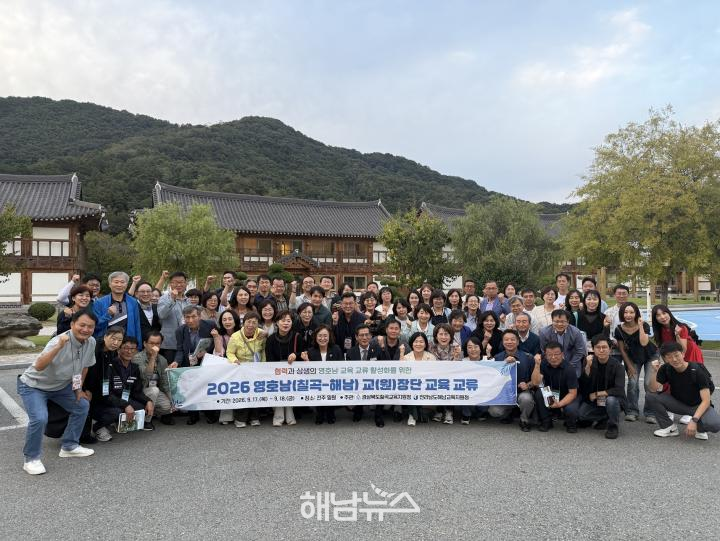 …해남·칠곡, 영호남 넘어 ‘교육동행’ / 사진제공=해남교육지원청 |
“지역은 달라도 학령인구 감소와 지역교육의 지속가능성이라는 고민은 같습니다.”
해남과 경북 칠곡의 교육공동체가 영호남의 지역적 경계를 넘어 학교와 지역이 함께 살아남는 미래교육의 해법을 찾기 위해 머리를 맞댔다.
전남광주통합특별시해남교육지원청과 칠곡교육지원청은 지난 9월 17일부터 18일까지 전주 일원에서 ‘2026 해남-칠곡 영호남 교육교류’를 실시했다.
이번 교류에는 해남 38명과 칠곡 39명 등 모두 77명의 교(원)장과 교육지원청 관계자가 참여했다.
이번 행사는 단순한 친선 교류를 넘어 양 지역이 공통으로 직면한 학령인구 감소와 지역소멸 문제에 대응할 지속가능한 지역교육 모델을 함께 찾는 자리로 마련됐다.
특히 학교별 교육활동과 교육지원청의 정책을 공유하고 각 지역의 우수사례를 학교 현장에 어떻게 적용할 것인지에 초점을 맞췄다.
■ 학령인구 감소 시대, 학교는 어떻게 달라져야 하나
칠곡교육지원청은 학교 규모와 지역 여건 변화에 대응하는 다양한 교육현장 사례를 소개했다.
북산초 고춘식 교장은 읍지역 센터학교로서 다양한 교육수요를 반영하고 지역 교육력을 견인하는 교육과정 운영 사례를 발표했다.
동명중·고 이문경 교장은 중학교와 고등학교 교육과정과 학교 운영을 연계한 ‘중·고 통합학교’ 운영 사례를 소개했다.
학생 수가 줄어드는 지역에서 학교의 기능과 교육과정을 어떻게 유지하고 발전시킬 것인지에 대한 하나의 가능성을 제시한 것이다.
칠곡교육지원청은 학교와 교육지원청, 지역의 여러 기관이 함께 학생을 지원하는 ‘학생맞춤형통합지원’ 운영 사례도 공유했다.
■ 해남 작은학교의 답은 ‘특성화와 연결’
해남교육지원청도 지역 특성과 학교 현장의 실천을 담은 교육사례를 내놓았다.
화산중 김몽주 교장은 해남과 칠곡의 지역적·교육적 여건을 비교·분석하고 두 지역이 안고 있는 공통적인 교육과제와 각각의 강점을 살펴봤다.
이를 바탕으로 일회성 방문에 그치지 않고 학교와 지역이 실질적으로 도움을 주고받을 수 있는 영호남 교육교류의 발전 방향을 제안했다.
어란진초 심지은 교장은 작은학교의 특성을 살린 독서인문교육 사례를 소개했다.
학생들이 책을 단순히 읽는 데 그치지 않고 깊이 읽고 생각하며 질문하는 과정을 통해 스스로 성장하도록 하는 교육활동을 공유했다.
■ ‘학교 하나’가 아니라 ‘지역 전체’를 교육생태계로
해남교육지원청은 학교별 특성화와 학교 간 협력, 지역자원 연계를 통해 지역 전체의 교육력을 높이는 ‘해남형 교육혁신선도지역’ 추진 방향도 소개했다.
핵심은 학령인구 감소를 단순히 학생 수가 줄어드는 위기로만 바라보지 않는 데 있다.
학생 수 감소를 학교와 지역의 교육체제를 새롭게 설계하는 계기로 전환하고, 개별 학교만의 노력에서 벗어나 학교와 학교, 교육지원청, 지역사회가 함께 지속가능한 교육생태계를 구축하자는 것이다.
참가자들은 각 지역의 학교가 가진 특성을 살리면서 지역의 인적·문화적·생태적 자원을 교육과 연결하는 방안을 함께 논의했다.
■ 수목원도, 폐공장도, 한옥마을도 ‘교실’
현장 탐방은 지역에 존재하는 자원을 학교 교육과정과 어떻게 연결할 것인지에 초점이 맞춰졌다.
전주수목원에서는 자연과 생태환경 자체를 학생들의 배움터로 활용하는 방안을 살펴봤다.
숲과 식물, 생태환경 등 지역의 자연자원을 교과와 체험활동에 연결하는 생태전환교육의 가능성을 직접 확인했다.
팔복예술공장에서는 기존 산업시설을 문화·예술공간으로 재생한 사례를 살펴봤다.
특히 학령인구 감소에 따라 학교에서 발생할 수 있는 유휴시설을 지자체 및 지역사회와 연계해 학생과 주민이 함께 이용하는 교육·문화공간으로 전환하는 방안이 관심을 모았다.
학교 공간을 학생들만 사용하는 폐쇄적인 시설이 아니라 지역공동체가 함께 활용하는 교육자산으로 바라볼 필요가 있다는 것이다.
둘째 날 찾은 전주한옥마을에서는 지역의 역사와 전통문화, 건축과 생활문화까지 모두 교육자원이 될 수 있다는 점을 확인했다.
참가자들은 지역 고유의 역사와 이야기를 학교 교육과정에 담아 학생들이 자신이 살아가는 지역을 이해하고 자긍심을 키우도록 하는 지역 기반 인문교육과 지역연계 교육과정의 중요성에도 공감했다.
■ “지역소멸 시대, 교육이 지역을 다시 연결해야”
이번 해남-칠곡 교육교류는 영호남이라는 지역적 경계를 넘어 학령인구 감소와 지역소멸이라는 공통의 문제를 ‘교육’이라는 연결고리로 함께 풀어보려 했다는 점에서 의미를 더했다.
학생 수가 줄어드는 상황에서 모든 학교가 과거와 같은 방식으로 운영되기는 어렵다.
작은학교의 특성화, 학교 간 교육과정 협력, 중·고 통합 운영, 지역자원의 교육과정 연계, 학교 유휴시설의 지역 공동 활용 등 새로운 지역교육 모델에 대한 고민이 필요한 이유다.
조연주 해남교육지원청 교육장은 “해남과 칠곡은 서로 다른 지역이지만 학령인구 감소와 지역교육의 지속가능성이라는 공통의 과제를 안고 있다”며 “이번 교류를 통해 서로의 좋은 교육활동과 정책을 배우고 각 지역의 경험을 새로운 교육의 가능성으로 발전시킬 수 있었다.”고 말했다.
이어 “앞으로도 공감과 상생을 바탕으로 함께 성장하는 영호남 교육동행을 이어가겠다.”고 밝혔다.
“Different Regions, Shared Educational Challenges”…Haenam and Chilgok Build an ‘Educational Partnership’ Beyond Regional Boundaries
77 school principals and education officials participate, sharing school programs and regional education policies
Joint response to declining student populations and regional depopulation…Cases of small schools and integrated middle-high schools shared
Haenam presents its “Education Innovation Leading Region” initiative, focusing on school specialization and local resources
Visits to Jeonju Arboretum and Palbok Art Factory explore ecological and underused spaces as educational resources
“Local history and culture can also become classrooms”…Participants emphasize community-based humanities education and locally connected curricula
Superintendent Cho Yeon-joo: “We will continue this educational partnership based on empathy, cooperation, and shared growth”
[HAENAM=Haenam News] haenamnews@kakao.com
“Although our regions are different, we share the same concerns about declining student populations and the sustainability of local education.”
Education communities from Haenam and Chilgok, North Gyeongsang Province, have joined forces across the traditional regional boundaries of Korea’s Honam and Yeongnam regions to explore solutions for the future of education and the sustainability of local communities.
The Haenam Office of Education and the Chilgok Office of Education held the 2026 Haenam-Chilgok Honam-Yeongnam Educational Exchange in Jeonju from September 17 to 18.
A total of 77 school principals, kindergarten directors, and education office officials participated, including 38 from Haenam and 39 from Chilgok.
The program was designed to go beyond a simple goodwill exchange. Its primary goal was to explore sustainable models for local education in response to challenges shared by both regions, particularly declining student populations and regional depopulation.
Participants shared educational programs from individual schools as well as policies implemented by the two education offices, with a particular focus on how successful practices from each region could be adapted and applied to local schools.
■ How Should Schools Change in an Era of Declining Student Populations?
The Chilgok Office of Education presented a range of examples showing how schools are responding to changes in school size and local conditions.
Ko Chun-sik, principal of Buksan Elementary School, introduced a curriculum model designed to accommodate diverse educational needs while strengthening the school’s role as a central educational hub in the township area.
Lee Moon-kyung, principal of Dongmyeong Middle and High School, presented an integrated middle-high school model that connects the curricula and administration of the two school levels.
The case demonstrated one possible approach to maintaining and improving the role and quality of schools in communities where student populations are declining.
The Chilgok Office of Education also shared its Integrated Student-Centered Support model, in which schools, the education office, and various community organizations work together to provide coordinated support tailored to individual students.
■ Specialization and Connection: A Path Forward for Haenam’s Small Schools
The Haenam Office of Education also presented examples reflecting the region’s distinctive characteristics and educational practices.
Kim Mong-ju, principal of Hwasan Middle School, compared and analyzed the geographical and educational conditions of Haenam and Chilgok, examining both the common challenges facing the two regions and their respective strengths.
Based on this analysis, Kim proposed ways to develop the Honam-Yeongnam educational exchange into a sustainable partnership in which schools and communities can provide practical support and learn from one another, rather than limiting the initiative to one-time visits.
Sim Ji-eun, principal of Eoranjin Elementary School, introduced a reading and humanities education program designed around the strengths of a small school.
The program encourages students not merely to read books, but to read deeply, think critically, ask questions, and grow through the learning process.
■ Turning the Entire Community into an Educational Ecosystem
The Haenam Office of Education also introduced its “Haenam Education Innovation Leading Region” initiative, which aims to strengthen educational capacity across the entire community through school specialization, cooperation among schools, and connections with local resources.
At the heart of the initiative is the idea that a declining student population should not be viewed solely as a crisis.
Instead, demographic change can provide an opportunity to redesign the relationship between schools and their communities and to establish a sustainable educational ecosystem involving schools, the education office, and local organizations.
Participants discussed ways to preserve the unique strengths of individual schools while connecting local human, cultural, and ecological resources with education.
■ Arboretums, Former Factories and Hanok Villages Can All Become Classrooms
Field visits focused on how existing community resources can be incorporated into school curricula.
At the Jeonju Arboretum, participants explored ways of using nature and ecological environments themselves as learning spaces.
They examined the potential of ecological transition education by connecting local forests, plants, and natural environments with classroom subjects and experiential learning activities.
At the Palbok Art Factory, participants studied the transformation of a former industrial facility into a cultural and artistic space.
Particular attention was given to the possibility of transforming underused school facilities, which may increase as student populations decline, into educational and cultural spaces shared by students and local residents in partnership with local governments and communities.
The visit provided an opportunity to rethink school facilities not as isolated spaces used exclusively by students, but as educational assets that can be shared with the broader community.
On the second day, participants visited Jeonju Hanok Village, where they explored how local history, traditional culture, architecture, and everyday life can all serve as educational resources.
Participants agreed on the importance of community-based humanities education and locally connected curricula that incorporate a region’s unique history and stories into school education, helping students better understand the places where they live and develop a stronger sense of local identity and pride.
■ “In an Era of Regional Depopulation, Education Must Reconnect Communities”
The Haenam-Chilgok educational exchange was particularly meaningful because it sought to address the shared challenges of declining student populations and regional depopulation through education, transcending the traditional geographical divide between Honam and Yeongnam.
As student populations continue to decline, it is becoming increasingly difficult for all schools to operate under traditional models.
This underscores the need to explore new approaches to local education, including the specialization of small schools, curriculum cooperation among schools, integrated middle-high school operations, the incorporation of community resources into curricula, and the shared use of underutilized school facilities.
“Haenam and Chilgok are different regions, but we face the same challenges of declining student populations and ensuring the sustainability of local education,” said Cho Yeon-joo, Superintendent of the Haenam Office of Education.
“Through this exchange, we were able to learn from each other’s successful educational programs and policies and turn the experiences of both regions into new possibilities for education,” Cho said.
“We will continue to strengthen this Honam-Yeongnam educational partnership so that both regions can grow together through empathy and cooperation.”
 해남뉴스 박충배 편집/논설 news@hbcnews.kr