| “김 양식은 1년에 5~6개월뿐인데 730일 채우라니”…진도 어업인 소형선박 면허 문턱 개선해야 귀촌 13년 차 김민국 씨 “계절 양식업 특성상 승무일수 충족에 장기간 소요” 해남뉴스 박충배 편집 및 논설위원 news@hbcnews.kr |
| 2026년 07월 27일(월) 15:04 |
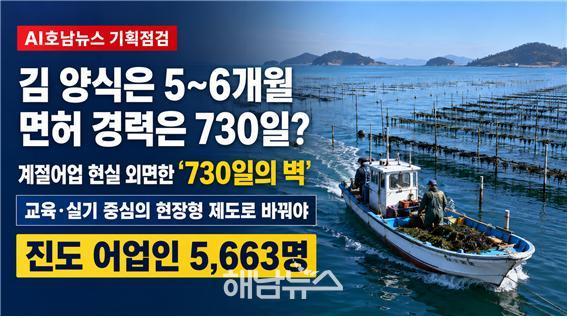 진도 김양식어업 배너 / 사진제공=AI호남뉴스 |
진도군에서 김 양식업에 종사하는 어업인이 소형선박조종사 면허 취득과 유지 과정에서 계절어업의 현실이 제대로 반영되지 않고 있다며 제도 개선을 요구하고 나섰다.
귀촌 13년 차인 김민국 씨는 현재 5톤 미만 선박을 이용해 김 양식업에 종사하고 있다. 김 씨는 “과거에는 현재와 같은 면허 문제가 크게 제기되지 않았지만, 어업 규모를 확대하거나 5톤 이상 선박을 운항하려면 소형선박조종사 면허가 필요하다”며 “면허 취득에 필요한 승무경력 730일을 실제 입·출항 기록으로 증명하려면 계절 양식업자는 지나치게 오랜 시간이 걸린다”고 주장했다.
김 양식업의 실제 조업 기간은 통상 1년에 5~6개월가량이다. 기상 악화와 휴어기, 시설 정비기간 등을 제외하면 매일 출항하는 것도 아니다. 김 씨는 이 같은 현실에서 입·출항일수로만 경력을 산정하면 730일을 채우는 데 8년 이상 걸릴 수도 있다고 호소했다.
진도군의 어업인은 현재 약 5천663명으로 파악되고 있다. 섬이 많고 김·미역·전복 등 양식업 비중이 큰 지역 특성을 고려하면 김 씨의 민원은 개인 한 사람의 문제가 아니라 귀어·귀촌인의 정착과 어업 후계인력 확보에 영향을 미치는 제도적 문제로 볼 필요가 있다.
730일은 누구에게나 똑같이 적용되는가.
관련 법령과 해양수산 당국의 안내를 종합하면 소형선박조종사 면허는 원칙적으로 총톤수 5톤 이상 25톤 미만 선박을 운항할 때 필요한 해기사 면허다.
일반적인 5톤 미만 어선이나 양식장 관리선은 「선박직원법」상 소형선박조종사 면허 적용 대상에서 제외된다. 다만 낚시어선, 다수의 승객을 태우는 선박, 별도의 사업 허가나 안전기준이 적용되는 선박은 크기와 용도에 따라 다른 면허·자격 요건이 적용될 수 있다.
따라서 김 씨가 현재 운항하는 선박이 실제로 5톤 미만 양식장 관리선이라면 소형선박조종사 면허가 법적으로 반드시 필요한 선박인지부터 진도군과 목포지방해양수산청이 정확히 확인해야 한다.
장래에 5톤 이상 선박을 운항하려는 것인지, 현재 선박이 낚시어선 등 별도 규제 대상인지, 양식장 관리선 지정이나 어업허가 과정에서 면허 제출을 요구받은 것인지도 구체적으로 구분해야 한다.
소형선박조종사 시험 응시에는 통상 해당 선박에서 2년 이상의 승무경력이 요구된다. 현장에서는 이를 총 730일의 승무경력이라고 설명한다. 다만 선장으로 신고한 입·출항 기록인지, 일반 선원으로 승선한 기록인지에 따라 경력의 종류와 인정 방식이 달라질 수 있다.
또한 2톤 이상 선박에서 4년 이상 승무한 어업인은 한국해양수산연수원이 실시하는 필기시험 면제교육을 이수한 뒤 정해진 절차에 따라 면허 취득을 추진할 수 있다. 진도군도 과거 지역 어업인을 대상으로 이 같은 필기시험 면제교육을 유치한 사례가 있다.
‘레저면허는 인정된다’는 주장도 정확히 구분해야
동력수상레저기구조종면허 보유자가 일정한 절차를 거쳐 소형선박조종사 한정면허를 발급받을 수 있는 통로가 있는 것은 사실이다.
그러나 이 면허는 레저 목적 등에 사용 범위가 제한된 ‘한정면허’다. 이를 김 양식업이나 낚시어선 등 영업용 선박을 자유롭게 운항할 수 있는 일반 소형선박조종사 면허와 동일한 자격으로 보기는 어렵다.
그럼에도 어업인 입장에서는 레저용 조종경력에는 별도의 전환통로를 열어두면서 생업 현장에서 장기간 배를 운항한 계절어업인에게는 입·출항일수 중심의 경력 증명을 요구하는 것이 형평성에 맞느냐는 문제를 제기할 수 있다.
제도 개선은 레저면허를 그대로 영업용 면허로 인정하는 방식보다 양식업 현장경력, 안전교육, 실기평가를 결합한 별도의 자격경로를 만드는 방향이 타당하다.
면허 취득과 갱신은 다르다
김 씨가 제안한 “의무교육을 이수하면 승무경력을 대신 인정해 달라”는 요구는 면허의 최초 취득과 갱신을 구분해 검토해야 한다.
소형선박조종사 면허의 유효기간은 5년이다. 갱신 신청 전 5년 동안 선박직원으로 1년 이상 승무한 경력이 있으면 경력증명으로 갱신할 수 있다. 승무경력이 없거나 부족하더라도 한국해양수산연수원의 면허 갱신교육을 이수하면 경력서류를 대신할 수 있다.
즉 면허를 이미 보유한 사람의 ‘유지·갱신’에는 교육 대체제도가 마련돼 있다. 진도군은 승무경력이 부족한 어업인에게 이 제도를 적극적으로 안내하고, 진도 현지에서 갱신교육을 받을 수 있도록 교육기관과 협의할 필요가 있다.
반면 면허를 처음 취득하는 사람의 승무경력을 의무교육만으로 전부 대체하려면 「선박직원법」과 시행령 등 국가 법령의 개정이 필요하다. 진도군이 자체 조례만으로 730일 기준을 줄이거나 면제할 수는 없다.
진도군이 당장 할 수 있는 대책
진도군 조례는 국가가 정한 해기사 면허의 응시자격이나 승무경력 기준을 직접 변경할 수 없다. 면허제도는 해양수산부 소관 국가사무이기 때문이다.
하지만 진도군의 귀농어업인 정착지원 제도와 수산업·어업인 지원정책을 활용하거나 별도의 조례를 제정해 다음 사업은 추진할 수 있다.
소형선박조종사 취득·갱신교육의 진도 현지 유치
교육비와 교재비, 건강진단비, 교통·숙박비 지원
고령 어업인을 위한 항해·기관·법규 사전교육 운영
해양수산연수원과 연계한 출장교육·이동교육 실시
어선 입·출항 기록과 승선경력을 통합 관리하는 행정지원 창구 설치
귀어인의 승무경력 확보를 위한 합법적인 현장실습선 운영
양식업 종사자 대상 응급처치·기상판단·기관고장 대응 실습교육
어업인 실태조사를 거쳐 해양수산부에 법령 개정 공동건의
특히 진도군은 김 씨의 선박이 면허 의무 대상인지부터 공식적으로 판정받도록 목포지방해양수산청과 연결해야 한다. 면허가 필요하지 않은 5톤 미만 양식장 관리선인데도 행정기관이나 관련 단체가 관행적으로 면허 제출을 요구했다면 이를 바로잡아야 한다.
필요한 것은 ‘무조건 면제’가 아닌 현장형 검증
해상 안전을 이유로 면허기준을 무작정 낮추는 것은 신중해야 한다. 어선 사고는 충돌·전복뿐 아니라 기상 판단 착오, 기관 고장, 구명장비 미사용 등 여러 원인으로 발생한다.
그러나 안전을 실제 승무일수 하나로만 판단하는 것도 한계가 있다. 같은 730일이라도 어떤 선박에서 무슨 업무를 수행했는지에 따라 운항 능력은 크게 다를 수 있기 때문이다.
현실적인 개선안은 김·미역·전복 등 계절 양식업 종사자를 위한 ‘양식장 관리선 한정 소형선박조종사’ 체계를 마련하는 것이다. 일정 기간의 현장경력에 항해·기관·해상법규·응급처치 교육과 실제 조종능력 평가를 더해 자격을 부여하는 방식이다.
승무경력 산정도 단순 출항일수뿐 아니라 어업허가, 양식장 관리일지, 위판·출하 기록, 어선위치발신장치 자료, 수협과 어촌계의 확인 등을 함께 활용하는 방안을 검토할 수 있다.
다만 서류만으로 경력을 부풀리는 부작용을 막기 위해 해양경찰과 해양교통안전공단, 수협, 지자체가 공동으로 사실관계를 검증해야 한다.
김민국 씨는 “안전 문제의 답은 바다와 양식장 현장에 있다”며 “어업인의 생업을 막는 기준이 아니라 안전교육과 실기능력을 제대로 확인하는 제도로 바뀌어야 한다”고 말했다.
진도군과 진도군의회는 5천663명 어업인을 대상으로 면허 취득·갱신 애로사항을 조사하고, 현지교육 지원 조례 또는 기존 귀농어업인 지원조례의 지원 범위를 보완해야 한다. 동시에 전남광주통합특별시와 함께 해양수산부에 계절어업 승무경력 산정 개선과 양식업 한정면허 도입을 공식 건의할 필요가 있다.
면허기준을 낮추는 것만이 규제개혁은 아니다. 현장 경험과 안전교육, 실기능력을 합리적으로 연결해 생업과 안전을 함께 지키는 것이 진정한 제도 개선이다.
“Seaweed Farming Lasts Only Five to Six Months a Year—How Are We Supposed to Log 730 Days?” Jindo Fishers Call for Easier Access to Small Vessel Operator Licenses
Kim Min-guk, a return-to-rural resident of 13 years, says seasonal aquaculture makes it extremely difficult to meet the required service period.
Applicants for a Small Vessel Operator License are generally required to have at least two years of sea service.
Fishers with four years of service aboard vessels of two gross tons or more may use an examination-exemption training program.
License holders lacking sufficient sea service may renew their licenses by completing designated refresher training.
Ordinary aquaculture management vessels under five gross tons are generally exempt from the licensing requirement.
Conversion from a powered water-leisure craft license results in a restricted license that must be distinguished from a commercial-use license.
Jindo County cannot relax national licensing standards through a local ordinance, but it can support training, transportation and field-based education.
“The government should recognize seasonal fishing experience, introduce a restricted license for aquaculture vessels and reform the national system.”
【Jindo=AI Honam News】 aihnnews@kakao.com
A seaweed farmer in Jindo County has called for institutional reform, arguing that the current process for obtaining and maintaining a Small Vessel Operator License fails to reflect the realities of seasonal fisheries.
Kim Min-guk, who moved to the countryside 13 years ago, currently operates a vessel of less than five gross tons for seaweed farming.
“In the past, licensing requirements like these were not a major issue,” Kim said. “However, anyone wishing to expand their fishing operation or operate a vessel of five gross tons or more must obtain a Small Vessel Operator License. For seasonal aquaculture workers, proving the required 730 days of sea service through actual port-entry and departure records takes far too long.”
Seaweed farming generally operates for only five to six months a year. Even during that period, fishers cannot sail every day because of bad weather, closed seasons and equipment maintenance.
Kim said that under such conditions, meeting the 730-day requirement solely through recorded sailing days could take more than eight years.
Jindo County currently has approximately 5,663 people engaged in fisheries. Given the county’s many islands and its heavy dependence on seaweed, kelp and abalone farming, Kim’s complaint should not be viewed as an isolated personal matter. It is a structural issue that could affect the settlement of people returning to fishing communities and the recruitment of future fishery workers.
Does the 730-Day Requirement Apply Equally to Everyone?
According to relevant laws and guidance from maritime authorities, a Small Vessel Operator License is generally required to operate a vessel of five gross tons or more but less than 25 gross tons.
Ordinary fishing boats and aquaculture management vessels of less than five gross tons are excluded from the Small Vessel Operator License requirements under the Ship Officers Act.
However, different licensing and qualification requirements may apply depending on the vessel’s size and purpose, particularly to recreational fishing boats, vessels carrying a large number of passengers and vessels subject to separate business permits or safety regulations.
If Kim’s vessel is, in fact, an aquaculture management vessel of less than five gross tons, Jindo County and the Mokpo Regional Office of Oceans and Fisheries should first determine whether a Small Vessel Operator License is legally required for that vessel.
Authorities must also clarify whether Kim intends to operate a vessel of five gross tons or more in the future, whether his current vessel falls into a separately regulated category such as a recreational fishing boat, or whether a license has been requested as part of an aquaculture-management vessel designation or fishing permit process.
Applicants for the Small Vessel Operator License are generally required to have at least two years of service aboard an eligible vessel. This is commonly described in the field as a total of 730 days of sea service.
However, the type of service and the method used to recognize it may differ depending on whether a person was registered as the vessel’s master in port-entry and departure records or served as an ordinary crew member.
Fishers with four or more years of service aboard vessels of at least two gross tons may pursue the license through a written-examination exemption course administered by the Korea Institute of Maritime and Fisheries Technology.
Jindo County has previously hosted this type of examination-exemption training for local fishers.
Claims That “Recreational Licenses Are Recognized” Require Clarification
It is true that holders of powered water-leisure craft operator licenses may obtain a restricted Small Vessel Operator License through a prescribed procedure.
However, that license is restricted to specified purposes, including recreational use. It should not be regarded as equivalent to a general Small Vessel Operator License permitting the unrestricted commercial operation of seaweed-farming vessels or recreational fishing boats.
Nevertheless, fishers may reasonably question whether the current system is fair. A separate conversion route is available to people with recreational boating qualifications, while seasonal fishers who have operated boats for years as part of their livelihoods are required to prove their experience mainly through recorded days of departure and arrival.
Rather than recognizing a recreational license as a full commercial qualification, reform should create a separate licensing pathway combining aquaculture field experience, safety education and practical operating assessments.
Obtaining a License and Renewing One Are Different Matters
Kim’s proposal—that mandatory training should be allowed to substitute for sea-service requirements—must be considered differently for first-time license acquisition and license renewal.
A Small Vessel Operator License is valid for five years. A license holder may renew it by proving at least one year of service as a ship officer during the five years preceding the renewal application.
If the holder lacks sufficient sea service or cannot prove it, the service documentation may be replaced by completing license-renewal training provided by the Korea Institute of Maritime and Fisheries Technology.
In other words, an education-based alternative already exists for maintaining and renewing a license.
Jindo County should actively inform fishers with insufficient service records about this option and work with the relevant training institution to make renewal courses available locally in Jindo.
For first-time applicants, however, replacing the entire sea-service requirement with mandatory training would require amendments to national legislation, including the Ship Officers Act and its Enforcement Decree.
Jindo County cannot reduce or waive the 730-day requirement through a local ordinance alone.
Measures Jindo County Can Take Immediately
Because maritime licensing is administered by the Ministry of Oceans and Fisheries as a national responsibility, a Jindo County ordinance cannot directly alter eligibility or sea-service requirements for maritime licenses.
Nevertheless, the county can use its programs supporting returning farmers and fishers, as well as its broader fisheries policies, or enact a separate ordinance to implement the following measures:
Host local courses in Jindo for obtaining and renewing Small Vessel Operator Licenses.
Subsidize training fees, textbooks, medical examinations, transportation and accommodation.
Offer preparatory courses in navigation, marine engineering and maritime law for older fishers.
Arrange visiting or mobile training in cooperation with the Korea Institute of Maritime and Fisheries Technology.
Establish an administrative support desk to integrate vessel entry and departure records with documented sea service.
Operate lawful onboard training programs to help new fishers accumulate qualifying experience.
Provide practical training in first aid, weather assessment and engine-failure response for aquaculture workers.
Survey local fishers and jointly petition the Ministry of Oceans and Fisheries for legislative reform.
Jindo County should first help Kim obtain an official determination from the Mokpo Regional Office of Oceans and Fisheries as to whether his vessel is legally subject to the licensing requirement.
If an administrative agency or related organization has routinely demanded a license for an aquaculture management vessel under five gross tons, even though the law does not require one, that practice should be corrected.
What Is Needed Is Field-Based Assessment, Not an Unconditional Exemption
Any proposal to simply lower licensing standards in the name of regulatory reform must be considered carefully.
Fishing-vessel accidents result not only from collisions and capsizing but also from poor weather judgment, engine failure and failure to use lifesaving equipment.
However, judging maritime safety solely by the number of recorded sea-service days also has limitations. Two people may each have 730 days of service but possess very different operating abilities depending on the vessels they served on and the duties they performed.
A realistic solution would be to establish a “restricted Small Vessel Operator License for aquaculture management vessels” for seasonal workers in seaweed, kelp and abalone farming.
The qualification could combine a specified period of field experience with education in navigation, marine engineering, maritime law and emergency first aid, followed by a practical vessel-operating assessment.
Sea-service calculations could also take into account fishing permits, aquaculture management logs, sales and shipment records, vessel-position transmitter data, and verification by fisheries cooperatives and fishing-village associations, instead of relying solely on recorded sailing days.
To prevent the fraudulent inflation of service records, however, the facts should be jointly verified by the Korea Coast Guard, the Korea Maritime Transportation Safety Authority, fisheries cooperatives and local governments.
“The answer to maritime safety lies at sea and at aquaculture sites,” Kim said. “The system should not obstruct fishers’ livelihoods. It should properly assess safety training and practical operating ability.”
Jindo County and the Jindo County Council should survey all 5,663 local fishers to identify difficulties related to license acquisition and renewal.
They should also consider adopting a local ordinance supporting on-site license training or expanding the scope of the county’s existing ordinance supporting people returning to farming and fishing communities.
At the same time, Jindo County should work with the Jeonnam-Gwangju Special Metropolitan City government to formally request that the Ministry of Oceans and Fisheries improve the calculation of sea-service experience for seasonal fishers and introduce a restricted license for aquaculture operations.
Lowering licensing standards is not, by itself, regulatory reform. Genuine reform means connecting field experience, safety education and practical ability in a reasonable way so that both livelihoods and maritime safety can be protected.
 해남뉴스 박충배 편집 및 논설위원 news@hbcnews.kr