| 홍범도 장군은 왜 총을 들었나…일본인이 아니라 ‘일본 제국주의’에 맞선 독립전쟁 평민 포수 출신으로 1907년 의병투쟁에 나서 해남뉴스 박충배 편집 및 논설위원 news@hbcnews.kr |
| 2026년 07월 27일(월) 14:02 |
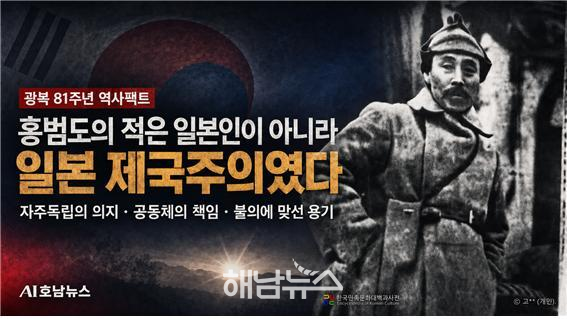 홍범도 장군 / 사진제공=AI호남뉴스 |
홍범도 장군은 특정 정치세력이나 이념을 위해 싸운 인물이 아니라, 일본 제국주의에 빼앗긴 나라를 되찾기 위해 평생을 바친 무장독립운동가다. 그의 생애를 제대로 이해하려면 오늘날의 정치적 기준을 과거에 그대로 적용하기보다, 국권이 무너지고 독립운동가들이 중국과 러시아를 떠돌아야 했던 시대적 조건부터 살펴야 한다.
평민 포수에서 항일 의병장으로
홍범도는 1868년 평안도 지역에서 태어났다. 어린 시절 부모를 잃고 군인·노동자·승려 생활 등을 거쳤으며, 이후 산포수로 활동한 것으로 알려져 있다.
산포수는 험한 산악지형을 익히고 사격술과 생존능력을 갖춘 사람들이었다. 홍범도가 훗날 일본군을 상대로 뛰어난 유격전을 펼칠 수 있었던 배경에는 이러한 경험이 있었다.
1905년 일본은 을사늑약을 강요해 대한제국의 외교권을 빼앗았다. 1907년에는 고종을 강제로 퇴위시키고 대한제국 군대를 해산했다. 같은 시기 일제의 총포 단속은 포수들의 생업과 무장능력까지 위협했다.
홍범도는 1907년을 전후해 포수들을 중심으로 의병부대를 조직하고 함경도와 평안도 일대에서 일본군 수비대와 경찰기관, 일제의 통치시설을 공격했다. 이는 단순한 생계형 저항이 아니라 국권 침탈에 맞선 무장투쟁이었다.
3·1운동 이후 ‘의병’에서 ‘독립군’으로
1910년 일제의 강제병합으로 대한제국이 국권을 완전히 잃자 국내에서 대규모 무장투쟁을 이어가기는 어려워졌다. 홍범도는 중국과 러시아 연해주 일대로 이동해 독립군을 양성했다.
1919년 3·1운동을 계기로 독립운동이 다시 확산되자 홍범도는 대한독립군을 이끌고 두만강을 건너 국내로 진입하는 국내진공작전을 전개했다. 독립군은 일제의 군사·행정기관을 공격한 뒤 다시 국경 밖으로 이동하는 유격전술을 활용했다.
그가 지휘한 부대는 신분과 출신보다 독립이라는 공동목표를 중시했다. 충분한 군수품과 국가의 지원이 없는 상황에서도 동포사회의 모금과 주민들의 도움으로 항일전쟁을 이어갔다.
봉오동전투, 독립군도 일본 정규군을 이길 수 있음을 보여주다
1920년 6월 일본군은 독립군을 추격해 중국 영토인 봉오동으로 진입했다. 이에 홍범도의 대한독립군과 최진동의 군무도독부, 안무의 국민회군 등 여러 독립군 부대가 연합해 일본군을 봉오동 골짜기로 유인했다.
독립군은 지형을 이용해 고지에 매복한 뒤 일본군을 집중 공격했다. 봉오동전투는 독립군 연합부대가 일본 정규군을 상대로 거둔 대표적인 승리였다. 국사편찬위원회는 이 전투가 독립군에게 ‘독립전쟁의 제1회전’으로 인식될 만큼 중요한 사건이었다고 설명한다.
다만 일본군 사상자 수는 독립군 측 기록과 일본군 측 보고가 서로 다르다. 따라서 특정 숫자를 절대적인 사실로 단정하기보다는, 서로 다른 사료를 비교해야 한다. 그럼에도 일본군이 중국 국경을 넘어 독립군을 추격하다 큰 타격을 입고 물러났다는 전투의 역사적 의미는 분명하다.
청산리전투와 일본군의 보복
봉오동 패배 이후 일본은 대규모 병력을 간도지역에 투입해 독립군을 토벌하려 했다. 1920년 10월 김좌진의 북로군정서군을 비롯한 독립군 부대들은 청산리 일대에서 일본군과 여러 차례 전투를 벌였다.
홍범도가 지휘한 부대도 청산리 일대 전투에 참여했다. 청산리전투는 어느 한 사람이나 한 부대가 단독으로 이룬 승리가 아니라, 여러 독립군 부대와 현지 동포사회가 함께 만들어낸 연합항전이었다.
일본군은 독립군을 근절한다는 명분으로 간도지역의 한인 마을을 공격하고 민간인을 학살했다. 이를 흔히 ‘간도참변’ 또는 ‘경신참변’이라고 부른다. 따라서 홍범도의 무장투쟁은 당시 일본군의 국경 침범과 민간인 탄압이라는 현실 속에서 이해해야 한다.
자유시참변 책임자라는 주장은 신중하게 검증해야
독립군은 일본군의 대대적인 토벌을 피해 러시아 자유시 지역으로 이동했다. 그러나 러시아 내전과 한인 무장부대들의 지휘권 갈등, 소련 당국의 통합정책이 얽히면서 1921년 자유시참변이 발생했다.
일부에서는 홍범도가 자유시참변에 직접 가담해 독립군을 공격했다는 주장을 제기한다. 그러나 현재 확인되는 자료만으로 그를 참변의 기획자나 학살 책임자로 단정하기는 어렵다.
홍범도가 사건 이후 조사위원으로 참여한 사실과 참변 자체를 지휘했다는 주장은 구분해야 한다. 당시 독립군 내부에는 여러 계파가 존재했고, 러시아 적군과 극동공화국 당국의 정책까지 복잡하게 얽혀 있었다. 역사적 책임은 구체적인 명령계통과 행위를 입증하는 사료에 따라 판단해야 한다.
소련 공산당 가입을 어떻게 봐야 하나
홍범도는 이후 소련 사회 안에서 생활했고 1927년 소련 공산당에 가입했다. 이 사실만 떼어내 그를 대한민국의 체제를 부정한 인물로 규정하는 것은 시대착오적인 해석이 될 수 있다.
당시는 대한민국 정부가 수립되기 전이었다. 독립운동가들은 중국 국민당 정부, 소련, 미국, 유럽 등 국제사회의 지원을 얻기 위해 다양한 외교·군사 노선을 선택했다. 사회주의 계열 독립운동가들도 일제 식민지배에서 벗어나려는 민족해방을 주요 목표로 삼았다.
홍범도의 소련 공산당 가입에는 그의 정치적 인식과 함께 소련에서 살아가야 했던 망명자의 현실도 작용했을 가능성이 있다. 이를 평가하려면 가입 사실뿐 아니라 구체적인 활동과 행적을 함께 살펴야 한다.
현재까지 확인된 홍범도의 중심 행적은 일본 제국주의에 맞선 무장독립투쟁이다. 해방 이후 북한 정권이나 북한군에 참여한 경력은 있을 수 없다. 그는 광복을 보지 못한 채 1943년 세상을 떠났다.
소련에서도 보호받지 못했던 독립군 장군
1937년 스탈린 정권은 연해주에 살던 고려인들을 중앙아시아로 강제이주시켰다. 일본의 첩자가 섞여 있을 수 있다는 집단적 의심이 주요 명분이었다. 홍범도도 이때 카자흐스탄 크즐오르다로 쫓겨났다.
그는 말년에 고려극장의 수위 등으로 생활하다 1943년 75세로 숨졌다. 소련 체제에 몸담았다는 이유만으로 그를 소련 권력의 수혜자처럼 묘사하기 어렵다. 오히려 그는 스탈린 체제의 강제이주정책으로 고향에서 더욱 멀어진 피해자이기도 했다.
홍범도의 유해는 2021년 카자흐스탄에서 국내로 봉환돼 국립대전현충원에 안장됐다. 대한민국 정부는 1962년 건국훈장 대통령장을 추서했고, 2021년 건국훈장 대한민국장을 추가로 추서했다.
일본과의 관계, ‘민족감정’보다 식민지배 책임으로 봐야
홍범도가 맞서 싸운 대상은 일본인이라는 민족 전체가 아니었다. 대한제국의 주권을 빼앗고 한반도를 식민지로 지배한 일본 제국주의 국가권력과 군대가 그의 적이었다.
오늘날 한일관계 역시 이 원칙에서 출발해야 한다.
일본 국민 전체를 적대하거나 과거의 원한을 세습하는 것은 홍범도의 독립정신을 올바르게 계승하는 길이라고 보기 어렵다. 그러나 미래지향적 협력을 이유로 강제동원, 일본군 ‘위안부’, 문화재 약탈, 식민지배와 민간인 학살의 책임까지 덮어서도 안 된다.
건강한 한일관계는 망각 위에서 만들어지는 것이 아니라 다음과 같은 토대 위에서 가능하다.
일본 정부가 식민지배와 전쟁범죄의 역사적 사실을 인정할 것
피해자의 명예와 권리를 존중할 것
역사교과서 왜곡과 침략전쟁 미화를 중단할 것
독도에 대한 부당한 영유권 주장을 철회할 것
시민·문화·경제 교류는 확대하되 국가주권과 역사정의는 지킬 것
과거를 기억하는 것과 현재의 일본 시민을 증오하는 것은 전혀 다른 문제다. 일본 사회 안에서도 침략전쟁을 반성하고 한일 시민연대를 실천해 온 사람들이 있다. 우리는 일본 제국주의의 책임과 오늘날 일본 국민 개개인을 구분하는 성숙한 역사인식을 가져야 한다.
후손들이 홍범도에게서 배워야 할 것
첫째는 신분을 넘어선 책임감이다. 홍범도는 권력이나 재산을 가진 지배층이 아니었다. 평범한 노동자이자 포수였지만 나라가 위기에 처하자 자신의 능력을 공동체를 위해 사용했다.
둘째는 현장을 아는 지도력이다. 그는 병사들과 같은 환경에서 생활하며 산악지형과 주민사회의 정보를 활용했다. 지도자의 권위는 직책이나 말이 아니라 책임과 실천에서 나온다는 사실을 보여준다.
셋째는 연대와 통합의 정신이다. 봉오동전투의 승리는 홍범도 한 사람의 영웅담이 아니라 여러 독립군 부대가 힘을 합친 결과였다. 분열을 넘어 공동목표를 세우는 능력이 국가적 위기를 극복하는 힘이 됐다.
넷째는 국제정세를 활용하는 현실적 지혜다. 나라를 잃은 독립운동가들에게 완벽한 지원국이나 안전한 망명지는 없었다. 홍범도는 중국과 러시아를 오가며 독립전쟁을 이어갔다. 오늘날에도 외교는 어느 강대국에 무조건 기대는 것이 아니라 국익과 자주성을 지키는 방향으로 전개돼야 한다.
다섯째는 역사를 정치적 편의에 따라 재단하지 않는 태도다. 독립운동가의 삶을 현재의 진영논리에 맞춰 영웅 또는 반역자로 단순화하면 역사의 복잡한 실체를 잃게 된다. 공적은 공적으로, 잘못이 확인되면 잘못으로 평가하되 반드시 사료와 검증을 근거로 해야 한다.
홍범도의 총구가 향했던 곳을 기억해야
홍범도 장군의 삶에는 봉오동의 승리만 있었던 것이 아니다. 나라를 잃은 슬픔, 독립군 내부의 분열, 자유시참변의 좌절, 스탈린 정권의 강제이주, 타국에서 맞은 죽음도 함께 있었다.
그를 기리는 일은 동상이나 흉상을 세우는 데 그쳐서는 안 된다. 강대국의 침략 앞에서 주권을 지키고, 사실에 근거해 역사를 판단하며, 사회적 약자도 나라의 주인이 될 수 있는 공동체를 만드는 것이 진정한 계승이다.
홍범도는 일본인에 대한 증오를 남긴 사람이 아니라 일본 제국주의의 지배에 굴복하지 않았던 사람이다. 우리 후손들이 본받아야 할 것도 증오가 아니라 자주독립의 의지, 공동체에 대한 책임, 불의한 권력에 맞서는 용기다.
그의 생애를 어느 한 이념의 칸에 가두는 순간 역사는 다시 정치의 도구가 된다. 홍범도 장군은 좌우의 소유물이 아니라, 나라를 빼앗긴 시대에 총을 들고 독립을 선택했던 대한민국 독립운동사의 주인공으로 기억돼야 한다.
[AI호남뉴스 광복 81주년 역사팩트]
“홍범도의 적은 일본인이 아니라 일본 제국주의였다”…봉오동 영웅의 삶을 다시 읽다
평민 포수 출신 홍범도, 1907년부터 항일 의병투쟁 전개
1919년 대한독립군 이끌고 국내진공작전…무장독립전쟁 본격화
1920년 봉오동전투 승리…독립군 연합부대의 전투력 입증
청산리 일대 전투에도 참여…일본군의 간도 독립군 토벌에 맞서
일본군 피해 규모는 자료마다 달라…숫자보다 전투의 역사적 의미 살펴야
‘자유시참변 주도자’ 주장은 사료상 확인 어려워…조사위원 참여와 구분해야
소련 공산당 가입만으로 독립운동 전체를 부정하는 것은 시대착오
1937년 스탈린 정권의 고려인 강제이주로 카자흐스탄에 정착
“일본 국민과 일본 제국주의 구분하되 식민지배 책임까지 지워서는 안 돼”
2026년 8월 15일은 대한민국이 일제 식민지배에서 벗어난 지 81주년을 맞는 날이다.
광복 81주년을 맞아 우리가 다시 물어야 할 것은 단순히 “누가 영웅인가”가 아니다. 나라를 빼앗겼을 때 누가 저항했고, 어떤 희생을 치렀으며, 그 역사를 오늘의 정치적 이해에 따라 왜곡하거나 축소하고 있지는 않은지 사실에 근거해 살펴야 한다.
그 중심에 평민 포수 출신으로 봉오동전투를 이끈 홍범도 장군이 있다.
홍범도는 특정 정당이나 이념을 위해 일본군과 싸운 인물이 아니다. 대한제국의 주권을 빼앗고 한반도를 식민지로 지배한 일본 제국주의에 맞서 독립전쟁을 벌인 무장독립운동가였다.
그의 생애를 오늘날의 좌우 진영논리만으로 재단하면 국권을 잃은 독립운동가들이 중국과 러시아를 떠돌며 생존과 투쟁을 이어가야 했던 당시의 역사적 조건을 놓치게 된다.
평민 포수에서 항일 의병장으로
홍범도는 1868년 평안도에서 태어났다. 어린 시절 부모를 잃고 군인과 노동자, 승려 생활 등을 거친 뒤 산포수로 활동한 것으로 전해진다.
산포수들은 산악지형에 익숙했고 사격술과 생존능력을 갖추고 있었다. 홍범도가 훗날 일본군을 상대로 산악 유격전을 펼칠 수 있었던 배경에도 이러한 경험이 있었다.
1905년 일본은 을사늑약을 강요해 대한제국의 외교권을 빼앗았다. 1907년에는 고종을 강제로 퇴위시키고 대한제국 군대를 해산했다.
일제가 추진한 총포 단속은 포수들의 생계수단을 빼앗는 동시에 조선인의 무장능력을 제거하려는 식민지배 과정의 하나였다.
홍범도는 1907년을 전후해 포수들을 중심으로 의병부대를 조직했다. 이후 함경도와 평안도 일대에서 일본군 수비대와 경찰기관, 일제의 통치시설을 공격하며 항일 무장투쟁을 전개했다.
이는 단순히 사냥총을 지키기 위한 저항이 아니었다. 일본의 국권 침탈과 군대 해산, 식민지화를 막기 위한 의병전쟁이었다.
3·1운동 이후 ‘의병’에서 ‘독립군’으로
1910년 일제의 강제병합으로 대한제국이 국권을 완전히 잃자 국내에서 대규모 무장투쟁을 계속하기 어려워졌다.
홍범도는 중국과 러시아 연해주 일대로 이동해 독립군을 양성했다. 1919년 3·1운동을 계기로 국내외 독립운동이 다시 확산하자 대한독립군을 이끌며 무장투쟁을 본격화했다.
홍범도 부대는 두만강을 건너 국내로 진입해 일제의 군사·행정기관을 공격한 뒤 국경 밖으로 이동하는 국내진공작전을 펼쳤다.
독립군에게는 안정적인 국가예산이나 군수지원 체계가 없었다. 무기와 식량, 의복 상당 부분을 중국과 러시아 지역 한인사회의 지원에 의존해야 했다.
홍범도의 독립전쟁은 한 사람의 영웅적 능력만으로 이뤄진 것이 아니다. 이름조차 남기지 못한 독립군 병사들과 군자금을 모으고 식량을 제공한 동포사회의 희생이 함께 만든 투쟁이었다.
봉오동전투, 독립군도 일본 정규군을 이길 수 있음을 보여주다
1920년 6월 일본군은 독립군을 추격해 중국 영토인 봉오동으로 진입했다.
이에 홍범도의 대한독립군과 최진동의 군무도독부, 안무가 이끄는 국민회군 등 여러 독립군 부대가 연합했다. 독립군은 봉오동 골짜기 주변 고지에 매복한 뒤 일본군을 안쪽으로 유인해 집중 공격했다.
봉오동전투는 독립군 연합부대가 일본 정규군을 상대로 거둔 대표적인 승리였다. 국사편찬위원회는 봉오동전투가 독립군에게 ‘독립전쟁의 제1회전’으로 인식될 만큼 중요한 사건이었다고 설명한다.
이 전투는 나라를 잃고 국경 밖으로 밀려난 독립군도 지형과 전술, 부대 간 협력을 활용하면 일본 정규군을 물리칠 수 있다는 사실을 보여줬다.
팩트체크 ① 일본군 피해 규모는 확정된 숫자인가
그렇지 않다.
봉오동전투의 일본군 사상자 규모는 독립군 측 기록과 중국 측 자료, 일본군 보고서가 서로 다르다. 일부 자료는 일본군 사상자를 수백 명 규모로 기록하지만 일본 측 기록은 이를 훨씬 적게 제시한다.
전쟁 당사자가 작성한 기록에는 전과를 확대하거나 피해를 축소할 가능성이 있다. 따라서 특정 숫자만을 절대적 사실로 제시하기보다 서로 다른 사료의 작성 주체와 목적을 함께 살펴야 한다.
다만 일본군이 중국 국경을 넘어 독립군을 추격하다 봉오동에서 상당한 타격을 입었고, 독립군 연합부대가 전술적 승리를 거뒀다는 역사적 의미까지 부정할 수는 없다. 국사편찬위원회 우리역사넷
청산리전투와 일본군의 간도지역 보복
봉오동전투 이후 일본은 대규모 병력을 간도지역에 투입해 독립군을 토벌하려 했다.
1920년 10월 김좌진의 북로군정서군을 비롯한 여러 독립군 부대는 청산리 일대에서 일본군과 연속적으로 전투를 벌였다. 홍범도가 지휘한 부대도 청산리 일대 전투에 참여했다.
청산리전투 역시 한 사람이나 한 부대가 단독으로 이룬 승리가 아니었다. 여러 독립군 부대의 연합작전과 현지 한인사회의 지원으로 만들어진 항일전쟁이었다.
일본군은 독립군을 토벌한다는 명분으로 간도지역 한인 마을을 공격하고 수많은 주민을 살해했다. 이를 ‘간도참변’ 또는 ‘경신참변’이라고 부른다.
홍범도의 무장투쟁을 평가할 때는 일본군이 중국 영토까지 침범해 독립군을 추격하고 민간인 사회에 보복했던 사실도 함께 살펴야 한다.
자유시참변 책임자라는 주장은 사실인가
봉오동·청산리전투 이후 독립군은 일본군의 대대적인 토벌을 피해 러시아 자유시 지역으로 이동했다.
그러나 러시아 내전과 한인 무장부대 사이의 지휘권 갈등, 소련 측의 독립군 통합정책이 복잡하게 얽히면서 1921년 자유시참변이 발생했다. 한인 무장세력 사이에 충돌이 벌어졌고 독립군 다수가 희생되거나 체포·해산됐다.
팩트체크 ② 홍범도가 자유시참변을 주도했나
홍범도를 자유시참변의 기획자 또는 독립군 학살 책임자로 단정할 만한 명확한 사료는 확인되지 않는다.
홍범도가 사건 이후 조사위원으로 참여한 사실은 알려져 있다. 그러나 사건 이후 조사 과정에 참여한 것과 참변을 사전에 기획하거나 공격을 직접 지휘했다는 것은 전혀 다른 문제다.
자유시참변은 러시아 내전, 극동공화국과 소련 당국의 정책, 한인 무장세력 내부의 주도권 다툼이 얽힌 복합적인 사건이다.
역사적 책임을 규명하려면 누가 어떤 명령을 내렸고, 실제 공격과 체포 과정에서 어떤 역할을 했는지를 사료로 입증해야 한다. 정치적 목적에 따라 조사위원 참여 사실만으로 홍범도에게 참변 전체의 책임을 씌우는 것은 신중하지 못한 해석이다.
소련 공산당 가입만으로 공산주의자인가
홍범도는 자유시참변 이후에도 소련에서 생활했고 1927년 소련 공산당에 가입했다.
이 사실만을 근거로 그의 평생에 걸친 항일독립운동을 부정하거나 대한민국의 정체성을 부정한 인물로 규정하는 것은 당시 시대상황을 충분히 반영하지 못한 평가다.
팩트체크 ③ 소련 공산당 가입은 대한민국에 대한 반역인가
홍범도가 공산당에 가입한 1927년에는 대한민국 정부가 수립되기 전이었다. 대한민국 정부는 광복 이후인 1948년 수립됐다.
나라를 잃은 독립운동가들은 중국과 러시아, 미국과 유럽 등지에서 독립운동을 전개했다. 일부는 민족주의를, 일부는 사회주의를 독립운동의 방법과 사상으로 받아들였다.
사회주의 계열 독립운동가 가운데 상당수도 일차적인 목표를 일제 식민지배로부터의 민족해방에 두고 있었다. 소련 지역에서 살아가던 홍범도의 공산당 가입 역시 그의 정치적 인식뿐 아니라 망명지에서의 생존과 활동 조건을 함께 검토해야 한다.
그가 해방 이후 북한 정권이나 북한군에서 활동했다는 주장은 성립할 수 없다. 홍범도는 광복을 보지 못한 채 1943년 세상을 떠났다.
공산당 가입 사실은 역사적 사실로 기록하되, 그것만으로 1907년부터 이어진 항일 의병투쟁과 봉오동전투의 공적까지 지우는 것은 사실에 근거한 역사평가가 아니다.
소련의 특혜가 아니라 강제이주의 피해자
1937년 스탈린 정권은 연해주 일대에 살던 고려인들을 중앙아시아로 강제이주시켰다. 일본 첩자가 침투할 수 있다는 집단적 의심이 강제이주의 주요 명분으로 이용됐다.
홍범도도 이때 카자흐스탄 크즐오르다로 강제이주됐다. 그는 말년에 고려극장의 수위 등으로 생활하다 1943년 75세로 숨졌다.
홍범도가 소련 사회에서 살았다는 이유만으로 소련 권력의 특혜를 누린 인물처럼 묘사해서는 안 된다. 그 역시 스탈린 정권의 민족 강제이주정책으로 삶의 터전을 빼앗긴 고려인 피해자였다.
대한민국 정부는 1962년 홍범도에게 건국훈장 대통령장을 추서했다. 2021년에는 카자흐스탄에 묻혀 있던 유해가 국내로 봉환돼 국립대전현충원에 안장됐고 건국훈장 대한민국장이 추가로 추서됐다. 한국민족문화대백과사전
홍범도가 싸운 대상은 ‘일본 국민’ 아닌 ‘일본 제국주의’
홍범도가 총을 들고 싸운 대상은 일본인이라는 민족 전체가 아니었다.
대한제국의 외교권과 군사권을 빼앗고 한반도를 강제로 병합한 일본 제국주의 국가권력과 군대가 그의 적이었다.
과거 일본 제국주의의 침략책임을 묻는 것과 오늘날 일본 국민 전체를 적대하는 것은 구분해야 한다. 일본 사회 안에도 침략전쟁과 식민지배를 반성하고 한일 시민연대를 실천해 온 사람들이 있다.
그러나 미래지향적 한일관계를 내세워 강제동원과 일본군 ‘위안부’, 문화재 약탈, 역사교과서 왜곡, 독도 영유권 주장 등의 문제를 덮어서도 안 된다.
건강한 한일관계는 과거를 지우는 데서 출발하지 않는다. 일본 정부가 식민지배의 역사적 사실과 책임을 인정하고 피해자의 명예를 존중할 때 지속 가능한 화해와 협력도 가능하다.
일본 국민과 교류하되 일본 제국주의의 침략을 잊지 않는 것, 경제·문화협력을 확대하되 국가주권과 역사정의를 포기하지 않는 것이 광복 81주년에 필요한 한일관계의 원칙이다.
후손들이 홍범도에게 배워야 할 다섯 가지
첫째는 나라와 공동체에 대한 책임감이다.
홍범도는 권력이나 재산을 가진 지배층이 아니었다. 가난한 평민이자 포수였지만 나라가 위기에 처하자 자신이 가진 사격술과 산악 경험을 독립전쟁에 사용했다.
둘째는 말보다 실천하는 지도력이다.
그는 병사들과 같은 환경에서 생활하며 전투현장을 지켰다. 지도자의 권위는 직책이나 구호가 아니라 위험을 함께 감당하는 책임에서 나온다는 사실을 보여준다.
셋째는 분열을 넘어서는 연대다.
봉오동전투의 승리는 대한독립군만의 전과가 아니었다. 여러 독립군 부대가 공동의 목표 아래 힘을 합쳤기 때문에 가능했다. 오늘날에도 지역과 세대, 이념을 넘어 공동체의 위기를 해결하는 연대가 필요하다.
넷째는 강대국에 의존하지 않는 자주외교다.
독립운동가들에게 중국과 러시아를 비롯한 주변국은 지원을 구해야 할 대상이었지만 언제나 믿을 수 있는 보호자는 아니었다. 자유시참변과 고려인 강제이주는 강대국이 자국의 이해에 따라 약소민족을 희생시킬 수 있음을 보여준다.
다섯째는 사실에 근거해 역사를 판단하는 태도다.
독립운동가의 삶을 현재의 정치적 필요에 맞춰 영웅 또는 반역자로 단순화해서는 안 된다. 공적은 공적으로 평가하고 잘못이 확인되면 비판하되, 모든 판단은 구체적인 사료와 학술적 검증을 토대로 해야 한다.
광복은 어느 날 갑자기 주어진 선물이 아니었다
1945년 8월 15일 일본의 패전으로 한반도는 식민지배에서 벗어났다. 그러나 광복은 일본이 스스로 베푼 선물이 아니었다.
홍범도를 비롯한 의병과 독립군, 3·1운동에 참여한 민중, 대한민국임시정부와 한국광복군, 국내외에서 저항한 수많은 독립운동가의 희생이 광복의 역사적 토대를 만들었다.
국제전쟁에서 연합국이 일본을 패배시킨 사실과 우리 민족이 수십 년 동안 독립운동을 이어온 사실은 서로 대립하지 않는다. 국제정세의 변화가 해방을 가져온 직접적인 조건이었다면, 독립운동은 우리가 일본의 식민지배를 인정하지 않았고 독립국가를 세울 의지와 정당성을 갖고 있었음을 증명한 역사였다.
홍범도 장군의 삶에는 봉오동의 승리만 있었던 것이 아니다. 국권 상실과 망명, 독립군 내부의 분열, 자유시참변의 좌절, 스탈린 정권의 강제이주와 타국에서 맞은 죽음도 함께 있었다.
그를 기리는 일은 흉상과 훈장을 둘러싼 정치적 논쟁에 머물러서는 안 된다.
역사를 사실대로 기록하고, 강대국 앞에서 국가주권을 지키며, 평범한 국민도 나라의 주인으로 존중받는 공동체를 만드는 것이 홍범도의 독립정신을 계승하는 길이다.
홍범도는 일본인에 대한 증오를 남긴 사람이 아니다. 일본 제국주의의 지배에 굴복하지 않은 독립군 장군이었다.
광복 81주년을 맞은 후손들이 그에게서 배워야 할 것은 증오가 아니라 자주독립의 의지, 공동체에 대한 책임, 불의한 권력에 맞서는 용기다.
역사를 정치적 편의에 따라 잘라내는 순간 독립운동은 다시 진영의 도구가 된다. 홍범도 장군은 어느 한쪽의 소유물이 아니라 나라를 빼앗긴 시대에 독립을 선택하고 실천했던 대한민국 독립운동사의 주인공으로 기억돼야 한다
15s 동안 처리함
The attached text contains two substantially overlapping versions. Below is the English translation of the final, expanded AI Honam News article, with duplicated passages consolidated.
[AI Honam News: Historical Fact-Check for the 81st Anniversary of Liberation]
“Hong Beom-do’s Enemy Was Not the Japanese People, but Japanese Imperialism”…Revisiting the Life of the Hero of Bongodong
Hong Beom-do, a commoner and hunter, launched an anti-Japanese righteous army struggle in 1907
Led the Korean Independence Army in cross-border operations from 1919
Victory at Bongodong in 1920 demonstrated the strength of united independence forces
Also fought around Cheongsanri against Japanese military campaigns in Jiandao
Japanese casualty figures differ among sources and require careful verification
Historical records do not substantiate claims that Hong orchestrated the Free City Incident
Dismissing his entire independence struggle because he joined the Soviet Communist Party is historically anachronistic
Forcibly relocated to Kazakhstan under Stalin’s deportation of ethnic Koreans in 1937
“The Japanese people must be distinguished from Japanese imperialism, but colonial responsibility must not be erased”
【Haenam·Seoul=AI Honam News】 aihnnews@kakao.com
August 15, 2026, marks the 81st anniversary of Korea’s liberation from Japanese colonial rule.
On this anniversary, the question we must revisit is not simply, “Who was a hero?” We must examine the historical record to determine who resisted when the nation was taken, what sacrifices they made, and whether their history is being distorted or diminished to serve present-day political interests.
At the center of this discussion stands General Hong Beom-do, a commoner and hunter who led Korean independence forces at the Battle of Bongodong.
Hong did not fight the Japanese military for a particular political party or ideology. He was an armed independence fighter who waged war against Japanese imperialism, which had stripped the Korean Empire of its sovereignty and colonized the Korean Peninsula.
Judging his life solely through today’s ideological divisions risks ignoring the historical circumstances in which stateless independence fighters had to survive and continue their struggle while moving through China and Russia.
From Commoner and Hunter to Anti-Japanese Righteous Army Commander
Hong Beom-do was born in the Pyeongan region in 1868. Orphaned at an early age, he reportedly worked as a soldier and laborer, spent time as a Buddhist monk, and later became a mountain hunter.
Such hunters were familiar with rugged terrain and skilled in marksmanship and wilderness survival. These experiences later helped Hong conduct effective mountain guerrilla warfare against Japanese forces.
In 1905, Japan imposed the Eulsa Treaty and deprived the Korean Empire of its diplomatic sovereignty. In 1907, Japan forced Emperor Gojong to abdicate and disbanded the Korean imperial army.
Japan’s firearms-control campaign not only deprived hunters of their livelihoods but also formed part of a broader colonial effort to eliminate the Korean people’s capacity for armed resistance.
Around 1907, Hong organized a righteous army largely composed of hunters. He attacked Japanese garrisons, police facilities and colonial administrative institutions across Hamgyeong and Pyeongan provinces.
This was not merely resistance by hunters seeking to protect their firearms. It was an armed struggle against Japan’s seizure of Korean sovereignty, disbandment of the Korean military and colonization of the country.
From a Righteous Army to an Independence Army
After Japan forcibly annexed Korea in 1910, it became increasingly difficult to sustain large-scale armed resistance within the country.
Hong moved to China and the Russian Maritime Province, where he trained independence fighters. After the March First Movement of 1919 revived the independence struggle at home and abroad, he led the Korean Independence Army and intensified armed operations.
Hong’s forces crossed the Tumen River into Korea, attacked Japanese military and administrative installations, and then withdrew across the border using guerrilla tactics.
The independence fighters had neither a stable national budget nor an established military supply system. They relied heavily on Korean communities in China and Russia for weapons, food and clothing.
Hong’s independence war was not the achievement of one heroic commander alone. It was made possible by unnamed soldiers and overseas Korean communities that raised funds and supplied food.
Bongodong Proved That Independence Fighters Could Defeat Japan’s Regular Army
In June 1920, Japanese troops crossed into Chinese territory while pursuing Korean independence forces.
Several Korean units formed a united force, including Hong Beom-do’s Korean Independence Army, Choi Jin-dong’s Military Affairs Command and An Mu’s National Association Army. The independence fighters took positions on the high ground surrounding the Bongodong Valley, drew the Japanese troops deeper inside and launched a concentrated attack.
The Battle of Bongodong became a landmark victory by united Korean independence forces over Japan’s regular army. The National Institute of Korean History explains that independence fighters regarded it as important enough to call it “the first engagement of the War of Independence.”
The battle demonstrated that even an independence army driven beyond its national borders could defeat regular Japanese troops by employing terrain, strategy and cooperation among units.
Fact-Check ① Is There a Definitive Figure for Japanese Casualties?
No.
Records from Korean independence forces, Chinese sources and Japanese military reports provide different casualty figures. Some sources report hundreds of Japanese casualties, while Japanese records cite far lower numbers.
Wartime records may exaggerate victories or understate losses. Rather than presenting one figure as an absolute fact, researchers must consider who created each record and for what purpose.
Nevertheless, these numerical disputes do not erase the battle’s historical significance: Japanese troops crossed the Chinese border in pursuit of the independence army, suffered substantial losses at Bongodong and were tactically defeated by the united Korean forces.
The Battle of Cheongsanri and Japanese Reprisals in Jiandao
Following its defeat at Bongodong, Japan deployed large numbers of troops to Jiandao in an attempt to eliminate the Korean independence army.
In October 1920, several independence units—including Kim Jwa-jin’s Northern Military Administration Office Army—fought a series of engagements against Japanese forces around Cheongsanri. Units commanded by Hong Beom-do also participated.
The Battle of Cheongsanri was not the victory of one person or one unit. It was an anti-Japanese campaign made possible by cooperation among several armed units and support from local Korean communities.
Under the pretext of suppressing the independence movement, Japanese troops attacked Korean villages in Jiandao and killed large numbers of civilians. These atrocities are commonly known as the Jiandao Massacre or the Gyeongsin Massacre.
Any assessment of Hong’s armed struggle must therefore also consider Japan’s violation of Chinese territory, its pursuit of Korean independence fighters and its reprisals against civilian communities.
Was Hong Beom-do Responsible for the Free City Incident?
After the battles of Bongodong and Cheongsanri, the independence forces moved toward Svobodny—known to Koreans as “Free City”—in Russia to escape Japan’s massive suppression campaign.
In 1921, however, the Russian Civil War, conflicts over command among Korean armed groups and Soviet efforts to integrate the units culminated in the Free City Incident. Armed Korean factions clashed, and many independence fighters were killed, arrested or disbanded.
Fact-Check ② Did Hong Beom-do Orchestrate the Free City Incident?
No definitive historical evidence has been identified that would justify describing Hong as the planner of the incident or as the person responsible for massacring independence fighters.
Hong is known to have served on an investigative committee after the incident. Participation in a subsequent investigation, however, is entirely different from planning the incident in advance or directly commanding the attack.
The Free City Incident was a complex event involving the Russian Civil War, policies of the Far Eastern Republic and Soviet authorities, and internal struggles for leadership among Korean armed groups.
Determining historical responsibility requires evidence showing who issued which orders and what roles they played in the actual attacks and arrests. Assigning responsibility for the entire incident to Hong solely because he later served on an investigative committee is not a sufficiently cautious historical interpretation.
Does Membership in the Soviet Communist Party Define Him as a Communist?
Hong continued to live in the Soviet Union after the Free City Incident and joined the Soviet Communist Party in 1927.
Using this fact alone to deny his lifelong anti-Japanese struggle or portray him as someone who rejected the identity of the Republic of Korea fails to account for the historical conditions of the period.
Fact-Check ③ Was Joining the Soviet Communist Party an Act of Treason Against the Republic of Korea?
When Hong joined the party in 1927, the government of the Republic of Korea had not yet been established. The Republic of Korea was founded in 1948, following liberation.
Stateless Korean independence activists operated in China, Russia, the United States and Europe. Some embraced nationalism, while others accepted socialism as an ideology or method for pursuing independence.
For many socialist-affiliated independence fighters, the primary objective was national liberation from Japanese colonial rule. Hong’s decision to join the Soviet Communist Party should therefore be examined in the context of both his political views and the conditions required to survive and operate in Soviet territory.
Claims that he later served the North Korean regime or the North Korean military are chronologically impossible. Hong died in 1943, two years before liberation and five years before the establishment of the two Korean governments.
His party membership should be recorded as a historical fact. But using it to erase his anti-Japanese righteous army struggle from 1907 onward and his achievements at Bongodong is not a fact-based historical assessment.
Not a Beneficiary of Soviet Privilege, but a Victim of Forced Deportation
In 1937, Stalin’s government forcibly deported ethnic Koreans living in the Russian Far East to Central Asia. Collective suspicion that Japanese spies might have infiltrated the Korean community was used as a major justification.
Hong was deported to Kyzylorda, Kazakhstan. In his final years, he worked in such positions as a caretaker at the Korean Theatre. He died in 1943 at the age of 75.
Hong should not be portrayed as a privileged beneficiary of Soviet power simply because he lived in Soviet society. He was himself a victim of Stalin’s forced deportation policy, which drove ethnic Koreans even farther from their homeland.
The South Korean government posthumously awarded him the Presidential Medal of the Order of Merit for National Foundation in 1962. His remains were repatriated from Kazakhstan in 2021 and interred at Daejeon National Cemetery. He was also posthumously awarded the Republic of Korea Medal, the highest class of the Order of Merit for National Foundation.
Hong Fought Japanese Imperialism, Not the Japanese People as a Whole
Hong did not take up arms against the Japanese as an entire ethnic population.
His enemy was the imperial Japanese state and military that deprived the Korean Empire of its diplomatic and military sovereignty and forcibly annexed the Korean Peninsula.
Holding Japanese imperialism accountable for its aggression must be distinguished from treating all present-day Japanese citizens as enemies. There have also been people within Japanese society who reflected on the history of invasion and colonialism and worked to promote solidarity between Korean and Japanese citizens.
At the same time, calls for a future-oriented relationship must not be used to bury unresolved issues such as forced labor, the Japanese military “comfort women,” the looting of cultural heritage, textbook distortions and Japan’s territorial claims over Dokdo.
A healthy Korea-Japan relationship does not begin by erasing the past. Sustainable reconciliation and cooperation are possible only when the Japanese government acknowledges the historical facts and responsibilities of colonial rule and respects the dignity of its victims.
The principle required on the 81st anniversary of liberation is clear: expand exchanges with Japanese citizens without forgetting Japanese imperial aggression, and strengthen economic and cultural cooperation without abandoning national sovereignty or historical justice.
Five Lessons Future Generations Should Learn from Hong Beom-do
First is responsibility toward the nation and the community.
Hong was not a member of the ruling class and possessed neither political power nor wealth. He was a poor commoner and hunter who used his marksmanship and mountain experience in the struggle for independence when his country faced destruction.
Second is leadership expressed through action rather than words.
He lived under the same conditions as his soldiers and remained on the battlefield. His example shows that a leader’s authority comes not from rank or slogans, but from accepting danger and responsibility alongside others.
Third is solidarity beyond division.
The victory at Bongodong did not belong solely to the Korean Independence Army. It became possible because several armed groups united around a common objective. Korea today also needs solidarity across regions, generations and ideologies to overcome shared crises.
Fourth is independent diplomacy that does not rely unconditionally on great powers.
For Korean independence activists, neighboring powers such as China and Russia were potential sources of assistance but were never consistently reliable protectors. The Free City Incident and the forced deportation of ethnic Koreans demonstrate how great powers may sacrifice smaller peoples for their own interests.
Fifth is the willingness to judge history on the basis of facts.
The life of an independence fighter should not be simplified into that of either a hero or a traitor to satisfy present-day political needs. Achievements should be recognized, and verified wrongdoing should be criticized, but every judgment must rest on specific historical records and scholarly examination.
Liberation Was Not a Gift That Suddenly Arrived
Japan’s defeat on August 15, 1945, freed the Korean Peninsula from colonial rule. Liberation, however, was not a gift voluntarily given by Japan.
The sacrifices of Hong Beom-do and other righteous army fighters, independence soldiers, participants in the March First Movement, the Provisional Government of the Republic of Korea, the Korean Liberation Army and countless resistance activists at home and abroad created the historical foundation for liberation.
The Allied defeat of Japan and the Korean people’s decades-long independence movement are not mutually exclusive historical facts. Changes in the international war created the immediate conditions for liberation, while the independence movement demonstrated that Koreans had never accepted Japanese colonial rule and possessed both the will and legitimacy to establish an independent state.
Hong’s life included more than the victory at Bongodong. It also contained the loss of national sovereignty, exile, division within the independence movement, the tragedy of the Free City Incident, forced deportation under Stalin and death in a foreign land.
Honoring him should not be reduced to political controversy over statues, busts or decorations.
The true continuation of Hong’s independence spirit lies in recording history truthfully, defending national sovereignty before great powers and building a society in which ordinary people are respected as the owners of the nation.
Hong Beom-do did not leave behind a legacy of hatred toward the Japanese people. He was an independence army commander who refused to submit to Japanese imperial rule.
On the 81st anniversary of liberation, future generations should inherit not hatred, but the will for national independence, responsibility toward the community and the courage to resist unjust power.
The moment history is cut apart for political convenience, the independence movement once again becomes a tool of factional politics. General Hong Beom-do belongs neither to the political left nor the right. He should be remembered as a central figure in the history of Korea’s independence movement—one who chose and acted for independence when his country had been taken from its people.
 해남뉴스 박충배 편집 및 논설위원 news@hbcnews.kr