| 폭염경보 속 해남 밭일하던 태국인 노동자 숨져…온열질환 여부 조사 25일 오후 3시15분께 해남군 황산면 밭길에서 발견 해남뉴스 박충배 편집 및 논설위원 news@hbcnews.kr |
| 2026년 07월 26일(일) 12:37 |
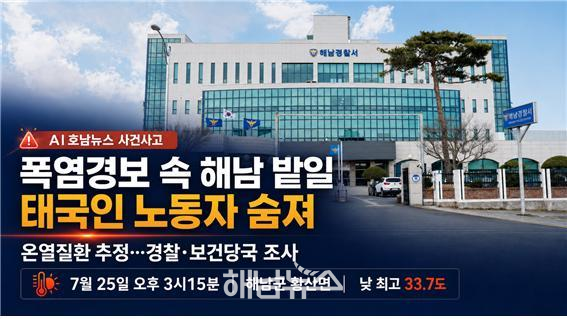 해남온열환자 배너 / 사진제공=AI호남뉴스 |
폭염경보가 내려진 전남광주통합특별시 해남군에서 밭일을 하던 태국 국적의 30대 이주노동자가 어지럼증을 호소한 뒤 쓰러져 숨졌다.
전남광주통합특별시소방본부와 경찰·보건당국, 복수의 언론 보도를 종합하면 사고는 지난 25일 오후 3시15분께 해남군 황산면의 한 밭길에서 발생했다.
태국 국적의 30대 남성 A씨는 사고 당일 밭에서 작업하던 중 어지럼증을 호소한 것으로 전해졌다. 이후 휴식을 취하기 위해 집으로 향하다가 밭길에서 쓰러진 채 발견됐다.
신고를 받고 출동한 119구급대는 의식이 없는 A씨에게 현장 응급처치를 실시한 뒤 인근 병원으로 긴급 이송했으나 A씨는 끝내 숨졌다.
사고 당일 해남지역에는 폭염경보가 발효돼 있었으며 낮 최고기온은 33.7도까지 올랐다. 기온과 습도, 직사광선, 작업 강도 등을 고려하면 실제 밭 작업현장의 체감온도는 기상관측 지점의 기온보다 더 높았을 가능성이 있다.
다만 A씨의 발견 당시 체온과 구체적인 활력징후, 작업 시작 시각과 휴식 횟수 등은 아직 공개되지 않았다.
소방당국 “의식 없는 상태로 병원 이송”
이번 사고와 관련해 현장 출동 및 이송 사실을 확인한 기관은 소방청 본청이 아니라 전남광주통합특별시소방본부다.
소방당국은 A씨가 의식이 없는 상태로 발견돼 병원으로 긴급 이송됐지만 숨졌다고 밝혔다. 그러나 소방당국은 현장 응급처치와 환자 이송을 담당하는 기관으로, 최종적인 의학적 사망 원인을 판정하지는 않는다.
따라서 폭염경보가 내려진 상황에서 A씨가 밭일을 했다는 정황만으로 사인을 ‘열사병’으로 확정해서는 안 된다. 발견 당시 체온과 병원 진료기록, 기존 질환, 사후 검사 결과 등을 종합한 의료진과 보건당국의 판단이 필요하다.
경찰·보건당국 “온열질환 가능성 조사”
경찰과 보건당국은 A씨가 온열질환으로 숨졌을 가능성이 있다고 보고 정확한 사망 경위를 조사하고 있다.
경찰은 A씨가 언제부터 밭일을 했는지, 어지럼증을 호소한 뒤 어떤 조치가 이뤄졌는지, 쓰러진 시점과 발견 시각 사이에 얼마나 시간이 흘렀는지 등을 확인할 것으로 보인다.
함께 일한 사람과 고용주 등의 진술을 토대로 작업 과정과 귀가 동선을 확인하고, 외상이나 범죄 관련성 등 다른 사망 가능성이 있는지도 살펴봐야 한다.
현재까지 경찰은 부검 실시 여부나 고용주 입건 여부, 범죄 혐의점 유무 등에 관한 구체적인 조사 결과를 공식적으로 발표하지 않았다.
보건당국은 의료기록과 역학조사 결과를 검토해 A씨를 질병관리청 온열질환 응급실감시체계상 사망자로 분류할지를 판단하게 된다.
A씨가 온열질환 사망자로 최종 분류되면 올해 전남광주 지역에서 확인된 첫 온열질환 사망 사례가 된다.
지난 5월15일부터 7월24일까지 전남광주 지역에서는 모두 98명의 온열질환자가 발생한 것으로 집계됐다. 전국에서는 같은 기간 1천232명의 온열질환자와 6명의 사망자가 보고됐다. 다만 관련 통계는 조사와 최종 판정 과정에서 달라질 수 있다.
현재까지 확인된 사실
현재까지 확인된 내용을 종합하면 이번 사고는 2026년 7월25일 오후 3시15분께 해남군 황산면의 한 밭길에서 발생했다.
숨진 사람은 태국 국적의 30대 남성 A씨다. A씨는 폭염 속에서 밭일을 하던 중 어지럼증을 호소했고, 휴식을 취하기 위해 집으로 돌아가던 길에 쓰러진 것으로 파악됐다.
A씨는 의식이 없는 상태로 발견됐다. 신고를 받고 출동한 119구급대가 응급처치를 실시하며 병원으로 이송했으나 결국 숨졌다.
당시 해남지역에는 폭염경보가 내려져 있었으며 낮 최고기온은 33.7도를 기록했다. 경찰과 보건당국은 이러한 기상 상황과 A씨가 쓰러지기 전 보인 어지럼증 등을 토대로 온열질환 가능성을 조사하고 있다.
그러나 A씨의 사망 원인이 열사병을 비롯한 온열질환으로 최종 확정된 것은 아니다. 발견 당시 체온과 병원 진료기록, 사후 검사 및 역학조사 결과가 공개되지 않았기 때문에 현 단계에서는 ‘온열질환 추정 사망’ 또는 ‘온열질환 여부 조사’라고 표현하는 것이 정확하다.
부검 실시 여부와 구체적인 사망 원인, A씨의 체류 및 고용 형태, 작업 시작 시각과 노동시간, 휴식 횟수, 물과 그늘 막 제공 여부도 아직 공식적으로 확인되지 않았다.
노동당국이 산업재해 해당 여부를 조사하고 있는지, 사업주 또는 작업 지시자를 상대로 폭염 안전조치 이행 여부를 확인했는지도 추가로 밝혀져야 한다.
개인 질환인가, 폭염 속 노동재해인가
이번 사고는 단순히 개인의 건강 문제만으로 다뤄서는 안 된다. A씨가 임금을 받고 고용돼 밭일을 했다면 폭염 속 노동환경과 안전관리 책임도 함께 조사해야 한다.
경찰과 노동당국은 실질적인 고용주와 작업 지시자가 누구인지, 폭염경보가 발효된 상황에서도 가장 더운 시간대에 작업하도록 했는지, 물과 휴식시간 및 그늘진 장소를 제공했는지 확인해야 한다.
특히 A씨가 작업 중 어지럼증을 호소했는데도 혼자 귀가하도록 했는지, 증상을 확인한 직후 작업을 중단하고 119에 신고했는지도 중요한 조사 대상이다.
고용노동부는 2026년 폭염 대응지침을 통해 사업주가 노동자에게 물과 바람, 휴식 등 기본적인 예방조치를 제공하고 온열질환 의심 증상이 나타나면 즉시 작업을 중단한 뒤 응급조치를 하도록 안내하고 있다.
질병관리청은 온열질환을 고온 환경에 장시간 노출돼 두통과 어지럼증, 근육경련, 피로감, 의식저하 등이 나타나는 급성질환으로 규정한다. 이 가운데 열사병은 체온조절 기능이 무너지면서 장기 손상과 사망으로 이어질 수 있는 가장 위험한 질환이다.
이번 사건을 단순히 ‘더위에 쓰러진 외국인’으로 처리해서는 안 된다. 경찰과 보건당국뿐 아니라 노동당국과 해남군도 고용관계와 작업환경, 휴식 제공 및 응급대응 과정을 면밀히 조사하고 그 결과를 투명하게 공개해야 한다.
[AI Honam News — Accident Report]
Thai Farmworker Dies While Working in Haenam Under Heatwave Warning…Authorities Investigate Possible Heat-Related Illness
Found on a farm road in Hwangsan-myeon, Haenam County, at around 3:15 p.m. on July 25
Thai man in his 30s transported to hospital unconscious but later pronounced dead
Reportedly complained of dizziness while working and collapsed on his way home to rest
Haenam recorded a daytime high of 33.7°C under a heatwave warning
Fire authorities provided emergency treatment and transported him to hospital; cause of death remains under investigation
Police and health authorities are investigating whether a heat-related illness caused his death
If officially classified, it would be the first heat-related death recorded in the Jeonnam–Gwangju region this year
“Employment status, working hours, rest provisions and compliance with heat-safety measures must be thoroughly investigated”
【HAENAM=AI HONAM NEWS】 aihnnews@kakao.com
A Thai migrant farmworker in his 30s died after reportedly complaining of dizziness and collapsing while working in a field in Haenam County, Jeonnam–Gwangju Integrated Special City, where a heatwave warning was in effect.
According to the Jeonnam–Gwangju Integrated Special City Fire Headquarters, police and health authorities, and multiple media reports, the incident occurred on a farm road in Hwangsan-myeon, Haenam County, at around 3:15 p.m. on July 25.
The man, identified only as A, reportedly began feeling dizzy while working in a field. He was later found collapsed on a farm road while heading home to rest.
Emergency responders dispatched to the scene administered first aid and rushed the unconscious man to a nearby hospital. He was subsequently pronounced dead.
A heatwave warning was in effect across Haenam at the time, and the daytime high reached 33.7°C. Considering the humidity, direct sunlight and intensity of the work, the temperature experienced in the field may have been higher than that recorded at the official weather station.
However, authorities have not disclosed A’s body temperature or detailed vital signs at the time he was found. His work starting time, total working hours and number of rest breaks also remain unknown.
Fire authorities: “Transported to hospital while unconscious”
The agency that confirmed the emergency response and hospital transport was the Jeonnam–Gwangju Integrated Special City Fire Headquarters, not the National Fire Agency’s headquarters.
Fire authorities said A was found unconscious and transported urgently to a hospital, where he later died. The fire service is responsible for emergency treatment and patient transportation, but it does not make the final medical determination of a person’s cause of death.
The circumstances—that A had been working in a field while a heatwave warning was in effect—are therefore insufficient to conclude that he died of heatstroke.
Medical personnel and health authorities must assess his body temperature when found, hospital records, underlying medical conditions and any post-mortem examination results before determining the cause of death.
Police and health authorities investigate possible heat-related illness
Police and health authorities are investigating the exact circumstances of A’s death, including the possibility that it resulted from a heat-related illness.
Police are expected to establish when A began working, what measures were taken after he complained of dizziness, and how much time elapsed between his collapse and discovery.
Investigators must also question coworkers and the employer to reconstruct A’s work activities and route home, while examining whether there were any injuries, criminal circumstances or other possible causes of death.
Police have not yet officially disclosed whether an autopsy will be conducted, whether the employer has been booked for questioning, or whether any evidence of criminal wrongdoing has been identified.
Health authorities will review A’s medical records and epidemiological findings before deciding whether to classify his death under the Korea Disease Control and Prevention Agency’s heat-related illness surveillance system.
If A is officially classified as having died from a heat-related illness, his death would be the first such fatality recorded in the Jeonnam–Gwangju region this year.
Between May 15 and July 24, the region recorded 98 patients with heat-related illnesses. Nationwide, 1,232 patients and six deaths were reported over the same period. These figures may change as investigations and final classifications proceed.
Facts confirmed so far
The incident occurred at around 3:15 p.m. on July 25, 2026, on a farm road in Hwangsan-myeon, Haenam County.
The deceased was a Thai man in his 30s. He reportedly complained of dizziness while working in a field under extreme heat and collapsed while returning home to rest.
A was found unconscious. Paramedics administered emergency treatment and transported him to a hospital, but he died.
A heatwave warning was in effect in Haenam at the time, and the daytime high reached 33.7°C. Based on the weather conditions and A’s reported dizziness before collapsing, police and health authorities are investigating whether a heat-related illness was responsible.
However, his death has not yet been officially attributed to heatstroke or any other heat-related illness. His body temperature when found, hospital records, post-mortem findings and epidemiological investigation results have not been released.
At this stage, the case should therefore be described as a “suspected heat-related death” or as a death “under investigation for a possible heat-related illness.”
It has also not been officially confirmed whether an autopsy will be conducted, what the precise medical cause of death was, or what A’s immigration and employment status was.
His working hours, rest periods and access to drinking water, shade and an appropriate rest area also remain unknown.
Authorities must additionally clarify whether labor officials are investigating the case as a potential occupational accident and whether the employer or work supervisor complied with required heat-safety measures.
An individual medical event or a heat-related workplace death?
The incident should not be treated solely as an individual health problem. If A was employed and paid to perform farm labor, investigators must also examine working conditions and responsibility for workplace safety during the heatwave.
Police and labor authorities should identify the actual employer and person directing the work. They must determine whether A was required to continue working during the hottest part of the day despite the heatwave warning and whether drinking water, rest breaks and a shaded resting place were provided.
It is particularly important to determine whether A was allowed to walk home alone after complaining of dizziness and whether work was stopped and emergency services contacted as soon as his symptoms became known.
Under the Ministry of Employment and Labor’s 2026 heatwave response guidelines, employers are instructed to provide workers with water, ventilation or cooling, and adequate rest. They are also required to stop work immediately and take emergency action when a worker shows symptoms of heat-related illness.
The Korea Disease Control and Prevention Agency defines heat-related illnesses as acute conditions caused by prolonged exposure to high temperatures. Symptoms may include headache, dizziness, muscle cramps, fatigue and loss of consciousness.
Heatstroke is the most dangerous form of heat-related illness. It occurs when the body’s temperature-regulation system fails and can result in organ damage and death.
This case must not be dismissed simply as that of “a foreign worker who collapsed in the heat.” Police, health and labor authorities, as well as Haenam County, should thoroughly investigate A’s employment relationship, working conditions, access to rest and the emergency response—and publicly disclose their findings.
 해남뉴스 박충배 편집 및 논설위원 news@hbcnews.kr