| 민형배“지방자치법 개정 환영…주민자치회 논평 이제 ‘마을자치정부’로 발전해야 합니다 해남뉴스 박충배 편집 및 논설위원 haenamnews@kakao.com |
| 2026년 04월 02일(목) 09:57 |
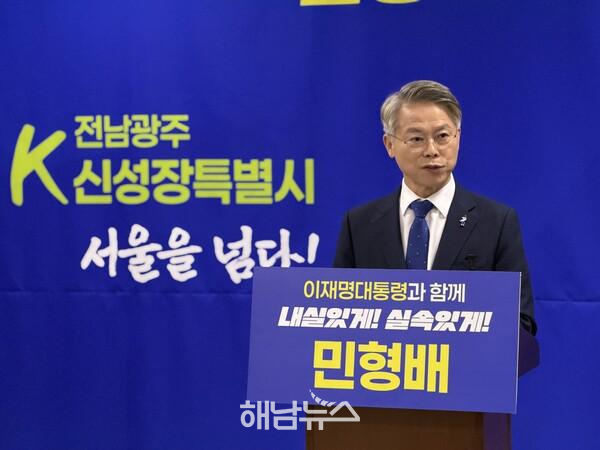 민형배 전남광주특별시장 예비후보 / 사진제공=민형배의원실 |
전남광주특별시 393개 읍면동 주민자치회,
이제 ‘마을자치정부’로 발전해야 합니다
2026년 3월 31일, 주민자치회 제도화를 담은 지방자치법 개정안 국회 본회의 통과를 크게 기뻐하고 환영합니다. 2013년부터 13년 넘게 시범운영을 해온 셈이니 이번 법률안 통과는 풀뿌리 민주주의를 제도적으로 한 단계 끌어올린 중요한 진전입니다. 이제 주민자치는 더 이상 실험이 아니라, 대한민국 자치분권의 핵심 제도로 자리 잡아야 합니다.
저는 이미 분명한 방향을 제시한 바 있습니다.
전남광주 393개 읍·면·동을 중심으로 ‘마을자치정부’를 구축하고, 27개 시·군·구 기초정부의 권한을 실질적으로 강화하는 것입니다. 이는 단순한 행정 개편이 아니라, 시민주권정부를 풀뿌리에서부터 구현하겠다는 선언입니다.
특히 이번 지방자치법 개정은 그 비전을 현실로 만들 수 있는 제도적 기반이 마련되었다는 점에서 큰 의미가 있습니다. 주민자치회가 단순 자문기구를 넘어 실질적 자치기구로 전환되고, 주민이 정책의 참여를 넘어 결정의 주체로 나아갈 수 있는 길이 열렸습니다.
그러나 제도화만으로 충분하지 않습니다. 이제는 ‘보충성의 원리’에 기반해 권한을 과감히 풀뿌리로 나눠야 합니다. 읍·면·동은 주민 삶의 최전선이며, 민주주의의 출발점입니다. 가능한 한 낮은 단계에서 결정하고, 상위 정부는 이를 지원하는 구조로 전환해야 합니다.
이를 위해 우리는 다음과 같은 방향을 분명히 합니다.
첫째, 주민자치회에 실질적인 권한과 재정을 부여해야 합니다.
둘째, 주민세 환원과 마을자치 재정 확대를 통해 자치의 기반을 강화해야 합니다.
셋째, 마을계획·예산·평가 전 과정에 주민 참여를 제도화해야 합니다.
넷째, 기초정부의 인사·재정·조직 자율성을 확대해 ‘강한 기초정부’를 만들어야 합니다.
전남광주 통합은 권한의 집중이 아니라 권한의 분산이어야 합니다.
광역은 전략과 조정을, 기초와 마을은 실행과 생활정치를 책임지는 구조로 재편되어야 합니다.
이제 주민자치회는 ‘위원회’가 아니라 ‘마을자치정부’로 나아가야 합니다.
393개 마을이 살아 있는 도시, 시민이 주권자인 도시,
대한민국 자치분권의 새로운 표준은 마을에서 시작됩니다.
2026년 4월 1일
더불어민주당 전남광주통합특별시장 경선 후보 민형배
[Statement Welcoming the Passage of the Local Autonomy Act Amendment in the National Assembly]
The 393 Eup·Myeon·Dong Residents’ Councils of Jeonnam–Gwangju Metropolitan City
Must Now Evolve into ‘Village Self-Governing Governments’
We strongly welcome and celebrate the passage of the amendment to the Local Autonomy Act, which institutionalizes residents’ councils, approved by the National Assembly plenary session on March 31, 2026. Having been piloted for over 13 years since 2013, this legislative milestone represents a significant advancement in elevating grassroots democracy to a formal institutional level. Resident self-governance must no longer remain an experiment—it should now be firmly established as a core pillar of decentralization in the Republic of Korea.
I have already made my direction clear.
We must establish “village self-governing governments” centered around the 393 eup, myeon, and dong in Jeonnam–Gwangju, while substantially strengthening the authority of the 27 municipal and district-level governments. This is not merely an administrative reform, but a declaration to realize a citizen-led sovereign government from the grassroots.
In particular, this amendment holds great significance in that it provides the institutional foundation to turn this vision into reality. Residents’ councils are no longer to function as advisory bodies; they must transform into substantive self-governing institutions, enabling citizens to move beyond participation toward becoming true decision-makers in public policy.
However, institutionalization alone is not sufficient.
We must now boldly devolve authority to the grassroots based on the principle of subsidiarity. Eup, myeon, and dong are the frontlines of citizens’ lives and the starting point of democracy. Decisions should be made at the lowest possible level, with higher levels of government serving in a supportive role.
To this end, we clearly propose the following directions:
First, grant residents’ councils real authority and fiscal power.
Second, strengthen the financial foundation of autonomy through the return of resident taxes and expansion of village-level funding.
Third, institutionalize citizen participation across the entire process of village planning, budgeting, and evaluation.
Fourth, expand personnel, fiscal, and organizational autonomy of local governments to build strong foundational administrations.
The integration of Jeonnam–Gwangju must not be about centralizing power, but about decentralizing it.
The metropolitan level should focus on strategy and coordination, while local governments and villages take responsibility for execution and everyday governance.
Residents’ councils must now move beyond being mere “committees” and evolve into true “village self-governing governments.”
A city where all 393 villages are vibrant, where citizens are sovereign—
The new standard of decentralization in Korea begins at the village level.
April 1, 2026
Min Hyung-bae
Preliminary Candidate for Mayor of the Jeonnam–Gwangju Integrated Metropolitan City
Democratic Party of Korea
 해남뉴스 박충배 편집 및 논설위원 haenamnews@kakao.com