| “50년 동안 세 사람 중 둘이 사라졌다… 솔라시도 AI가 해남·완도·진도의 ‘청년 탈출 공식’을 깨뜨릴 수 있는가” 해남뉴스 박충배 편집 및 논설위원 haenamnews@kakao.com |
| 2025년 12월 12일(금) 14:04 |
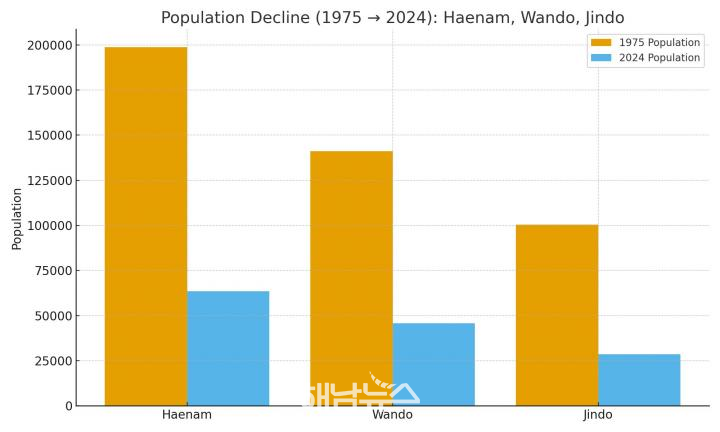 해남, 완도, 진도 인구 감소 그래프 / 사진제공=해남뉴스 |
박충배 편집/칼럼/논설
〖사설〗
해남·완도·진도의 인구 그래프를 1970년대부터 2020년대까지 한 번에 놓고 보면, 사실상 한 가지 그림만 반복된다.
가파른 내리막, 그리고 끝이 보이지 않는 추락.
1975년, 해남은 19만 8천여 명, 완도는 14만 1천여 명, 진도는 10만여 명이었다.
2024년 현재, 해남 6만 3천, 완도 4만 5천, 진도 2만 8천, 50년 사이 세 군 모두 인구가 3분의 1로 줄었다.
열 명이 살던 자리에 세 명만 남았다.
이 숫자는 “그냥 아이를 덜 낳아서” 생긴 결과가 아니다.
우리 사회가 지난 반세기 동안 선택해 온 경제·교육·도시정책의 총계를, 해남·완도·진도의 땅 위에 적나라하게 그려 놓은 결과다.
1. ‘서울로 가는 게 합리적인 사회’에서, 누가 남겠는가.
전국 통계를 보면, 19~34세 청년의 평균 연소득은 약 2,600만 원 수준이다.
그런데 연구를 조금만 들여다보면 더 중요한 사실이 드러난다.
지방에 남은 청년의 소득 증가율 : 약 12.1%
지방에서 수도권으로 이동한 청년의 소득 증가율 : 약 22.8%
같은 또래, 같은 청년이라도 “그냥 지방에 남은 경우”와 “수도권으로 이동한 경우”의 연봉 상승 속도가 거의 두 배 차이가 난다는 뜻이다.
해남·완도·진도 청년에게 이 구조는 무엇을 말해 주는가.
간단하다.
“여기서 버티는 것보다, 서울로 가는 게 경제적으로 합리적이다.”
청년들이 떠나는 이유를 “요즘 젊은 사람들 끈기가 없다”는 도덕 잣대로 설명하는 순간, 우리는 구조를 보지 못한다.
지금의 대한민국은 ‘수도권으로 갈수록 임금과 기회가 빠르게 올라가는 시스템’을 설계해 놓았고, 청년은 그 시스템에 합리적으로 반응하고 있을 뿐이다.
2. 세 번의 파도 : 이촌향도 → 초저출산·초고령화 → 수도권 직행
해남·완도·진도의 인구 감소는 세 번의 큰 파도로 구분할 수 있다.
① 첫 번째 파도: 1970~1990년대 ‘이촌향도’
1970년대, 서울 인구는 10년 동안 300만 명이 늘었다.
이 엄청난 증가의 상당 부분은 농촌 인구의 대규모 유출, 즉 ‘이촌향도’였다.
새마을운동, 농기계 보급, 다수확 품종은 “농촌 근대화”의 상징이었지만, 현실에서는 “사람이 덜 들어가는 농업”을 만들었다.
어업 역시 근해 남획, 경제수역(EEZ) 체제 전환, 기후 변화 속에서 전통 연안어업만으로는 생계를 버티기 어려운 구조가 되었다.
그 결과는 분명하다.
해남·완도·진도에서 자란 젊은이들이 여수·목포·광주 공단, 그리고 서울·울산·포항의 공장과 도시로 ‘통째로’ 이동했다.
이 시기의 인구 감소는 “조금 줄었다”가 아니다.
한 세대의 젊은 층이 통으로 빠져나간 대이동이었다.
지금 60~70대가 된 이들이 그때의 마지막 잔여 인구다.
② 두 번째 파도: 2000년대 이후 ‘초저출산·초고령화’
이미 젊은 층이 빠져나간 상태에서, 대한민국은 합계출산율 1명도 채 되지 않는 초저출산 사회로 들어섰다.
전남의 많은 군이 그렇듯, 해남·완도·진도 역시 출생아 수보다 사망자가 훨씬 많은 ‘자연감소’ 구조에 빠져 있다.
여기에 노인 비율은 65세 이상이 3분의 1을 훌쩍 넘는 초고령 사회다.
젊은이들은 떠났고, 남아 있는 인구의 상당수는 고령층인 상태에서 인구 그래프는 해마다 속도를 더해 내려오고 있다.
③ 세 번째 파도: ‘광주도 건너뛰고 바로 수도권’으로
최근 전남 인구이동 자료를 보면, 유출 인구의 80%쯤이 18~39세 청년층이다.
과거에는 “전남 → 광주 → 수도권”이라는 2단계 이동 구조였다면, 이제는 “전남 → 바로 수도권”으로 변화하고 있다는 연구자들의 지적이 이어진다.
광주조차 더 이상 “지역 청년의 완충지” 역할을 하지 못하는 것이다.
이 흐름 속에서 해남·완도·진도는 전남 안에서도 ‘끝단에 있는 공급지’가 된다.
청년은 이곳을 출발점으로 삼고, 광주를 중간 기착지로 거치지 않은 채 바로 서울·수도권으로 간다.
3. 해남·완도·진도, 같은 내리막·다른 얼굴
숫자는 비슷하지만, 세 군의 얼굴은 조금씩 다르다.
▷ 해남 : “대형 농촌군 + AI·에너지 시대의 전초기지”
해남은 1970년대 20만 명에 육박하는 대형 농업군이었다.
그러나 농업 구조조정, 쌀값·FTA, 청년 이탈이 겹치며 오늘날 6만 명 초반에 머무르고 있다.
하지만 해남에는 다른 두 군에는 없는 카드가 하나 있다.
바로 솔라시도 기업도시, 분산에너지 특구, AI컴퓨팅센터·AI데이터센터다.
지금 이 시설들은 “데이터센터 몇 개 더 짓는다.”는 차원이 아니라, 해남이 처음으로 “고소득·첨단 일자리”를 지역 안에 들여올 수 있는 기회다.
그러나 설계가 잘못되면, 이 기회는 언제든지 악몽으로 바뀔 수 있다.
전력과 토지, 환경 부담은 해남이 떠안고 고급 일자리와 이익은 수도권 본사가 가져가는 “서버창고형 발전소”로 전락하는 순간, 해남은 또 한 번 “자원을 제공하고 소득은 밖으로 흘려보내는” 반복을 경험할 수 있다.
▷ 완도: “섬과 바다에 기대 선 군, 파도에 가장 민감한 경제”
완도는 1974년 전후 15만 명에 달했던 인구가 지금은 4만 5천 명 수준으로 떨어졌다.
도시가 아니라 섬으로 이뤄진 군이기에, 한 번의 기후 재난, 한 번의 어장 붕괴, 한 번의 가격 폭락을 몸으로 받아내야 하는 구조다.
김·전복·해조류, 수산업이 주력인 완도에서 청년이 직업의 안정과 성장 경로를 기대하기란 쉽지 않다.
교육·의료·문화 인프라도 육지 도시에 비해 열악하다.
완도에서 자란 아이가 중·고등학교, 대학을 거치며 “한 번 육지로 나가면 다시 돌아오지 않는” 패턴은 이제 예외라기보다 일상이 되었다.
▷ 진도: “소멸위기 최전선, 다리는 놓였지만 남을 이유가 없다”
진도는 1975년 10만 명이 넘던 인구가 2024년 3만 명이 채 안 되는 수준으로 줄어들었다.
진도대교 개통은 육지와의 물리적 거리를 획기적으로 줄였지만, 그 효과는 양면적이었다.
관광객이 오기 쉬워진 만큼 청년이 나가기 쉬워지는 길도 함께 열린 것이다.
농업·어업에 동시에 의존하는 구조 속에서 제조·서비스·콘텐츠·관광 등 새로운 산업 기반이 충분히 쌓이지 못했다.
그 결과, 진도는 지금 전남 소멸위기 논의의 최전선에 서 있다.
4. 솔라시도 AI, “희망의 간판”에서 “청년의 사다리”로 바뀌려면
이제 우리는 질문해야 한다.
“솔라시도 AI산업단지와 AI컴퓨팅센터는 해남·완도·진도 청년에게 실제로 무엇이 될 것인가?”
홍보 문구로는 이미 충분하다.
“AI·에너지 수도 전남”, “농어촌수도 해남”, “RE100 국가산단”, “AI컴퓨팅 허브”, 그러나 청년의 눈높이는 다르다.
이 센터가 어떤 직무를 만들고, 그 직무에 내가 어떻게 접근할 수 있으며, 그 과정에서 해남·완도·진도 출신이라는 사실이 불리하지는 않은지,
“여기에 남을 경우”와 “서울로 갈 경우” 커리어와 소득의 차이가 얼마나 나는지를 청년은 냉정하게 계산한다.
따라서 정책의 핵심은 단순하다.
“AI 인프라를 세우는 것”에서 끝나지 말고, 그 인프라를 지역 청년의 ‘커리어 사다리’로 만드는 것.
구체적으로는 이런 그림이어야 한다.
AI·에너지 특화 직업학교·아카데미 – 해남에 설치
데이터센터 운영, 서버·네트워크 관리, 에너지·냉각 시스템, 보안 관제, ESG·탄소 관리 등 해남·완도·진도 고교·전문대·폴리텍과 연계한 채용연계형 과정, 입주기업–지자체 간 ‘지역 청년 우선 채용’ 협약, 신규 채용의 일정 비율을 지역 청년·귀향 청년·전입 청년에게 할당, 보여주기식 할당이 아니라 교육 → 인턴 → 정규직 전환으로 이어지는 패키지 설계, AI + 농어업 + 관광 융합 프로젝트.
- 해남의 스마트팜·스마트축산,
- 완도의 스마트양식·해양치유,
- 진도의 민속·국악·관광 콘텐츠를
데이터·플랫폼·콘텐츠 산업과 연결
→ AI컴퓨팅센터는 서버실이 아니라,
→ 세 군 전체의 농어업·관광·문화 산업을 디지털로 묶는 ‘두뇌’**가 되어야 한다.
5. 이 지역에서 청년이 “남는 것이 손해가 아니게” 만드는 것
지금까지의 50년은 분명했다.
해남·완도·진도에서 태어난 청년에게, ‘서울행’은 합리적인 선택이었다.
이제 다음 50년을 준비하는 해남·완도·진도의 과제는 단 하나다.
“여기 남는 것이 손해가 아니다”라는 사실을 숫자와 경력, 삶의 질로 증명하는 것.
솔라시도 AI산업단지와 AI컴퓨팅센터, 분산에너지 특구, 농어촌수도 비전은 그 자체로 미래를 보장해 주지 않는다.
그것은 도구일 뿐이다.
그 도구를 어떻게 설계하고, 지역 청년의 삶과 경력에 어떤 통로를 열어줄 것인지가.
이제 해남·완도·진도 지방정부와 전남도, 그리고 중앙정부가 책임지고 답해야 할 질문이다.
50년 동안 세 사람 중 둘이 사라진 땅.
이제는 그 빈자리를 “탈출의 통계”가 아니라 “귀향과 정착의 통계”로 채울 수 있는가가.
AI 시대 남도 지방정부의 진짜 실력 시험대다.
[Haenam, Wando, Jindo = Haenam News]
haenamnews@kakao.com
Park Chung-bae, Editor / Columnist / Editorial Writer
〖Editorial〗
“Two out of three have disappeared in 50 years…
Can Solaseado AI break the ‘youth exodus formula’ of Haenam, Wando, and Jindo?”
If you lay out the population graphs of Haenam, Wando, and Jindo from the 1970s to the 2020s, you see essentially one picture repeated over and over again:
A steep downward slope, and a plunge with no visible end.
In 1975, Haenam had around 198,000 people, Wando 141,000, and Jindo 100,000.
As of 2024, Haenam has 63,000, Wando 45,000, and Jindo 28,000.
In 50 years, the populations of all three counties have shrunk to one-third.
Where ten people once lived, only three remain.
These numbers are not the result of “simply having fewer children.”
They are the outcome, laid bare on the land of Haenam, Wando, and Jindo, of the economic, educational, and urban policies that our society has chosen over the past half-century.
1. In a society where “moving to Seoul is rational,” who would stay?
According to nationwide statistics, the average annual income of young people aged 19 to 34 is around 26 million won.
But a closer look at the research reveals something more important.
Income growth rate of young people who stay in non-metropolitan regions: about 12.1%
Income growth rate of young people who move from the provinces to the Seoul metropolitan area: about 22.8%
In other words, even among people of the same age group,
the speed of salary increase is almost twice as fast for those who move to the capital region compared to those who remain in the provinces.
What does this structure say to the youth of Haenam, Wando, and Jindo?
It is simple:
“It is economically more rational to go to Seoul than to endure life here.”
The moment we explain youth out-migration with a moralistic line like “young people today just lack grit,”
we fail to see the structure.
Today’s Korea has built a system in which
the closer you are to the capital region, the faster wages and opportunities rise,
and young people are merely responding rationally to that system.
2. Three waves: Rural exodus → ultra-low fertility and super-aging → direct leap to the capital
The depopulation of Haenam, Wando, and Jindo can be divided into three major waves.
① The first wave: “Rural exodus” in the 1970s–1990s
In the 1970s, Seoul’s population increased by three million in just ten years.
A large portion of that astonishing increase came from massive outflows of rural populations — the so-called ichonhyangdo (migration from countryside to cities).
The Saemaul Undong (New Village Movement), the spread of agricultural machinery, and high-yield varieties were symbols of “rural modernization,”
but in reality they created “agriculture that needed fewer people.”
Fisheries faced a similar fate: coastal overfishing, the EEZ regime, and climate change made it difficult to sustain a livelihood through traditional inshore fishing alone.
The result is clear.
Young people who grew up in Haenam, Wando, and Jindo
moved en masse to the industrial complexes and cities of Yeosu, Mokpo, and Gwangju, and further to the factories and urban centers of Seoul, Ulsan, and Pohang.
The population decline of this period was not “a slight decrease.”
It was the great migration of an entire generation of young people.
Those who are now in their 60s and 70s are the last remaining members of that generation.
② The second wave: “Ultra-low fertility and super-aging” since the 2000s
With the younger generations already gone,
Korea entered an era of ultra-low fertility, with a total fertility rate of less than 1.
As in many counties across Jeollanam-do,
Haenam, Wando, and Jindo are now trapped in a demographic structure where deaths far outnumber births.
On top of that, they are super-aged societies where the proportion of residents aged 65 and older easily exceeds one-third.
Young people have left, and many of those who remain are elderly,
so the population curve drops faster with each passing year.
③ The third wave: “Skipping Gwangju, heading straight to the capital”
Recent data on population movement in Jeollanam-do show that about 80% of out-migrants are young people aged 18–39.
In the past, the path was:
“Jeonnam → Gwangju → Capital region.”
Now, researchers point out that it has shifted to:
“Jeonnam → directly to the capital region.”
Even Gwangju no longer functions as a “buffer zone” for local youth.
In this flow, Haenam, Wando, and Jindo become “terminal suppliers” within Jeollanam-do.
For young people, these counties are the starting line,
and they head directly to Seoul and the capital region without even passing through Gwangju as an intermediate stop.
3. Haenam, Wando, Jindo: the same downward slope, different faces
The numbers are similar, but the faces of the three counties differ slightly.
▷ Haenam: “A large agricultural county + a forward base in the AI and energy era”
Haenam was a large agricultural county with close to 200,000 residents in the 1970s.
But agricultural restructuring, rice prices, FTAs, and youth outflows combined
to bring the population down to the low 60,000s today.
Yet Haenam holds one card that the other two counties do not.
It is home to the Solaseado corporate city, the distributed energy special zone, and the AI computing center and AI data center.
These facilities are not merely “a few more data centers.”
They are an opportunity for Haenam, for the first time,
to bring “high-income, high-tech jobs” into the region.
But if the design is wrong, this opportunity can turn into a nightmare at any time.
If Haenam shoulders the burden of electricity, land, and environmental impact,
while the high-quality jobs and profits are taken by headquarters in the capital region,
then these facilities will degenerate into “server-warehouse-style power plants.”
At that point, Haenam will once again experience
the familiar pattern of “providing resources while letting income flow out.”
▷ Wando: “A county standing on islands and sea, most sensitive to the waves”
Wando’s population reached around 150,000 in the mid-1970s
and has now fallen to about 45,000.
This is a county composed not of a single city but of islands.
That means it must physically absorb the impact of
every climate disaster, every collapse of fishing grounds, and every price crash.
With laver, abalone, and seaweed as its main industries,
it is difficult for young people in Wando to expect job stability and a clear growth path.
Educational, medical, and cultural infrastructure is also weaker than in inland cities.
For children born in Wando, the pattern of
leaving for the mainland for middle and high school and college,
and then “never returning once they leave”
is no longer the exception; it has become the norm.
▷ Jindo: “On the front line of extinction; the bridge is there, but there is no reason to stay”
Jindo’s population fell from over 100,000 in 1975
to less than 30,000 in 2024.
The Jindo Bridge dramatically shortened the physical distance to the mainland,
but its effect was two-sided.
The bridge made it easier for tourists to come,
but it also made it easier for young people to leave.
With a structure that depends on both agriculture and fisheries,
a robust foundation for new industries — manufacturing, services, content, tourism —
has not been sufficiently built.
As a result, Jindo now stands on the front line of debates about regional extinction in Jeollanam-do.
4. Solaseado AI: from “signboard of hope” to “ladder for youth”
Now we must ask:
“What will the Solaseado AI industrial complex and AI computing center actually mean for the youth of Haenam, Wando, and Jindo?”
The slogans are already abundant.
“Jeonnam, the AI and energy capital,”
“Haenam, the capital of rural Korea,”
“RE100 national industrial complex,”
“AI computing hub”…
But the perspective of young people is different.
For them, questions look like this:
What specific jobs will this center create?
How can I realistically access those jobs?
Will being from Haenam, Wando, or Jindo put me at a disadvantage in the hiring process?
If I stay here versus moving to Seoul,
how different will my career trajectory and income be over the next 5, 10, 20 years?
Young people calculate these questions with cold clarity.
So the core of policy is simple.
Do not stop at “building AI infrastructure,”
but turn that infrastructure into a “career ladder” for local youth.
More concretely, the picture should look like this:
Establish an AI and energy-focused vocational school/academy in Haenam
Training in data center operations, server and network management, energy and cooling systems, security monitoring, ESG and carbon management, etc.
Linked employment-track programs in cooperation with high schools, junior colleges, and polytechnics in Haenam, Wando, and Jindo.
Conclude agreements between tenant companies and local governments for “local youth priority hiring”
Allocate a certain percentage of new hires to local youth, returning youth, and in-migrating youth.
Not as a token quota, but as part of a package that connects education → internships → full-time employment.
Promote AI + agriculture + tourism convergence projects
Smart farming and smart livestock in Haenam,
Smart aquaculture and marine healing in Wando,
Folk culture, gugak (traditional Korean music), and tourism content in Jindo,
linked with data, platforms, and the content industry.
In this scenario, the AI computing center is not just a server room.
It becomes the “brain” that digitally connects the agricultural, tourism, and cultural industries of all three counties.
5. Making it so that staying here is “not a losing choice” for young people
The past 50 years are clear.
For young people born in Haenam, Wando, and Jindo,
“going to Seoul” has been the rational choice.
The task for Haenam, Wando, and Jindo as they prepare for the next 50 years can be summed up in a single line:
Prove, through numbers, careers, and quality of life,
that “staying here is not a losing choice.”
The Solaseado AI industrial complex and AI computing center,
the distributed energy special zone, and the vision of a “capital of rural Korea”
do not guarantee the future on their own.
They are only tools.
How we design those tools,
and what kinds of pathways they open for the lives and careers of local youth —
these are the questions that the local governments of Haenam, Wando, and Jindo,
the provincial government of Jeollanam-do,
and the central government must now answer, with responsibility.
On this land where two out of three people have vanished in 50 years,
the real test of competence for local governments in the AI era is this:
Can they fill that empty space
not with “statistics of escape,”
but with “statistics of return and settlement”?
 해남뉴스 박충배 편집 및 논설위원 haenamnews@kakao.com