| “768구의 부처, 바다를 건너 돌아오다” 경주 불석산에서 시작된 천불의 여정, 그리고 기적 같은 귀향기 해남뉴스 박충배 편집 및 논설위원 haenamnews@kakao.com |
| 2025년 12월 03일(수) 13:56 |
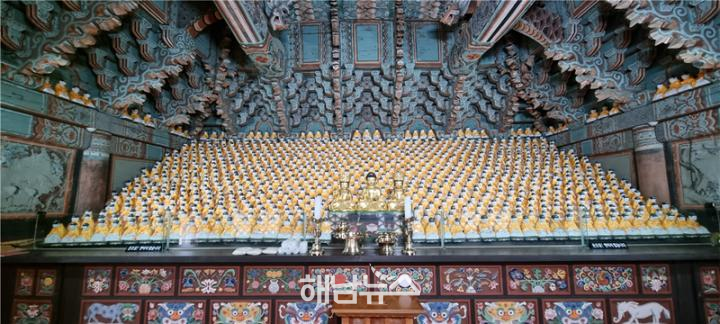 대흥사 천불전 불상 / 사진제공=해남뉴스 |
박충배 편집‧칼럼‧논설
유형문화재 제52호 : 천불상(1974영 09월 24일)
두륜산 깊은 품 속, 대흥사 천불전의 불단을 바라보고 있으면 작은 몸체를 지녔지만 말없이 강한 기운을 내뿜는 옥불(玉佛)들이 끝없이 줄지어 앉아 있다.
그 수는 정확히 1,000구(千佛). 그러나 그중 768구는 한때 이 땅을 떠났고, 죽음과도 같은 표류를 견디며 다시 고향으로 돌아온 부처님들이 있다.
그들의 여정은 단순한 이운(移運)이 아니다.
그것은 조선 불교사의 가장 극적인 드라마,
그리고 오늘을 사는 우리에게까지 닿는 귀향(歸鄕)의 은밀한 가르침이다.
Ⅰ. 경주의 산이 깨어나던 순간 — 천불의 탄생
1817년 여름, 경상북도 경주시 문무대왕면 호암리. 기림사 마당에는 전국에서 모인 화원(畵員)과 조각승들의 망치 소리, 그리고 염불음이 뒤섞여 울려 퍼지고 있었다.
그들이 다듬던 것은 단단한 회백색 빛의 불석(佛石)., 재료는 모두 인근 경주 불석산(佛石山)에서 직접 채석해 내려온 돌이었다.
풍계 현정 스님은 나중에 이 과정을 『일본표해록』(1821)에 이렇게 적었다.
“가경 22년(1817), 완호 대사의 청으로 경주 불석산에 들어가 옥을 쪼아 부처를 만들었다.”
기림사에서는 8월 7일부터 10월 20일까지 경산·영남·전라 일대의 화원들이 한자리에 모여 단숨에 불상 1,000구를 조성했다.
그야말로 조선 후기 최대의 집단 불사(佛事)였다.
Ⅱ. 출항 — 천불을 가득 실은 두 척의 배
조성이 끝난 불상들은 1817년 11월 16일, 경주 장진포 포구에서 두 척의 배에 나눠 실렸다.
큰 배 : 768구
작은 배 : 232구
기록은 이 두 숫자를 놀랍도록 정확하게 남기고 있다.
그 날의 바다는 잔잔했다.
부처님들은 두륜산으로 돌아갈 준비를 마친 듯 배 안에서 조용히 서로 기대어 있었다.
그러나 운명은 그들을 바로 고향으로 보내지 않았다.
Ⅲ. 풍랑 — 생사(生死)를 건너는 표류
장진포를 떠난 지 며칠 되지 않아, 하늘은 갑자기 무너져 내리듯 어두워졌다.
텁텁한 바람이 배를 때리고, 파도는 천불이 실린 배의 옆구리를 잔인하게 쳤다.
배는 방향을 잃었다.
항로는 지워졌다.
밤과 낮의 경계는 무너지고, 배는 일본 바다로 떠밀리기 시작했다.
부처님들은 아무 말이 없었다.
다만 서로 맞닿은 작은 어깨가 폭풍 속에서도 흔들리지 않게 지탱하고 있었을 뿐.
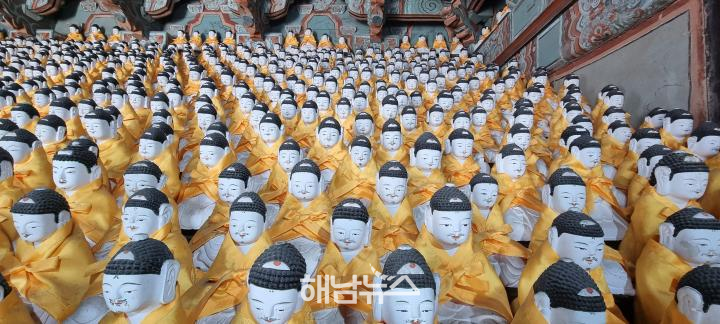 대흥사 천불전 불상 / 사진제공=해남뉴스 |
Ⅳ. 일본 땅에 닿다 — 귀향을 꿈꾸던 부처님들
표류한 배가 닿은 곳은 낯선 땅, 일본 국경이었다.
일본인들은 768구의 옥불을 보고 크게 놀랐다.
“이토록 많은 부처님이… 조선에서 왔단 말인가?” 그들은 조선 불상들의 아름다움과 단단함에 감탄했고, 표류한 승려들을 극진히 대접하며
부처님들을 일본에 봉안하자고 제안하기도 했다.
그러나 그날 밤, 일본 곳곳에서 기이한 꿈 이야기가 퍼졌다.
“우리는 해남 대둔사로 가는 중이다. 이 땅에 머무를 수 없다.”
부처님들이 일본인의 꿈에 나타나 자신들의 ‘본래 자리’를 이야기했다는 것이다.
그리고 결국 일본인들은 결심한다.
“이분들은 돌아가야 한다. 조선의 부처는 조선에 있어야 한다.”
Ⅴ. 귀향 — 등 뒤에 새겨진 붉은 ‘日本’의 의미
돌아가는 여정은 더디었지만 마침내 1818년 여름, 768구의 부처님은 해남 땅을 다시 밟았다.
그날 대둔사(대흥사)에는 수행자와 마을 사람들이 몰려와 눈물을 흘리며 부처님들을 맞았다.
풍계 스님은 기록했다.
“사람들이 모두 놀랍고 기이하게 여겨 마치 죽었다가 다시 살아 돌아온 듯 기뻐하였다.”
다산 정약용은 이 기적 같은 귀향 소식을 듣고 풍계 스님에게 이렇게 권한다.
“일본에 갔다 돌아온 부처님들의 등에 ‘日本’이라 새겨 표기하라.”
그래서 지금 대흥사 천불전의 일부 옥불의 왼쪽 등에는 붉은 글씨로 ‘日本’ 이란 두 글자가 조용히 새겨져 있다.
그 글자는 상처가 아니라 귀향의 증표이고, 떠나갔다가 돌아온 존재만이 지닐 수 있는 영혼의 흔적이다.
Ⅵ. 천불전 — 금란가사를 입은 천 귀향의 얼굴들
귀향한 부처님들을 포함해 천불전의 옥불들은 지금 모두 금란가사를 입고 있다.
그 금빛 옷은 천불이 겪은 고난과 귀향의 상징이며, 대흥사가 그 여정을 온몸으로 끌어안으며 부처님께 입혀 드린 감사의 옷이다.
오늘 천불전에 들어서면 작은 옥불 하나하나가 금빛 속에서 묵묵히 이런 말을 건네는 것 같다.
“나는 떠났고, 돌아왔다. 그대도 길을 잃을 수 있다. 그러나 반드시 돌아갈 자리가 있다. 그것은 바로 그대 마음의 본래 자리다.”
Ⅶ. 맺음말 — 떠남도 길이고, 귀향도 길이다
768구의 부처님이 겪은 표류와 귀향의 여정은 200년이 지난 지금에도 믿기 어려운 역사적 사건이다.
그러나 이 이야기는 단순한 기적이 아니다.
그것은 떠남과 귀환, 상실과 회복, 그리고 자신의 자리로 돌아오는 삶의 진실을 담고 있다.
해남 대흥사 천불전은 그래서 오늘도 말없이 우리에게 가르친다.
“머물러도 수행, 떠나도 수행이다. 그러나 결국 수행은 돌아오는 것이다.”
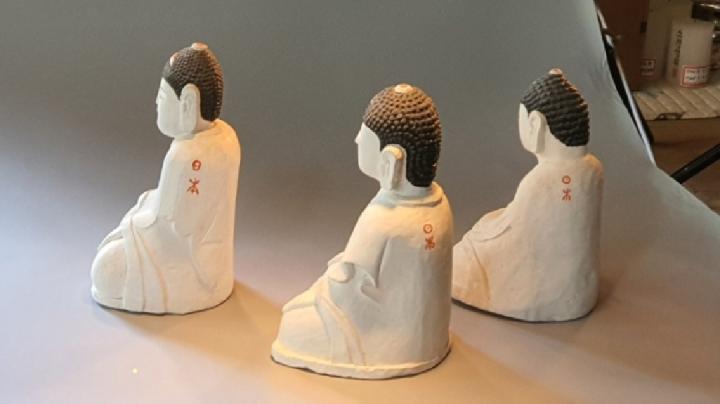 대흥사 천불전 불상 / 사진제공=해남뉴스 |
[Haenam = Haenam News] haenamnews@kakao.com
Column / Editorial / Commentary by Park Chung-bae
Jeonnam Local Tangible Cultural Property No. 52: The Thousand Buddhas (Designated Sept. 24, 1974)
“768 Buddhas Crossing the Sea and Returning Home”
— From the Stone Mountains of Gyeongju to a Miraculous Homecoming at Daeheungsa
Deep within the embrace of Mt. Duryun, inside the Thousand-Buddha Hall of Daeheungsa, rows of small jade Buddhas sit in silence, radiating a quiet but unmistakable presence.
Exactly 1,000 statues dwell here today.
Yet among them, 768 Buddhas once left this land, endured a perilous voyage that nearly claimed their existence, and—against all odds—returned home.
Their story is not a mere episode of transport.
It is one of the most dramatic chapters in Joseon Buddhist history,
and a hidden teaching on return, resilience, and destiny—a lesson whispered even to us living two centuries later.
Ⅰ. When the Mountains of Gyeongju Awoke — The Birth of a Thousand Buddhas
Summer, 1817.
Hoeam-ri, Munmu-daewang-myeon, Gyeongju, Gyeongsangbuk-do.
In the courtyard of Girimsa Temple, the sound of chisels and hammers mingled with the solemn chant of monks. Craftsmen, painters, and sculptor-monks from across Korea had gathered for one purpose:
To carve a thousand Buddhas.
Their material was the hard, pale-gray Bulseok (佛石)—a sacred stone quarried from the nearby Bulseoksan, the “Mountain of Buddha Stone.”
Venerable Punggye Hyeonjeong, the leader of the entire project, later recorded this process in his Japan Drifting Record (Ilbon Pyohaerok, 1821):
“In the 22nd year of Jiaqing (1817), at the request of Venerable Wanho,
I entered Gyeongju’s Bulseoksan and carved jade stone into Buddhas.”
From August 7 to October 20, the work never ceased.
Artisans from Gyeongsang, Yeongnam, and Jeolla carved day and night.
It was, without exaggeration, one of the greatest collective Buddhist undertakings of the late Joseon era.
Ⅱ. Departure — Two Ships Filled with a Thousand Buddhas
When the statues were complete, they were loaded onto ships at Jangjinpo Port in Gyeongju on November 16, 1817.
Large ship: 768 statues
Small ship: 232 statues
Astonishingly, the records preserve these numbers with meticulous precision.
The sea was calm that day.
The Buddhas, nestled tightly together inside the hulls, seemed ready for their journey to Mt. Duryun.
But destiny had a different plan.
Ⅲ. The Tempest — A Drift Between Life and Death
Only days after setting sail, the skies suddenly collapsed into darkness.
A heavy wind slammed against the vessels,
and waves battered the sides with merciless force.
The ships lost direction.
The sea erased their route.
Day and night blended into one,
and the vessel carrying the 768 Buddhas began drifting eastward—
toward the shores of Japan.
The Buddhas said nothing, of course.
Yet in the howling storm, their small shoulders leaned against one another
as if to endure the ordeal together.
Ⅳ. Landing in Japan — Buddhas Who Longed for Home
The ship eventually reached the unfamiliar coastline of Japan.
People there were astonished at the sight of 768 stone Buddhas.
“Did all of these truly come from Joseon?”
They admired the craftsmanship and the solemn beauty of the statues.
They treated the monks with extraordinary respect
and even proposed enshrining the Buddhas in Japan.
But that very night, a strange phenomenon spread across the region.
Villagers reported dreams—dreams filled with small jade Buddhas saying:
“We are traveling to Daeheungsa in Haenam.
We cannot remain in this land.”
The voices in these dreams moved the Japanese deeply.
And at last, they reached a single conclusion:
“These Buddhas must return.
A Buddha of Joseon belongs in Joseon.”
Ⅴ. Homecoming — The Red Mark of ‘日本’
The journey back was slow, but in the summer of 1818,
all 768 Buddhas set foot again on Korean soil.
At Daeheungsa, villagers and monks gathered in tears to welcome them.
Venerable Punggye recorded:
“People were astonished and moved,
rejoicing as if the dead had come back to life.”
Upon hearing the miraculous news,
scholar Jeong Yak-yong (Dasan) sent a message to Punggye:
“Engrave ‘日本’ on the backs of the Buddhas who returned from Japan,
so their history will never be forgotten.”
Thus, even today,
some of the Buddhas in the Thousand-Buddha Hall bear on their left backs
a quiet, red inscription: 日本.
It is not a scar.
It is a testament—
a mark that only those who have departed and returned may carry.
Ⅵ. The Thousand-Buddha Hall — A Thousand Faces in Golden Robes
Including the returned Buddhas,
all the jade statues in the hall now wear golden kasaya robes.
This gold is not merely decoration.
It is the temple’s offering of gratitude—
a luminous embrace for Buddhas who endured storms, exile, and miraculous reunion.
When one stands inside the hall,
each small Buddha seems to whisper softly through its golden radiance:
“I left and returned.
You too may lose your way.
But you, like me, have a place you will return to—
the original home within your own heart.”
Ⅶ. Epilogue — Leaving Is a Path, Returning Is Also a Path
The voyage, drift, and homecoming of the 768 Buddhas
remain one of the most extraordinary events in Korean Buddhist history.
But this story is more than a miracle.
It is a meditation on departure and return,
loss and restoration,
and the profound truth of finding one’s rightful place again.
That is why the Thousand-Buddha Hall of Daeheungsa
still teaches us today, without a single spoken word:
“To stay is practice, to wander is practice,
but in the end, practice is returning.”
 해남뉴스 박충배 편집 및 논설위원 haenamnews@kakao.com